Supplier management software is the system of record for the companies that supply a manufacturing plant: who they are, what they are approved to supply, how they perform on quality and delivery, and what risk they carry. It replaces the spreadsheet and the email chain, and often adds a portal where suppliers confirm orders and dates. Most products in the category record the supplier. Few connect a late delivery to the work order, shift, and customer it will stop. The timing matters more in 2026 than it did: the ISM Supplier Deliveries Index has read “slower” for nine consecutive months, and 44.6% of US manufacturers named supply chain challenges a growing business problem in NAM’s third-quarter survey.
In this guide
What is supplier management software?
What does supplier management software do?
What are the types of supplier management software?
Which supplier management software is best for manufacturers?
What should a supplier scorecard measure?
What is supplier risk management, and how is it different from performance management?
How volatile are supplier deliveries in 2026?
What happens on the floor when a supplier slips?
How do you choose supplier management software for a plant?
Where does Morsa fit?
FAQ
Sources, Changelog, Related pages
What is supplier management software?
Supplier management software holds the supplier master data, the qualification and onboarding documents, the certificates and their expiry dates, the audit findings, the corrective action requests, the performance scores, and the risk flags. Vendors also sell it as supplier relationship management (SRM) or supplier lifecycle management. The record underneath is the same.
The category exists partly because a standard requires it. ISO 9001:2015 clause 8.4, on control of externally provided processes, products, and services, says the organization “shall determine and apply criteria for the evaluation, selection, monitoring of performance, and re-evaluation of external providers” [5]. A spreadsheet meets that clause. It does not survive an audit, a staff change, or a bad quarter, and most plants are still running on one: IoT Analytics estimates that 54% of plants globally managed manufacturing operations with pen, paper or spreadsheets in 2024 [25].
One naming trap matters before you shortlist anything. An ERP (enterprise resource planning system, the business record of the plant) calls every supplier a vendor: in Microsoft Dynamics 365 Business Central, “each vendor you purchase from must be registered with a vendor card” [10]. In the wider software market, “vendor management” and “third-party risk management” usually mean IT and SaaS vendors. Of the pages Google showed for “supplier management software” when we read the results on 12 September 2026, one was a Gartner Peer Insights page for vendor management software and one a thread in r/SaaS about software vendors [24]. If you buy steel, castings, resin, or fasteners, read the product page for the words “purchase order”, “receipt”, and “quality” before you book a demo.
What does supplier management software do?
Seven capabilities cover nearly every product in the category. The ones a plant needs first are not the ones vendors list first: of the ten vendor pages cited below (sources 12 to 21), read on 12 September 2026, three lead with onboarding and one leads with the purchase order. A plant’s pain usually starts at row three.
Capability | What it does | Who uses it in the plant |
|---|---|---|
Onboarding and qualification | Collects W-9s, certificates, capability surveys; approves a supplier for specific parts or commodities | Purchasing, quality |
Supplier master data and documents | One record per supplier: contacts, terms, certificates with expiry, approved part list | Purchasing, quality, finance |
PO collaboration and portal | Supplier acknowledges the purchase order (PO), confirms or changes the promise date, posts an advance shipping notice (ASN) | Buyer, stores, planner |
Scorecards and performance | Scores each supplier on on-time delivery, quality, cost, responsiveness, from receipts and inspections | Purchasing, quality, plant manager |
Supplier quality | Receiving inspection results, supplier corrective action requests (SCAR), production part approval process (PPAP) submissions, audits | Quality, incoming inspection |
Risk monitoring | Watches financial health, location events, sub-tier exposure, single-source parts | Purchasing, operations |
ERP integration | Moves vendor master, PO lines, promise dates, and receipts between systems | IT, purchasing |
When a product says “we integrate with your ERP”, ask whether that means the vendor master syncs nightly or the PO line updates when the promise date moves. The first does nothing for a date that changed this morning. Where the ERP sits among the twelve types of manufacturing software, and which record each one owns, is mapped in that guide.
What are the types of supplier management software?
The category is really five categories that share a name. They are built around different objects, sold to different people, and each one has a blind spot on the plant floor. QMS below means quality management system, the plant’s record of holds, inspections, nonconformances, and corrective actions.
Procurement suite (source-to-pay)
Built around: Spend, contracts, the supplier lifecycle
Examples: SAP Ariba, Coupa, Jaggaer, Ivalua, GEP
Best for: Large enterprises with a procurement function and a chief procurement officer
What it misses on the floor: Direct-material timing. Risk means legal, financial, and ESG, not whether this part lands Tuesday
Supplier quality (QMS module)
Built around: Nonconformances, SCAR, PPAP, audits
Examples: Intelex, MasterControl, Octave Reliance (formerly ETQ)
Best for: Regulated and automotive plants that must show supplier control
What it misses on the floor: Delivery. A rejected lot is a quality event here, and the schedule it breaks lives elsewhere
PO collaboration
Built around: Open PO lines, acknowledgments, promise dates, ASNs
Examples: SourceDay, supplier portals built on SharePoint
Best for: Plants running direct-material POs on a mid-market ERP
What it misses on the floor: The consequence. It shows a late PO; it does not say which work order waits
ERP-native vendor records
Built around: The vendor card and the purchase order
Examples: Dynamics 365 Business Central, SAP Business One, Odoo Purchase
Best for: Every plant, because you already own it
What it misses on the floor: Performance and risk. None of the three vendor-record documents mention a scorecard, a rating, or on-time delivery [10] [11] [12]
Risk monitoring
Built around: External events, sub-tier maps, risk scores
Examples: Resilinc, Everstream Analytics, Interos, Prewave
Best for: Enterprises mapping multi-tier supply networks
What it misses on the floor: Your own early signals: the unacknowledged PO, the supplier who has gone quiet
You will probably end up with two of the five: the ERP you already run, plus one more. If audits hurt, it is the QMS module. If chasing hurts, it is PO collaboration. If the company has a procurement organization, the suite is probably already chosen for you. The fifth type is now a Gartner category of its own: a Magic Quadrant for Supplier Risk Management Solutions was published on 4 May 2026 [26], which tells you where the analyst money is, and that the tools in it watch the outside world rather than your receiving dock.
Which supplier management software is best for manufacturers?
There is no consensus shortlist. Of the vendors named in the results Google showed for this term on 12 September 2026, only Intelex and MasterControl appeared more than once. So this list is ordered by type, not by rank. Every fact below comes from the vendor’s own site or documentation, read on 12 September 2026 and re-read on 19 September 2026, and nine of the ten do not publish a price.
1. SAP Ariba Supplier Lifecycle and Performance
Procurement suite. SAP’s training material leads with “automate supplier onboarding and compliance checks” and lists integration with SAP S/4HANA, SAP ERP, SAP Business Network, and SAP Master Data Governance for Suppliers [13]. For large enterprises already on SAP. Limit: a plant on Business Central, Epicor, or SAP Business One gets less of the value, which is the SAP integration.
2. Coupa Supplier Management
Procurement suite with a third-party risk bent. The datasheet (dated 2021) lists onboarding, ongoing management, continuous risk monitoring, performance tracking and scorecards, and “risk scoring across multiple relationship types and tiers”, in Standard and Advanced tiers plus fees for the risk data service [14]. Limit: no ERP is named, and the only manufacturing phrase in it is “contract manufacturers”.
3. Jaggaer Supplier Management
Procurement suite with the most manufacturing vocabulary of the five. Jaggaer’s source-to-pay page names “BOM-driven direct materials sourcing”, “supplier quality (SCAR, APQP, PPAP)” and “supply chain resilience (VMI, ASN)”, with pre-built connectors to SAP, Oracle, Workday, Infor, and NetSuite [15]. (BOM is the bill of materials; APQP is advanced product quality planning; VMI is vendor-managed inventory.) Limit: still sold to a procurement function; the words “production”, “plant”, “work order” and “purchase order” do not appear on the supplier management page.
4. Ivalua Supplier Management
Procurement suite. Promises “AI-powered visibility into supplier performance, risk, and relationships from a single source”, with risk monitoring “at the supplier, sub-tier, and contract level” [16]. For enterprises that want one source-to-pay platform with sub-tier risk. Limit: nothing on the page is specific to a plant.
5. GEP Quantum Intelligence
Procurement suite built around agents: Supplier Discovery, Performance Monitor, Certificate Extraction, Communication Summarizer, Supplier Onboarding, Profile Enrichment [17]. Named integrations include SAP ECC and S/4HANA, Oracle, Microsoft Dynamics, Workday, Infor and Basware. Limit: nothing on the page is specific to manufacturing.
6. Intelex Supplier Management
Supplier quality module inside the Intelex environment, health, safety, and quality (EHSQ) platform: onboarding, centralized certifications and documentation, supplier nonconformances with corrective and preventive action plans [18]. Logos include Subaru, Campbell’s Soup, and Air Liquide. Limit: the page never mentions an ERP, and delivery performance is out of scope.
7. MasterControl Supplier
Supplier quality for regulated manufacturers, FDA first. It “automates all supplier corrective action request (SCAR) tasks” and covers quality audits, nonconformance reports, and supplier deviations [19]. Limit: a SCAR closes the loop after the bad lot arrived; nothing here is about the date before it.
8. Octave Reliance Supply Chain Quality Management (formerly ETQ Reliance)
Four applications: PPAP, receiving and inspection, SCAR, and supplier rating. Integrates with SAP and Oracle [20]. For discrete manufacturers that want PPAP and receiving inspection in the same system as the rating. Limit: recently rebranded; confirm the roadmap before signing.
9. SourceDay
PO collaboration for manufacturers and distributors, sitting on the ERP: PO management, acknowledgment, line-level ASNs, shipment visibility, supplier scorecards, a supplier portal. Named ERPs: NetSuite, Infor, Epicor, Acumatica [21]. It is the only vendor here whose page connects the supplier problem to the plant: “Missed commit dates create timing gaps that affect production and customers” [21]. Limit: it surfaces past-due and at-risk POs; deciding what to do about the work order behind them is still a person’s job. For how distributors choose that ERP, see distribution management software.
10. Odoo Purchase
ERP-native purchasing: requests for quotation, vendor pricelists, blanket orders, reordering rules, vendor bills, and a Purchase Analysis dashboard to “measure supplier performance” [12]. The one published price: on 24 September 2026 the US page showed one app free, Standard at $24.90 per user per month billed yearly ($31.10 billed monthly), and Custom at $49.00 billed yearly ($61.10 monthly), with the discount valid for the first 12 months [22]. For small plants that want purchasing and manufacturing in one low-cost ERP. Limit: no scorecard, supplier rating, or on-time delivery metric is named on the Purchase page.
One page that ranks for this term is not a product at all. Amazon Business ranks with a guide to supplier performance management software, published August 2025 and updated May 2026, scorecards and on-time delivery included; the product behind it is purchasing visibility for indirect and tail spend, not a supplier record [23]. The ERPs themselves, with their purchasing modules and honest limits, are compared in manufacturing ERP software.
What should a supplier scorecard measure?
A supplier scorecard is a periodic score, usually monthly or quarterly, that compares suppliers on the same few measures so the plant can see who to grow, who to fix, and who to exit. Penn State’s supply chain course puts the intent plainly: to “understand key supplier relationships and high performers” and “signal low performers that could be eliminated from the supplier list” [9].
A typical scorecard has four dimensions. The automotive standard adds a fifth that most software cannot compute.
Delivery
Typical measure: On-time delivery: deliveries received on or before the promise date, divided by all deliveries. Customer-side OTD is covered in AI for on-time delivery.
Where the data lives: ERP receipts against PO lines
What it misses: A delivery that arrived on time but short, or on time to the wrong date after three reschedules
Quality
Typical measure: Rejected parts per million (PPM), lots rejected at receiving, open SCARs
Where the data lives: QMS or receiving inspection
What it misses: The line that waited while the lot was quarantined
Cost
Typical measure: Price versus quote, price change frequency, premium freight paid
Where the data lives: ERP purchasing, accounts payable
What it misses: Expedite costs booked to freight, not to the supplier
Responsiveness
Typical measure: Time to acknowledge a PO, time to answer a query, time to confirm a new date
Where the data lives: Email, portal, phone
What it misses: Almost always unmeasured, because it lives in inboxes and chats
Disruption at the receiving plant
Typical measure: Delays or stoppages the supplier caused on the customer’s floor
Where the data lives: Production records, shift reports
What it misses: Not captured by any supplier management product on this page
That fifth row comes from the standard. IATF 16949, the automotive quality standard, requires supplier monitoring on four indicators, which the secondary we cite renders as “delivered product conformity to requirements”, “customer disruptions at the receiving plant, including yard holds and stop ships”, “delivery schedule performance” and “number of occurrences of premium freight” [6]. The standard already says a supplier’s score should include what they did to your production. To compute it, the software has to read production. None of the ten vendor pages cited here (sources 12 to 21) mention a work order or the plant floor.
What is supplier risk management, and how is it different from performance management?
Supplier performance management looks backward. It scores what a supplier did last month from data you already hold. Supplier risk management looks forward. It asks what could stop a supplier from delivering next month and watches for the signs: financial stress, a fire at a sub-tier site, a port closure, a tariff, a single-source part with a twelve-week lead time.
The forward view became a purchase rather than a spreadsheet because the volatility is measured, and it has stayed high through 2026.
63.3% of US manufacturers reported increased supply chain volatility in the past 12 months, and 25.3% said it increased significantly (NAM Manufacturers’ Outlook Survey, Q1 2026, 240 responses) [1]. The share naming supply chain challenges a growing business challenge went from 29.8% in Q1 to 50.2% in Q2 and 44.6% in Q3 2026 [1] [2] [27]. The ISM Supplier Deliveries Index read 59.3 in August 2026, which ISM calls the ninth month of slowing deliveries in a row [3].
VOLATILITY
The forward view stopped being optional
Three measures from two sources every buyer already reads.
63.3%
of US manufacturers reported increased supply chain volatility in the past 12 months. 25.3% said it increased significantly.
NAM Manufacturers’ Outlook Survey, Q1 2026
44.6%
now cite supply chain challenges as a growing business challenge, after 29.8% in Q1 and 50.2% in Q2.
NAM Manufacturers’ Outlook Survey, Q3 2026
59.3
ISM Supplier Deliveries Index for August 2026. Above 50 means slower deliveries; ISM calls it the ninth month of slowing in a row.
ISM Manufacturing PMI Report, August 2026
A scorecard tells you what a supplier did last month. None of these numbers are in it. The earliest signal for a single plant is usually inside: the PO nobody acknowledged, the rep who stopped replying on Thursday.
Sources 1, 2, and 3 on this page
Buyers are responding by looking further out. In Deloitte’s 2025 Global Chief Procurement Officer (CPO) Survey of more than 250 CPOs across 40 countries, the top risk actions were “maintaining active alternative sources (74%), enabling greater visibility into the supply chain (64%) and enhancing supplier information sharing and collaboration (61%)” [7]. Ryan Flynn, Principal at Deloitte, in the same release: “Procurement is at the forefront of managing increasing supply market complexity.” Resilinc’s EventWatchAI disruption notifications rose 38% year over year in 2025, with “human-health disruptions” up 143%, regulatory change up 92% and cyber events up 64% [4], vendor figures from a vendor’s own feed.
The risk monitoring tools watch the outside world: news, weather, filings, sanctions lists, sub-tier maps. That is valuable for a global network. For a single plant, the earliest signal is usually inside: the PO that was never acknowledged, the supplier rep who stopped replying on Thursday, the partial shipment nobody flagged. Those signals live in the ERP and the chat, and no external feed will ever see them. Our guide to AI in the supply chain covers which of these forecasting and monitoring tools earn their place, and which stop at a prediction nobody acts on.
How volatile are supplier deliveries in 2026?
Slower every month since December 2025, by the one index that measures it. Susan Spence, Chair of the Institute for Supply Management’s Manufacturing Business Survey Committee, in the August 2026 report: “The Supplier Deliveries Index indicated slowing performance for the ninth month in a row after one month in ‘faster’ territory. The reading of 59.3 percent is up 0.4 percentage point from its July reading of 58.9 percent.” It was the only one of the five PMI subindexes that rose in August, “indicating a continuing slowdown of the supply chain,” and five of the six big industries, including machinery, chemical products and transportation equipment, reported slower deliveries [3]. Prices rose for the 23rd straight month (Prices Index 71.1) while customers’ inventories stayed “too low” at 42.8. For distributors chasing vendor ship dates, see AI for distributors.
Plants are carrying more stock to cover it. The US Census Bureau’s July 2026 manufacturers’ report puts the inventories-to-shipments ratio at 1.47, with inventories up ten consecutive months to $966.9 billion and unfilled orders up in 24 of the last 25 months to $1,600.3 billion [28]. NAM’s third-quarter survey (220 responses, fielded 11 to 27 August 2026) has the buyer’s side: 77.3% named freight rates and 74.1% fuel costs as the transportation issues hurting them most; of manufacturers that had to change how they import machinery, 41.3% sourced from alternative suppliers or countries and 36.5% delayed planned import orders; 33.2% said supply disruption from the Middle East conflict had worsened since the previous quarter [27]. Every one of those numbers arrives at a plant as a date that moves.
What happens on the floor when a supplier slips?
Here is the chain, in the order a plant usually finds out.
THE CHAIN
From a late purchase order to a stopped line
The order in which a plant usually finds out. Each step is recorded somewhere, and nothing connects them until a person does.
01 / PROMISE DATE
The promise date passes
The PO line in the ERP still shows the original date. Nothing changes color. The supplier may have known for a week.
02 / STORES
No receipt is posted
Stores has nothing to receive, so there is nothing to enter. The absence is silent.
03 / NEXT MRP RUN
MRP recalculates
On the next run, nightly or weekly, the shortage appears as one planned exception among hundreds.
04 / JOB START
The work order cannot be kitted
The stores clerk is the first person who actually notices, often the morning the job was due to start.
05 / THE SHIFT
The line waits or re-sequences
The supervisor pulls the next job forward if there is one, then pays the changeover twice.
06 / THE CUSTOMER
Customer date slips, freight is booked
Both costs land in different ledgers. Neither is attributed to the supplier on the scorecard.
Supplier software, sometimes: a portal with acknowledgments at least moves the date. The ERP records this: it reports the exception. It does not act on it. Only people see this: found by walking, calling, and reconstructing the morning after. The first person to notice is a stores clerk on the morning the job starts. The scorecard never learns what the delay cost.
The promise date passes. The PO line in the ERP still shows the original date. Nothing changes color. The supplier may have known for a week.
The receipt is not posted. Stores has nothing to receive, so there is nothing to enter. The absence is silent.
MRP recalculates. Material requirements planning runs nightly or weekly, and the shortage appears as one planned exception among hundreds.
The work order cannot be kitted. The stores clerk is the first person who actually notices, often the morning the job was due to start.
The line waits or re-sequences. The supervisor pulls the next job forward if there is one, then pays the changeover twice.
The customer date slips, and premium freight is booked. Both costs land in different ledgers, and neither is attributed to the supplier on the scorecard.
Ganpati Goel, Senior Global Supply Chain Manager at Lucid Motors, described the asymmetry in IndustryWeek in July 2026: “For the supplier, it’s a mislabeled box. For you, it’s a stopped line, a quarantine cage and a containment weekend.” And on why the systems do not catch it: “Once the label is wrong, your ERP and your traceability records are wrong, too, and nothing in the building will tell you.” A commenter in a procurement thread on Reddit put the human version in one line: “One delayed PO and suddenly everyone starts blaming finance, procurement, or ‘the system.’” [24] The people who catch this are already stretched: the Hackett Group’s 2026 procurement study reports an “8% workload increase amid declining headcount and operating budgets” [8].
Supplier management software sometimes catches step one: a portal with acknowledgments and promise-date updates means the date at least moves in the system. Steps two and three live only in the ERP, which reports the exception rather than acting on it. Steps four through six are not recorded anywhere until someone writes them down after the fact. That is the gap the rest of this page is about. What AI does with a late purchase order, step by step, is on AI for supplier delays.
How do you choose supplier management software for a plant?
Eight questions. If a vendor cannot answer one with a screen rather than a slide, note it.
Which of the five types is this? Ask which object it is built around: the spend, the nonconformance, the PO line, the vendor card, or the external event. That tells you what it will and will not see.
Where does on-time delivery come from? If the answer is “the buyer enters it”, the score will be stale within a quarter.
Does a changed promise date write back to the ERP PO line? If not, it is a report, not a system.
Is a rejected lot counted as a delivery miss? In the plant it is one. In most software it is two events in two modules.
Can it score a supplier on what they did to production? IATF 16949 asks for it [6]. Most tools cannot, because they do not read work orders.
How do your suppliers actually communicate? If your castings supplier’s rep answers in a chat app and never logs into a portal, the portal will be empty in six months. Ask how the product handles email and chat.
What happens between the flag and the fix? A past-due list is a flag. Ask who is told, who owns the action, and how the tool knows it was done.
What does it cost, and how long to go live? Only one product in this list prints prices [22]. Ask for the number and the go-live plan in writing before the second call.
Where the supplier record sits next to the ERP, MES, QMS and the rest, and what each one costs, is in manufacturing management software.
Where does Morsa fit?
Morsa, the AI that operates the factory for you, is not supplier management software. It does not replace the ERP, the QMS, or the portal. It reads them, and the conversations around them, and works the part of the chain the tools above leave to people: from the moment the date slips to the moment the line is running and the receipt is posted.
WHERE MORSA FITS
One supplier slip, through the loop
Morsa, the AI that operates the factory for you, runs the same six steps on every change. An illustration of what each step means when a promise date moves.
1 / SIGNAL
A supplier rep writes “Thursday now” in the buyer’s chat. The PO line still says Monday. No receipt has posted.
ERP PO LINE, RECEIPTS, WHATSAPP, TEAMS, EMAIL
2 / CONTEXT
Which part. Which two work orders need it. Which line and shift. Which customer order sits behind that. Who owns the next step.
ERP, MES, THE SCHEDULE, THE ORG CHART
3 / CONSEQUENCE
Job A cannot start on its scheduled shift. Job B slips behind it. The customer date is at risk unless someone acts before the promise date.
A CONSEQUENCE, NOT A STATUS FLAG
4 / DECISION
Within the plant’s rules: get a confirmed date before the promise date, raise the expedite to purchasing with the numbers, propose the re-sequence to the planner.
CHANGING THE ORDER OR THE SCHEDULE STAYS WITH A PERSON
5 / EXECUTION
The buyer, the planner, and the supervisor each get one message in the channel they already use, with an owner and a due time.
CHASED BEFORE THE DATE, ESCALATED IF IT GOES QUIET
6 / VERIFICATION
The job closes on a posted receipt, an inspection result, or a confirmed date in writing. Not on a “done” in the chat.
PROOF, NOT A STATUS UPDATE
BACK TO SIGNAL. REALITY CHANGES AGAIN.
Reads the ERP, the QMS, the portal, and the chat. Replaces none of them.
What Morsa reads. Open PO lines and promise dates from the ERP (SAP Business One, Dynamics 365 Business Central, Odoo, and others), receipts and inspection results, work orders and the schedule from the ERP or the MES (manufacturing execution system), and the threads where the buyer and the supplier’s rep actually talk, in WhatsApp, Teams, email, SMS, or whatever channel they use. Any system with an API, a database, a file export, a message stream, or an email trail can be connected, machines and sensors included.
What it works out. Which part is late, which work orders need it, which line and shift are affected, which customer order sits behind that, and who owns the next step. Then what the delay costs in hours, and when the last safe moment to act is.
What it decides and does, within the rules the plant approved. Gets a confirmed date before the promise date, not after, through the buyer or, where the plant allows it, directly. Raises the expedite to purchasing with the numbers attached. Proposes the re-sequence to the planner. Tells the supervisor before the shift, not during it. It does not change an order, a schedule, or a supplier on its own; those stay with the people whose call they are.
What the user sees. The message in the group they already use, with the owner and the date. Behind it, a reliability record for people and for suppliers: how many promised dates a supplier hit on the first date, how often the date moved, whether they go quiet when a job is slipping. That is the fifth scorecard row, computed from the plant’s own record.
What closes the job. A posted receipt, an inspection result, a confirmed new date in writing. Not a “done” in the chat.
One night shift shows the mechanism. The target was 8,000 parts. Scheduling showed 4,131 pieces planned and dispatch had posted 4,035 as available. Morsa connected the 96-piece shortage to the blocked target, told dispatch to arrange the parts, told production the target was blocked by supply, and created the priority dependency, in under a minute. Nobody had to reconstruct it in the morning.
At JRG Automotive, an automotive and plastic body-parts manufacturer serving OEMs, Morsa identified 5 of 8 production-stopping material shortages early enough to act, and saved the plant $2 million. At J4S, a 120-person glass plant onboarded in two days, on-time completion of operational commitments rose from about 30% to about 75% in the first four weeks, across about 900 commitments in the first month (how the glass plant did it with no new software). Plant Head Sunil K Verma: “I used to spend the first hour of every morning reconstructing yesterday. Now the chasing happens in the WhatsApp groups my supervisors already use, whether or not I remember.” Production Head Anil Kohli: “Our people don’t have to learn any new software. People just message the way they always have.”
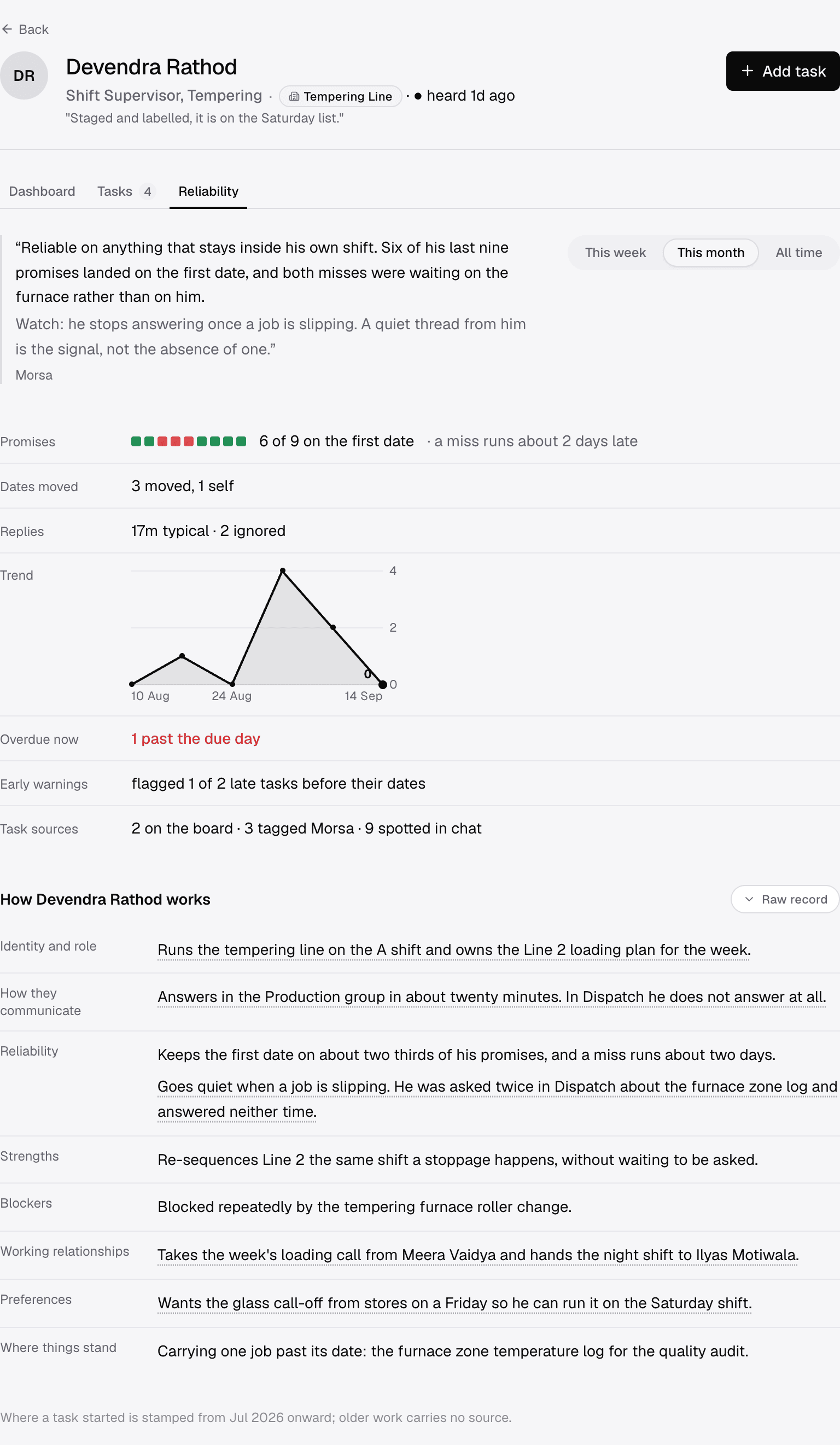
The Reliability tab in Morsa. Northline Glass, a demo plant.
Morsa deploys in the cloud, a private cloud, or fully on-premise including the models and the databases, in four steps: Connect, Configure, Shadow, Live. A pilot starts on one line or one workflow, and supplier follow-through is a natural place to start because the ERP already holds the PO data. Read what an AI that operates the factory does across the whole plant, or book a demo.
Sources
National Association of Manufacturers, “NAM Manufacturers’ Outlook Survey, First Quarter 2026”, 12 March 2026, 240 responses, fielded 10 to 26 February 2026 (63.3%, 25.3%; appendix: supply chain challenges 29.79%). https://nam.org/wp-content/uploads/securepdfs/2026/03/NAM_Q1_2026_Outlook_Write_Up.pdf
National Association of Manufacturers, “NAM Manufacturers’ Outlook Survey, Second Quarter 2026”, 10 June 2026, 215 responses, fielded 12 to 28 May 2026 (50.2%). https://nam.org/wp-content/uploads/securepdfs/2026/06/NAM_2026_Q2_Outlook_Survey_Writeup.pdf
Institute for Supply Management, “Manufacturing PMI at 54.6%; August 2026 ISM Manufacturing PMI Report”, issued by Susan Spence, Chair of the ISM Manufacturing Business Survey Committee, via PR Newswire, 1 September 2026. https://www.prnewswire.com/news-releases/manufacturing-pmi-at-54-6-august-2026-ism-manufacturing-pmi-report-302865127.html
Resilinc, “Supply Chain Disruption Is Accelerating and Why 2026 Demands a New Response”, 22 January 2026 (vendor data from its own EventWatchAI feed). https://resilinc.ai/blog/supply-chain-disruption-accelerating-why-2026-demands-new-response/
ISO 9001:2015 clause 8.4.1, as quoted by Auditor Training Online, Jackie Stapleton, “ISO 9001 Clause 8.4 Control of externally provided processes, products and services”, 11 December 2023 (secondary; the standard’s text is sold, not published). https://blog.auditortrainingonline.com/blog/iso-9001-8-4
IATF 16949:2016 clause 8.4.2.4 Supplier monitoring, as summarized by Pretesh Biswas, updated 17 May 2024 (secondary; no IATF or AIAG page publishes the clause). https://preteshbiswas.com/2023/07/30/iatf-169492016-clause-8-4-2-4-supplier-monitoring/
Deloitte, “2025 Global Chief Procurement Officer Survey”, press release, 19 August 2025, over 250 CPOs across 40 countries (Ryan Flynn quote). https://www.deloitte.com/us/en/about/press-room/2025-chief-procurement-officer-survey.html
The Hackett Group, “2026 Procurement Key Issues: The Agentic Enterprise” (no publication date, sample size or method stated on the page). https://www.thehackettgroup.com/insights/2026-procurement-key-issues/
Penn State College of Earth and Mineral Sciences, BA 850, supplier scorecards lesson. https://courses.ems.psu.edu/ba850/node/672
Microsoft Learn, “Register a new vendor”, Dynamics 365 Business Central documentation, updated 1 April 2026. https://learn.microsoft.com/en-us/dynamics365/business-central/purchasing-how-register-new-vendors
SAP Learning, “Exploring Master Data and Documents”, Managing Logistics in SAP Business One. https://learning.sap.com/courses/managing-logistics-in-sap-business-one/exploring-master-data-and-documents
Odoo, “Purchase” product page. https://www.odoo.com/app/purchase
SAP Learning, “Understanding SAP Ariba Supplier Lifecycle and Performance Integration”. https://learning.sap.com/courses/configure-supplier-lifecycle-and-performance-slp-integration/understanding-supplier-lifecycle-performance-slp-integration
Coupa, “Coupa Supplier Management” datasheet, 2021 (PDF created 26 January 2021). https://get.coupa.com/rs/950-OLU-185/images/Coupa_Supplier_Management_Datasheet.pdf
Jaggaer, “Supplier Management” and “Source-to-Pay” pages. https://www.jaggaer.com/solutions/supplier-management and https://www.jaggaer.com/solutions/source-to-pay
Ivalua, “Supplier Management Software”. https://www.ivalua.com/solutions/process/strategic-sourcing/supplier-management/
GEP, “GEP Quantum Intelligence Platform”. https://www.gep.com/software/gep-smart
Intelex, “Supplier Management”. https://www.intelex.com/products/applications/supplier-management/
MasterControl, “Supplier Management Software Systems”. https://www.mastercontrol.com/supplier/supplier-management/
Octave, “Reliance Supply Chain Quality Management”. https://www.octave.com/products/asset-performance-management/reliance/supply-chain-quality-management
SourceDay, “Purchase Order Management”. https://sourceday.com/purchase-order-management/
Odoo, “Pricing”, US page as displayed 12 September 2026, unchanged on 19 September 2026, and re-read 21 September 2026 when both tiers had moved up a step. https://www.odoo.com/pricing
Amazon Business, Alexia Cooley, “Supplier performance management software: Key features and best practices”, published 21 August 2025, updated 29 May 2026. https://business.amazon.com/en/blog/supplier-management-software
Reddit, r/SaaS, “Which Vendor Management Software do you all use?”, posted 2 December 2025, comment thread. https://www.reddit.com/r/SaaS/comments/1pc6bb0/which_vendor_management_software_do_you_all_use/
IoT Analytics, Anand Taparia, “MES vendors replace pen, paper, and spreadsheets”, 15 December 2025. https://iot-analytics.com/mes-vendors-replace-pen-paper-spreadsheets/
Gartner, “Magic Quadrant for Supplier Risk Management Solutions”, Martin Shreffler, Cheryl Van Dyke, Cian Curtin, 4 May 2026, as cited in Resilinc’s press release of 6 May 2026 (gartner.com blocks automated readers; the existence and date of the report are taken from the vendor’s citation line, and no vendor’s placement is stated). https://resilinc.ai/press-release/resilinc-named-a-leader-in-2026-gartner-magic-quadrant-for-supplier-risk-management-solutions/
National Association of Manufacturers, “2026 Third Quarter Manufacturers’ Outlook Survey”, 14 September 2026, 220 responses, fielded 11 to 27 August 2026 (44.6%, 33.2%, 41.3%, 36.5%, 77.3%, 74.1%). https://nam.org/wp-content/uploads/2026/09/Q3_2026_Writeup_Final.pdf
US Census Bureau, “Manufacturers’ Shipments, Inventories, and Orders (M3)”, full report, July 2026 data, released 2 September 2026. https://www.census.gov/manufacturing/m3/current/index.html
IndustryWeek, Ganpati Goel, “Your Best Poka-Yoke May Be in Your Supplier’s Factory”, 28 July 2026. https://www.industryweek.com/operations/continuous-improvement/article/55394157/your-best-poka-yoke-may-be-in-your-suppliers-factory
Changelog
24 September 2026: Odoo prices re-read. Billed yearly, Standard is $24.90 and Custom $49.00 per user per month for the first 12 months (lists $31.10 and $61.00); billed monthly they are $31.10 and $61.10 (lists $38.90 and $76.20). Every current Odoo price on this page now names its billing term.
20 September 2026: added NAM’s third-quarter 2026 survey (published 14 September; supply chain challenges 44.6%, completing the 29.8% to 50.2% to 44.6% series, plus freight, fuel, import and Middle East figures), the full ISM August supplier-deliveries detail with Susan Spence’s sentence, and the Census Bureau’s July 2026 inventories-to-shipments ratio, as a new section on delivery volatility.
20 September 2026: added named quotations from Ganpati Goel (Lucid Motors, IndustryWeek), Susan Spence (ISM), Ryan Flynn (Deloitte) and Anil Kohli (J4S); added Deloitte’s sample, NAM’s samples, Resilinc’s disruption breakdown, IoT Analytics’ 54% spreadsheet figure and Gartner’s May 2026 supplier risk Magic Quadrant.
20 September 2026: corrected the Amazon Business citation (the article is “Supplier performance management software: Key features and best practices”, published August 2025 and updated May 2026, not a 2026 guide); cited the 29.8% comparator to NAM’s Q1 survey, where it appears; changed the Hackett wording to “amid” and removed an unsupported publication date; removed “(formerly GEP SMART)”, which the vendor’s page does not say; matched Jaggaer’s and Microsoft Learn’s current wording.
20 September 2026: quoted IATF 16949’s four indicator names as the secondary renders them instead of its paraphrase; date-stamped the three observations about Google’s results as a 12 September 2026 read.
20 September 2026: rephrased the two remaining statement headings as questions, matched the table of contents, gave the J4S link a descriptive anchor, and added links to the manufacturing software, manufacturing management software and manufacturing ERP guides.
Prices re-read 21 September 2026: Odoo’s published ladder moved up a step. Standard is now $31.10 per user per month billed yearly ($38.90 monthly) and Custom is $61.00 ($76.20 monthly), replacing the $24.90 and $49.00 figures read on 12 and 19 September. The Odoo entry, the price answer and the source note all now carry the 21 September read.

