An AI copilot for manufacturing is software that reads a plant’s systems and conversations, works out what a change means, and helps people respond. An operating AI goes further. It connects to the ERP, MES, and other plant systems, catches a problem, understands the production impact, replans within approved rules, coordinates the response across systems and people, and verifies that it happened. Morsa, the AI that operates the factory for you, is built on that second definition. The distinction matters because most of what is sold under the name stops at answering: in Stanford’s AI Index 2026, 88% of organizations report using AI, yet “AI agent deployment was in the single digits across nearly all business functions.”
In this guide
What happens when one shortage hits a plant?
What does the gap between a change and a response cost?
What does an AI copilot for manufacturing actually do?
What is the difference between a copilot, an agent and an operating AI?
How do OpenAI, Anthropic, IBM and Gartner define an AI agent?
What is agentic AI in manufacturing?
How many manufacturers actually use AI agents today?
What does an operating AI look like on a real shift?
What does an operating AI read, and what does it write?
Where are the approval boundaries?
Which systems does an AI copilot connect to?
How is an operating AI deployed?
Why do AI pilots stall in manufacturing?
What has an operating AI done in real plants?
What are examples of AI agents for manufacturing?
How do you evaluate an AI copilot for manufacturing?
Where does Morsa fit?
FAQ
Sources, Changelog, Related pages
What happens when one shortage hits a plant?
One late delivery touches five departments and eight steps, and nobody owns the whole chain. Imagine a factory plans to build 1,000 pumps tomorrow. Each pump needs one valve.
At | 9:00 AM | 11:00 AM |
|---|---|---|
ERP | Shows 1,000 valves available or expected | Unchanged |
Purchasing | No news | Learns 400 valves will arrive two days late |
Production plan | Build 1,000 pumps tomorrow | Now impossible as written |
What happens next without an operating AI. Someone checks which work orders consume the missing valves. Someone figures out which customer shipments are at risk. The planner checks whether another product can run instead. Purchasing calls or emails the supplier about an expedite. Quality or Engineering may need to approve substitute material. Production needs a revised schedule. Customer Service may need a new promise date. Someone must follow up later to confirm the material arrived and the schedule recovered.
What an operating AI does. Notice that 400 valves are late. Connect the shortage to the affected jobs and customers. Work out the best safe response. Coordinate systems and people until it is done.
The valves are one case. A supplier slips, the ERP (enterprise resource planning system, the commercial record of orders, stock and purchases) shows material the floor cannot find, a lot fails inspection, a mold goes down, a customer pulls an order forward. The plant already has systems that record pieces of each situation. The hard part is connecting the pieces, deciding what should happen next, and following through.
What does the gap between a change and a response cost?
It costs production time first and customer trust second, and the first is measured. Siemens’ True Cost of Downtime 2024, based on 181 interviews at large industrial firms, finds that “in Automotive, unplanned downtime now costs $2.3 million an hour.” The recovery is getting slower, not faster: the same report finds incidents per plant fell from 42 to 25 a month since 2019 while the time to recover from each rose from 49 to 81 minutes. Capgemini and Microsoft name exactly this loop as an agentic use case, “production plan adaptation”: regenerating schedules “according to actual production events (e.g. machine breakdown, urgent order, missing part, etc.).” That is the loop the rest of this page describes.
“Supplier X is late” is an alert. “Supplier X is late, so Jobs A and B are at risk, Tuesday’s schedule should change, Purchasing should expedite, and Production needs the new sequence” is operational reasoning. The difference between a copilot and an operating AI is the second sentence, produced and acted on without being asked.
What does an AI copilot for manufacturing actually do?
A working one runs a single loop, continuously, on every change it can see. Six steps. Each answers a question a good shift supervisor would ask.
1. Signal
The question it answers: What changed?
What that means in real life: Reads changes from plant systems and human communication: ERP inventory moves, MES (manufacturing execution system) job status, a supplier email, a quality message in a group chat
Where a chat assistant stops: Waits to be asked
2. Context
The question it answers: What does it belong to?
What that means in real life: Which part? Which work order? Which machine? Which customer? Who owns it?
Where a chat assistant stops: Answers with a summary
3. Consequence
The question it answers: What does it mean downstream?
What that means in real life: “This shortage blocks Wednesday’s build”
Where a chat assistant stops: Rarely gets here
4. Decision
The question it answers: What should happen next, and is it allowed?
What that means in real life: Expedite, resequence, escalate, request approval, notify the owner, within approved rules; anything outside the rules becomes a question to a named person
Where a chat assistant stops: Not its job
5. Execution
The question it answers: Who does what, where?
What that means in real life: Update state, create the action, message the owner, request the approval, across systems and people
Where a chat assistant stops: Not its job
6. Verification
The question it answers: Did it actually happen?
What that means in real life: Material arrived, task completed, schedule updated, issue closed. System actions are verified from system state, human work by explicit completion evidence. Not a “done” message
Where a chat assistant stops: Not its job
The loop is six steps: Signal, what changed; Context, what it belongs to; Consequence, what it means downstream; Decision, what should happen next and whether it is allowed; Execution, who does what, where; Verification, whether it actually happened.
THE LOOP
What an operating AI does when reality moves off the plan
Six steps, run on every change the plant can see. The example: a plant plans to build 1,000 pumps tomorrow, one valve each. At 9:00 AM the ERP shows 1,000 valves. At 11:00 AM purchasing learns 400 of them will arrive two days late.
STEP 01
Signal
What changed? Reads changes from ERP, MES, CMMS, QMS, WMS, and the chats where people talk.
THE EXAMPLE
Purchasing learns 400 of tomorrow’s 1,000 valves will arrive two days late.
STEP 02
Context
What does it belong to? Ties the change to a part, a work order, a machine, a customer, and an owner.
THEN
Which work orders use those valves. Which customer shipments sit behind them.
STEP 03
Consequence
What does it mean downstream? Works out which build, order, or customer promise slips if nobody acts.
THEN
Tomorrow’s 1,000-pump build cannot run as planned. Jobs A and B are at risk.
STEP 04
Decision
What next, and is it allowed? Picks the next action within approved rules, or asks a named person.
THEN
Expedite, run another product, or use approved substitute material with a quality sign-off.
STEP 05
Execution
Who does what, where? Acts across systems and people: updates, assigns, messages, requests approval.
THEN
Purchasing gets the expedite. Production gets the new sequence. Customer Service gets the new date.
STEP 06
Verification
Did it actually happen? Checks it happened: material in, task done, schedule updated. Not a “done” message.
THEN
Closed when the valves are received in the ERP and the schedule has recovered. Not when someone says handled.
REALITY CHANGES AGAIN. BACK TO STEP 01.
Steps 01 and 02 are where a copilot stops: it reads and answers. Steps 03 to 06 are where an AI that operates the factory earns the name: it works out the consequence, decides within rules, acts, and verifies.
Most of the pages that rank for “ai copilot for manufacturing” describe steps one and two. Connect the data, ask it questions, get a good answer. That is useful, and it is what the word copilot has come to mean. It is also why so many pilots stall. MIT’s The GenAI Divide: State of AI in Business 2025, as quoted by Fortune, found that “about 5% of AI pilot programs achieve rapid revenue acceleration; the vast majority stall, delivering little to no measurable impact on P&L.” Fortune’s explanation of the gap is specific to generic tools: they “excel for individuals because of their flexibility, but they stall in enterprise use since they don’t learn from or adapt to workflows.”
A copilot that stops at step two is a search box with better manners. Nobody is chasing the shortage at 2 a.m.
What is the difference between a copilot, an agent and an operating AI?
A copilot suggests and a person acts. An agent acts on its own toward a goal. An operating AI is an agent whose job is the plant’s daily coordination, run inside approval boundaries and closed on proof. The words get used interchangeably, and vendors have an incentive to blur them. In June 2025 Gartner estimated that “only about 130 of the thousands of agentic AI vendors are real” and predicted that “over 40% of agentic AI projects will be canceled by the end of 2027, due to escalating costs, unclear business value or inadequate risk controls.” Two months later it named the confusion: “The most common misconception is referring to these AI assistants as agents, a misunderstanding known as ‘agentwashing’” (Gartner, 26 August 2025). The comparison table below is the short version; the definitions and their sources follow.
Reads plant systems
Assistant: On request
Copilot: Yes, in real time
Agent: Yes
Operating AI: Yes, plus the chats where work is agreed
Remembers the job
Assistant: No
Copilot: No
Agent: For one task
Operating AI: For every open commitment in the plant
Decides
Assistant: No
Copilot: Suggests
Agent: Yes, for its task
Operating AI: Yes, within approved rules; asks a person for the rest
Acts in systems
Assistant: No
Copilot: No
Agent: Yes
Operating AI: Yes, within rules
Acts with people
Assistant: No
Copilot: No
Agent: Sometimes
Operating AI: Yes: routes, reminds, escalates up the reporting line
Verifies on proof
Assistant: No
Copilot: No
Agent: Rarely
Operating AI: Yes; the job stays open until the evidence shows up
Who is accountable
Assistant: The user
Copilot: The user
Agent: Depends on the setup
Operating AI: The plant’s managers, by the rules they set
Best for
Assistant: Looking things up
Copilot: Faster answers on the floor
Agent: One narrow, repeatable process
Operating AI: Running the daily gap between plan and reality
How do OpenAI, Anthropic, IBM and Gartner define an AI agent?
Each draws the line at the same place: an agent controls its own workflow and takes actions; an assistant does not. Here are the four definitions we use, with the sources, and the fifth we add.
Assistant (or chatbot). Answers a question from documents and data. It has no memory of the job and changes nothing unless a person does it. OpenAI’s guide to building agents draws the line here: applications that use a language model but “don’t use them to control workflow execution” are not agents.
Copilot. A conversational layer on top of the systems you already run. It pulls information together in real time and suggests. A person takes the action. Gartner’s August 2025 wording: assistants “simplify tasks and interactions for users but depend on human input and do not operate independently.”
Agent. Software that can take actions on its own to reach a goal. Anthropic defines agents as “systems where LLMs dynamically direct their own processes and tool usage, maintaining control over how they accomplish tasks.” In manufacturing, IBM describes agentic AI as “autonomous, goal-driven artificial intelligence systems that can plan, make decisions and act across production environments with minimal human intervention.”
Operating AI. An agent with a job, not a task. The job is the plant’s daily coordination: capture, routing, follow-through, shift handovers, plan versus reality. It runs the full six-step loop, works inside approval boundaries the plant sets, executes across systems and people, and verifies on proof. It does not replace the ERP or the MES, and it does not replace the people who make the calls that matter. It replaces the chasing.
What is agentic AI in manufacturing?
Agentic AI in manufacturing is AI that acts rather than answers: it watches plant systems and conversations, decides within limits it was given, and carries the action out across systems and people. The phrase covers everything from a single scheduling agent to an AI that operates a plant’s daily coordination. It is useful in a slide and useless in a purchase order. Ask instead what the system reads, what it writes, who signs off, and how it proves the work happened. The rest of this page answers those four questions.
The numbers say the phrase is ahead of the practice. The Manufacturing Leadership Council’s April 2026 survey (member survey, sample not published) found that “66% of respondents say they are either currently using or plan to use agentic AI tools in their manufacturing operations,” while “more than 75% of respondents placed themselves at below five” on a ten-point AI maturity scale. Among the World Economic Forum’s 223 Lighthouse factories, the best-run plants in the world, AI agents enabled just 5% of solutions in 2025. McKinsey’s State of AI 2026 survey of 1,719 respondents, as reported by The Register, puts the share of $1 billion-plus companies scaling AI agents at 40%, up from 27% a year earlier.
How many manufacturers actually use AI agents today?
Fewer than the vendor slides suggest, and the honest number depends on the question asked. The US Census Bureau’s Business Trends and Outlook Survey found that AI use across all US businesses “hovered between 17% and 20%” from December 2025 to May 2026, rising to 37% of firms with at least 250 employees. That is any use, in any function. Production is narrower: Rockwell Automation’s 2026 State of Smart Manufacturing Report (1,560 respondents, 17 countries) puts 34% of operations as AI-augmented today, with manufacturers expecting more than half by 2030. At scale is narrower still: Capgemini and Microsoft report that “only 5% of industrial companies have deployed AI in manufacturing at scale,” a figure they source to Capgemini and Everest Group research from 2024 with no published sample.
The gap between intent and operating model is measured too. A Gartner survey of 128 manufacturing and supply chain leaders (May 2025) found that “nearly half of organizations lack confidence in their manufacturing strategy to deliver on business outcomes over the next three years,” and that “66% of survey respondents say integrating supply chain and manufacturing is the most significant challenge.” Simon Jacobson, VP Analyst in Gartner’s Supply Chain practice: “CSCOs picture a near future of advanced automation where machines are involved in completing a majority of tasks, yet most operating models are not keeping pace.” Deloitte’s 2026 Manufacturing Industry Outlook expects more than 81% of manufacturing task hours to remain human-driven. The agent’s job is the coordination around those hours.
What does an operating AI look like on a real shift?
One example from a live deployment, step by step. The numbers are real.
The night shift is 96 pieces short
At a Morsa customer plant, a manager set an 8,000-part night-shift target. About seven hours later, dispatch posted photos showing several parts unavailable. Nobody explicitly connected the two.
Signal. The dispatch photos land in the group.
Context. The previous schedule showed 4,131 units scheduled for the relevant part family. Dispatch showed 4,035.
Consequence. A 96-piece shortage, four parts at 24 each, that blocks the 8,000-part target.
Decision. Within the rules: mark the target blocked by supply and open the shortage as high-priority work with named owners.
Execution. Dispatch is told to arrange the unavailable parts. Production is told the target is blocked by supply. A high-priority dependency is created.
Verification. The target stays blocked until the parts are arranged and the dependency is closed.
The connection was made in under a minute. Nobody had said “the 8,000-part target is blocked by a 96-piece shortage.” Morsa derived it from pieces of information posted by different people at different times. Anil Kohli, Production Head at J4S, on what that asks of the floor: “Our people don’t have to learn any new software. People just message the way they always have. Morsa coordinates all the messages in the background.”
What does an operating AI read, and what does it write?
An operating AI reads everything the plant will give it and writes only what the plant has approved: reminders, routing, and questions to people on its own; entries in systems only where a rule allows it; nothing consequential without the approval the rules require. The useful question for any AI copilot is not “what can it do” but “what is it allowed to change, and where does it stop.”
For anyone new to the alphabet: MRP is material requirements planning, usually inside the ERP; APS is advanced planning and scheduling; CMMS is the maintenance system; QMS is the quality system; WMS is the warehouse system; a BOM is a bill of materials.
THE BOUNDARY
What it reads, what it writes, and where it asks
Read by default. Act alone only on low-risk work inside approved boundaries. Consequential changes follow your plant’s approval rules.
MORSA
Operating AI
01 Signal 02 Context 03 Consequence 04 Decision 05 Execution 06 Verification
READS
ERP / MRP / APS
orders, work orders, BOMs, stock, due dates
MES
dispatch, actuals, downtime, plan vs actual
CMMS
breakdowns, PMs, open maintenance work
QMS
rejections, holds, NCRs, SOP versions
WMS
receipts, picks, shortages
Excel / Sheets / PDFs
plans, trackers, supplier confirmations
Machines / PLCs / SCADA / sensors
machine state, alarms, counts, sensor readings
WhatsApp / Teams / email / Slack / SMS
any channel your plant runs on; where the commitments are actually made
WRITES
ON ITS OWN
Low-risk follow-ups and status checks
Reminders before the date
Routing to purchasing, planning, tooling
Escalation when work goes quiet
Questions and proof requests
WITHIN APPROVED RULES
Where the plant pre-approved it for the workflow
Status notes and entries on the work order
Updates to trackers the plant designates
Supplier expedite requests, where approved
FOLLOWS YOUR APPROVAL RULES
Morsa asks. A named person decides.
A production-plan change
An external supplier commitment
A date promised to a customer
Purchases over the limit
Anything the rules do not cover
Morsa asks before the third group. When information is insufficient, Morsa asks the right person instead of inventing an answer. System actions are verified from system state, human work by completion evidence.
Plan of record
Systems: ERP, MRP, APS
What it reads: Orders, work orders, BOMs, stock, due dates, supplier commitments
What it writes: Notes, status, and entries the plant has approved for the workflow
Condition: Only inside approved rules; anything else is a question to a named person
Execution, maintenance, quality, warehouse
Systems: MES, CMMS, QMS, WMS
What it reads: Dispatch, actuals, downtime, breakdowns, PM schedules, rejections, holds, receipts, picks, shortages
What it writes: Read only, unless the plant approves a specific rule for that workflow
Condition: Read by default
Files
Systems: Excel, Google Sheets, PDFs
What it reads: Plans, trackers, supplier confirmations
What it writes: Updates to trackers the plant designates
Condition: Named files only
People
Systems: Any channel the plant runs on: WhatsApp, Teams, email, Slack, SMS are examples
What it reads: The commitments, questions, and updates in the threads where work is agreed
What it writes: Reminders, routing, escalations, questions, proof requests
Condition: Always, in the channel the person already uses
The reason the reading layer matters is that the systems themselves rarely agree. In Rockwell Automation’s July 2026 survey of 1,560 manufacturers, 93% have an MES but only 23% report full integration with ERP, PLM, quality and OT systems, and 44% named integration their top MES buying requirement. Lorenzo Veronesi, Associate Research Director at IDC, in the same release: “organizations risk leaving significant value on the table if disconnected systems and underutilized data go unaddressed.” ISA-95, the enterprise-control integration standard, defines the interface between plant control functions and the rest of the enterprise, initially at levels 3 and 4 of the Purdue Reference Model. An operating AI sits across that interface and the conversations around it. It is not a new level. See what an MES system is for the plant side of that line.
Where are the approval boundaries?
The approval boundaries sit in three tiers: what the operating AI may do on its own, what it may do under the plant’s approval rules, and what always goes to a person. The plant sets them in configuration before go-live, and an operating AI is only as trustworthy as that line.
Tier | What the operating AI does | Examples |
|---|---|---|
On its own | Low-risk follow-ups and status checks, inside approved boundaries | Read a dispatch entry; ask a supervisor why a job moved; remind an owner the day before a date; log a commitment; route a shortage to purchasing; escalate an idle job up the reporting line after the agreed interval |
Within the plant’s approval rules | Consequential actions follow the rules your managers define: which need a sign-off, from whom, above what threshold | A production-plan change; an external supplier commitment; a new promise date to a customer; a purchase above the limit; a status entry in the ERP for that workflow |
Always a person | Anything the rules do not cover, and any case where the information is insufficient | Morsa routes the question to the right person instead of inventing an answer |
This matches how the people who build agents say to do it. OpenAI’s guide names two triggers for human intervention, “exceeding failure thresholds” and “high-risk actions,” defined as “actions that are sensitive, irreversible, or have high stakes” that “should trigger human oversight until confidence in the agent’s reliability grows.” NIST’s AI Risk Management Framework is blunter: “Trustworthy AI depends upon accountability. Accountability presupposes transparency.” Ramakrishna Garine, a senior member of IEEE, told Manufacturing Dive in June 2026 that the current state of the art is “a semiautomatic human-in-the-loop state, where human validation is still needed for unplanned scenarios.” That is the third tier, stated by someone who does not sell one. Gartner’s October 2025 manufacturing survey puts the organizational half plainly: “Plant leaders must be empowered to shift from command-and-control oversight to using AI for data-driven decision making and performance optimization.”
Writing the rules: a checklist
[ ] Which systems are read-only, and which accept entries from the operating AI, for which workflow
[ ] Which channels it may post in, and whether it may message people outside the plant
[ ] The escalation path for an idle job: who, after how long, how many times
[ ] Which actions need a sign-off, from whom, and above what money threshold
[ ] What counts as proof for each kind of job: photo, document, system entry
[ ] Who reviews the log of actions, and how often
Which systems does an AI copilot connect to?
Morsa connects to SAP Business One, SAP Ariba, Microsoft Dynamics 365 Business Central, Odoo, Zoho, QuickBooks, Excel, and Google Sheets; Gmail and Outlook for email; and WhatsApp, Microsoft Teams, Slack, and SMS for the conversations where work is agreed. Those are examples, not the boundary. Any platform with an API, a database, a file export, a message stream, or an email trail can be connected, machines, PLCs, SCADA systems, and sensors included. Customer-specific schemas are normalized into one internal model during onboarding, so the same core runs on every plant without a custom rebuild.
That normalization step is not a detail. Chandra Surbhat, chief industrial AI and transformation officer at Altimetrik, told Manufacturing Dive: “Agentic AI works best when it has clean, consistent, historical data to learn from. But in a lot of manufacturing settings that data either doesn’t exist, isn’t integrated, or varies too significantly from plant to plant for a single model to be reliable across all of them.” One thing matters more than the logo list: the chats. A plant’s real plan of record on a Tuesday afternoon is the supervisors’ group, and a copilot that cannot read it is working from yesterday’s ERP. See what an ERP cannot do when the plan changes and how MES and ERP divide the work.
How is an operating AI deployed?
Four steps. A pilot starts on one line or one workflow, typically material availability and supplier recovery, not the whole plant.
Step | What happens | What you see |
|---|---|---|
1. Connect | Morsa reads the plant’s systems and one live workflow: ERP, MES, the other systems you run, and the group chats the plant already uses, whatever it runs on | Morsa reading, not writing |
2. Configure | Schemas, owners, rules, and approval boundaries are mapped. Configuration, not bespoke code | A rule set your managers have signed |
3. Shadow | Morsa runs the full loop without consequential actions, and its understanding is compared against the plant’s | A daily comparison of what it saw against what the team saw |
4. Live | Approved actions and verification are turned on for the pilot scope. Scope grows when the numbers justify it | Commitments with owners, dates, and proof; misses reported |
Deployment options are cloud, private cloud, or fully on-premise. On-premise means the entire stack, including the AI models, the databases, and the integration layer, runs on hardware inside the plant or your own data center, with no plant data leaving your perimeter. That matters to plants working under ITAR or CMMC obligations, to defense and aerospace suppliers, and to any plant whose IT policy forbids operational data in a third-party cloud. Morsa operates inside your security perimeter from day one. J4S went from connect to live in two days.
There is nothing new to roll out to operators. They keep working in the chats they already use. The change is that the chasing now happens whether or not anyone remembers.
Why do AI pilots stall in manufacturing?
Pilots stall because the data was never built for them, because the tool answers instead of acting, and because nobody designed what happens after the alert. The measured version: MIT’s 2025 study found 95% of generative AI pilots “falling short,” and the World Economic Forum repeated that figure in January 2026 with its own diagnosis: “The challenge is not a lack of technological potential, but the absence of stable operating conditions required to translate that potential into durable, enterprise-level value.” Capgemini and Microsoft report that 80% of industrial data and AI initiatives require investment in technical foundations first (Capgemini and Everest Group research, 2024). The Manufacturing Leadership Council’s 2026 survey ranks data quality the top barrier at 63.2%, “more than 20 points ahead of the second biggest challenge,” skills.
The business case is the other half. Anushree Verma, Senior Director Analyst at Gartner, in the June 2025 release: “Most agentic AI projects right now are early stage experiments or proof of concepts that are mostly driven by hype and are often misapplied.” McKinsey’s 2026 survey found only 37% of respondents attribute any EBIT impact to AI, even though 80% of those who use it say it improved their own productivity. In Stanford’s AI Index 2026, the barriers to scaling agents were led by security and risk (62%), with “unclear or insufficient business value” at 32%. A pilot that stops at an answer produces productivity nobody can find in the P&L. Morsa’s cure is structural: start on one workflow, close each job on proof, and report the misses.
What has an operating AI done in real plants?
At two live plants: on-time completion of operational commitments rose from about 30% to about 75% in four weeks at J4S, and 5 of 8 production-stopping shortages were caught early enough to act at JRG Automotive, saving the plant $2 million.
PROOF
What changed at two live plants
Numbers from the first weeks of deployment. The misses are reported alongside the catches.
30% to 75%
on-time completion of operational commitments in the first four weeks
J4S, glass manufacturing
~900
operational commitments captured with an owner and a date in the first month
J4S, glass manufacturing
5 of 8
production-stopping material shortages identified early enough for the plant to act
JRG Automotive, running live
$2M
saved for the plant by the shortages caught in time
JRG Automotive, running live
SUNIL K VERMA, PLANT HEAD, J4S
“I used to spend the first hour of every morning reconstructing yesterday. Now the chasing happens in the WhatsApp groups my supervisors already use, whether or not I remember.”
J4S, a 120-person glass plant. Onboarded in two days. On-time completion of operational commitments rose from about 30% to about 75% in the first four weeks, across about 900 commitments in the first month (the four-week story, told by the people who ran it). Plant Head Sunil K Verma: “I used to spend the first hour of every morning reconstructing yesterday. Now the chasing happens in the WhatsApp groups my supervisors already use, whether or not I remember.”
JRG Automotive, an automotive and plastic body-parts manufacturer serving OEMs. Running live. Morsa identified 5 of 8 production-stopping material shortages early enough for the plant to act, and saved the plant $2 million. The 3 of 8 it did not catch in time are on this page on purpose. An honest operating AI reports its misses, because the misses are how the rules get better.
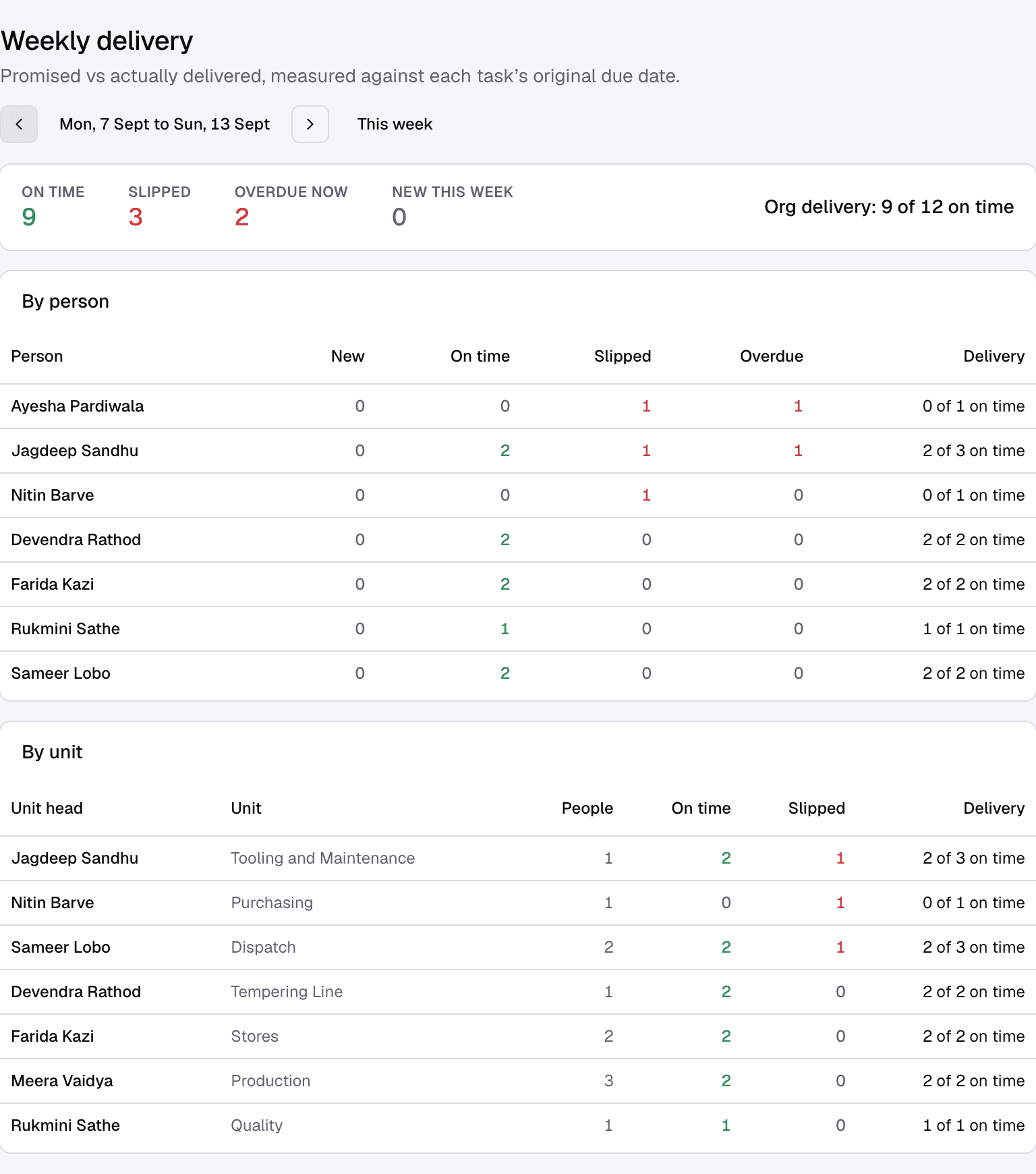
The weekly delivery view in Morsa. Northline Glass, a demo plant.
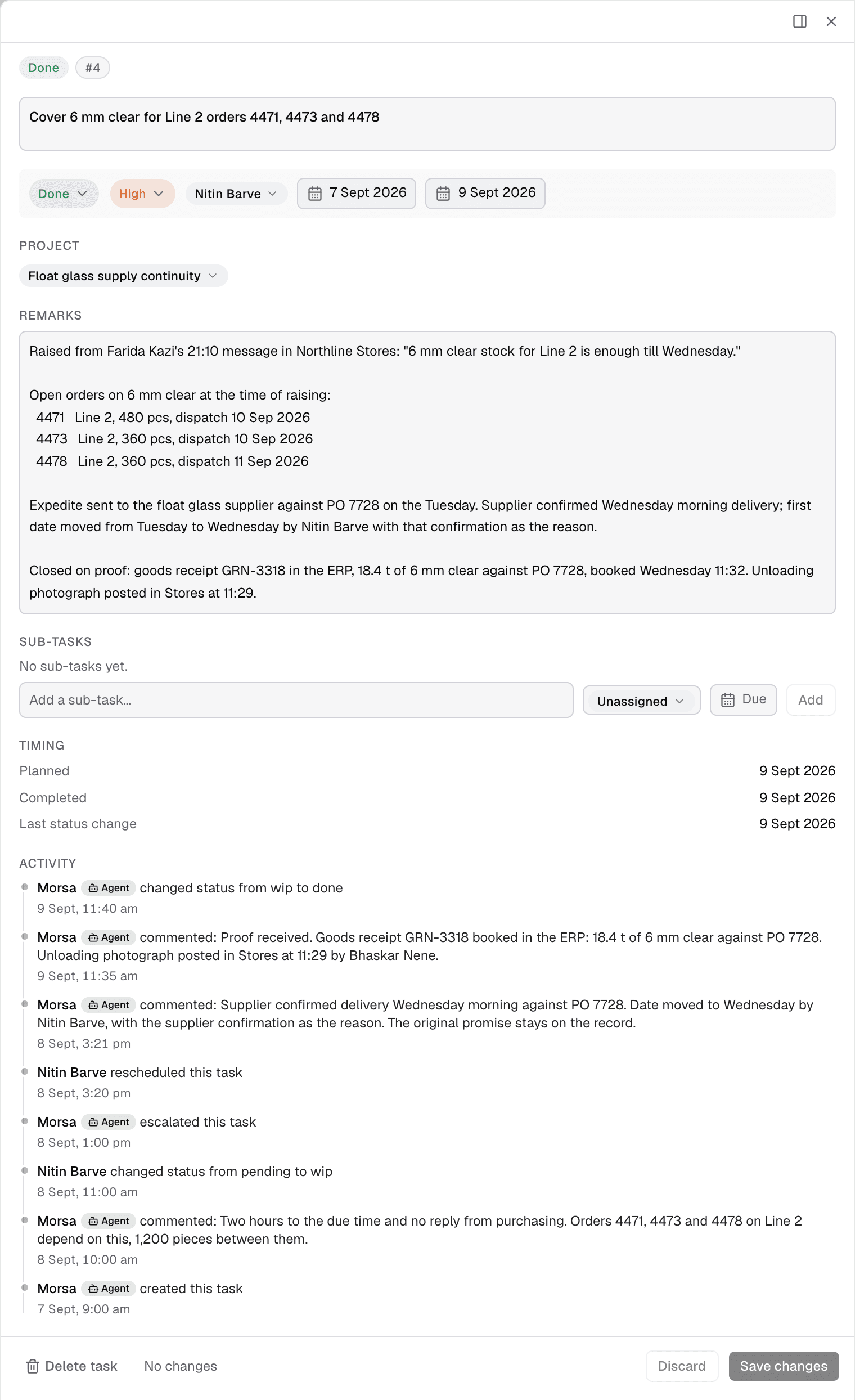
A commitment and its activity trail in Morsa. Northline Glass, a demo plant.
What are examples of AI agents for manufacturing?
Examples of AI agents for manufacturing include predictive maintenance agents, quality inspection agents, scheduling agents, supplier and procurement agents, inventory agents, and shift handover agents. Each is narrow by design, which is not a criticism: a narrow agent with a clear boundary is easier to trust than a broad one without. The question is what happens between them. For copilots and agents compared side by side, see best AI software for manufacturing.
Predictive maintenance agent
What it reads: Sensor data, machine logs, CMMS history
What it does: Flags likely failures, proposes or schedules maintenance
Where it stops: Does not know which orders the stoppage hits, or who is expediting the spare; see twelve predictive maintenance tools compared
Quality inspection agent
What it reads: Camera images, inspection results, QMS
What it does: Catches defects and out-of-spec parts in real time
Where it stops: Does not chase the rework or say which customer order is at risk
Scheduling agent
What it reads: Orders, capacity, material availability, APS
What it does: Re-sequences jobs when inputs change
Where it stops: Does not confirm the material actually arrived or the operator actually showed; see production planning software
Supplier and procurement agent
What it reads: Purchase orders, supplier messages, receipts
What it does: Chases confirmations, flags late deliveries, proposes expedites
Where it stops: Does not connect the late part to the line that stops on Thursday; see supplier management software
Inventory agent
What it reads: Stock levels, movements, WMS
What it does: Flags shortages and discrepancies, proposes replenishment
Where it stops: Does not know that stores promised the 96 pieces in a group chat
Shift handover agent
What it reads: Handover notes, open issues, downtime
What it does: Structures the handover and carries open items forward
Where it stops: Does not chase them on the next shift
Operating AI
What it reads: All of the above, plus the conversations where work is agreed
What it does: Runs the six-step loop on every change; routes, chases, escalates, verifies; asks a named person for anything outside the rules
Where it stops: Does not change the plan, the money, or a customer promise without the approval the plant’s rules require
The clearest shipped example of a narrow agent is Microsoft’s Procurement Agent for Dynamics 365, in public preview since 16 April 2026. Microsoft’s description: it helps teams “by decoding supplier communications and identifying which production orders, inventory positions, and customer commitments are at risk, while keeping humans in control.” Sean Barrett, Inventory and Analytics Manager at Farmlands Cooperative, in the same post (a vendor case study): “the agent has read the email, found the order, found the lines affected, decoded what the vendor is trying to say, and recommended actions.” Steps one to three, then a recommendation. The pattern holds: each narrow agent produces a signal, and the plant still needs someone to own what happens next. For the wider picture, see the twelve types of manufacturing software and AI in manufacturing.
How do you evaluate an AI copilot for manufacturing?
Seven questions. If the vendor cannot answer one with a demonstration on your data, treat the answer as no.
Can it read the group chats where our supervisors actually agree things, not only the ERP?
Show me step three. When a part is late, which orders does it say will slip, and how did it work that out?
What is it allowed to write, into which system, under which rule? Show me the rule.
What does it do when the case is outside the rules? Who gets the question?
What counts as “done”? Show me a job closed on proof and a job it refused to close.
Can the models and the database run on our premises?
What did it miss last month, and what changed because of it?
Gartner’s warning about “agent washing,” the “rebranding of existing products, such as AI assistants, robotic process automation (RPA) and chatbots, without substantial agentic capabilities,” is the reason for question two. Anushree Verma’s advice in the same release is the reason for question three: “Many use cases positioned as agentic today don’t require agentic implementations.” A chatbot in front of the ERP will pass questions one and six and fail the rest. The integration question is not optional either; Gartner notes that “integrating agents into legacy systems can be technically complex, often disrupting workflows and requiring costly modifications.” Ask for the integration plan in writing before the second call. The wider map of what a plant runs on, and what each system owns, is in manufacturing management software.
Where does Morsa fit?
Morsa is the AI that operates the factory for you. Built in the United States for mid-market and enterprise manufacturers. Factories make a plan. Reality changes. Morsa handles the gap.
What it reads. The ERP, MES, CMMS, QMS, and WMS you already run, the spreadsheets between them, and the threads where the plant’s commitments are actually made, in WhatsApp, Teams, email, Slack, SMS, or whatever your plant runs on.
What it decides. Within the rules your managers set: which jobs and customer orders are actually at risk, who owns the response, by when, who to remind, when to escalate, and what proof closes it. Consequential changes such as a production-plan change or an external supplier commitment follow your approval rules. Anything the rules do not cover becomes a question to a named person.
What it does. Catches shortages and supplier issues before they disrupt production. Turns every commitment into a job with an owner and a date. Routes work to purchasing, planning, tooling, or maintenance instead of leaving it in a group. Nudges idle work, then escalates before the date. Closes on proof. Tracks the reliability of people and vendors over time.
What the user sees. Operators see nothing new; they keep working in their chats. Supervisors see reminders and questions in the group, from Morsa. Managers see the calls that matter, and what is open, late, closed on proof, or missed.
What changes. Fewer shortages reach the line. Replanning happens when conditions change, not at Friday’s review. Less manual chasing across Purchasing, Planning, Production, Quality, and suppliers. Customer commitments stop being surprised by problems discovered too late.
If you run planning, the division of labor is simple: you are improving the plan; Morsa handles what happens when reality stops matching it. Morsa does not replace the ERP, the MES, or the people who make the decisions. It replaces the chasing. See it on your own line: book a demo.
Sources
Siemens (Senseye), The True Cost of Downtime 2024, 181 online interviews at large industrial organizations, April 2019 to March 2023 (vendor research) (link).
Fortune, Sheryl Estrada, MIT report: 95% of generative AI pilots at companies are failing, 18 August 2025, quoting MIT NANDA, The GenAI Divide: State of AI in Business 2025.
Gartner, Gartner Predicts Over 40% of Agentic AI Projects Will Be Canceled by End of 2027, press release, 25 June 2025 (Anushree Verma quotes; the host blocks automated fetches, text verified against an archived copy of the release on 19 September 2026).
Gartner, Gartner Predicts 40% of Enterprise Apps Will Feature Task-Specific AI Agents by 2026, Up From Less Than 5% in 2025, press release, 26 August 2025 (same verification method).
Gartner, Gartner Survey Shows 49% of Organizations Lack Confidence in Future Manufacturing Strategy, press release, 28 October 2025, 128 manufacturing and supply chain leaders surveyed May 2025 (Simon Jacobson quote; same verification method).
OpenAI, A practical guide to building agents, 2025 (link).
Anthropic, Building effective agents, 19 December 2024.
IBM, Matthew Finio and Amanda Downie, How agentic AI in manufacturing drives transformation (undated).
International Society of Automation, ISA95, Enterprise-Control System Integration..
NIST, Artificial Intelligence Risk Management Framework (AI RMF 1.0), NIST AI 100-1, January 2023, section 3.4 (link).
Capgemini and Microsoft, The New AI Imperative in Manufacturing, 2025; the 5%, 45%, 25% and 80% figures are footnoted to Capgemini and Everest Group, Making brownfield factories smarter and greener, 2024, with no published sample (link).
The Register, Brandon Vigliarolo, McKinsey says enterprise AI is finally on the road to ROI, 25 August 2026, reporting McKinsey’s State of AI 2026 survey of 1,719 respondents.
US Census Bureau, Grundy, Breaux and Khatiwoda, Large Firms With at Least 20 Employees Biggest AI Users, 26 May 2026, Business Trends and Outlook Survey, 14 December 2025 to 3 May 2026.
Rockwell Automation, 90% of Manufacturers Say Digital Transformation Is Now Essential, 2026 State of Smart Manufacturing Report, 19 May 2026, 1,560 respondents in 17 countries (vendor research).
Rockwell Automation, 93% of Manufacturers Have MES, But Only 23% Have Fully Integrated It, Scaling MES Across the Enterprise, 14 July 2026, 1,560 respondents (Lorenzo Veronesi quote; vendor research).
Deloitte Insights, 2026 Manufacturing Industry Outlook, 13 November 2025.
Stanford Institute for Human-Centered AI, The AI Index 2026 Annual Report, April 2026 (corporate adoption and agent figures drawn from a McKinsey 2025 survey) (link).
Manufacturing Leadership Council, Survey: GenAI Adoption Surges as Manufacturers Continue to Grapple with Data, Skills Issues, 1 April 2026 (member survey, sample size not published).
World Economic Forum with McKinsey and Company, Global Lighthouse Network: Rewiring Operations for Resilience and Impact at Scale, January 2026 (link).
Manufacturing Dive, Sakshi Udavant, Agentic AI in manufacturing: adoption, data gaps and evolution, 22 June 2026 (Chandra Surbhat and Ramakrishna Garine quotes).
Microsoft Dynamics 365 blog, Raghav Jandhyala, Becoming a Frontier Manufacturing Firm: Agentic decisions across the manufacturing value chain, 16 April 2026 (Procurement Agent public preview; Sean Barrett quote, vendor case study).
Changelog
20 September 2026: added a section on why AI pilots stall (MIT and Fortune, World Economic Forum January 2026, Capgemini, Manufacturing Leadership Council, McKinsey via The Register, Stanford AI Index 2026) and a section on how many manufacturers use AI agents (US Census, Rockwell, Gartner October 2025, Deloitte).
20 September 2026: added Gartner’s August 2025 “agentwashing” definition and its October 2025 manufacturing survey, and named quotations from Anushree Verma and Simon Jacobson (Gartner), Ramakrishna Garine (IEEE), Chandra Surbhat (Altimetrik), Lorenzo Veronesi (IDC), Sean Barrett (Farmlands Cooperative, vendor case study) and Anil Kohli (J4S).
20 September 2026: corrected the Siemens downtime attribution to “automotive manufacturers” as the report states, and the MIT finding to the report’s own sentence rather than Fortune’s summary.
20 September 2026: added Rockwell’s July 2026 MES integration figures to the reads-and-writes section, and Microsoft’s Procurement Agent (April 2026) as the shipped example of a narrow agent.
20 September 2026: rephrased every heading as a buyer’s question, split the definitions and the cost of the gap into their own sections, matched the table of contents, and added dated sources with verification notes.

