A manufacturing ERP is the system of record for a plant: sales orders, bills of materials, routings, inventory, purchasing, production orders and costing in one database. Manufacturing ERP software, or an ERP for manufacturing, differs from a generic ERP in three things it knows about: a bill of materials, a routing, and what a production order costs. The best one for you depends less on company size than on how you make things. This page compares 12 systems for North American discrete manufacturers, with prices where they are public and the complaints left in. It also covers the gap every ERP leaves open once the plan changes: in Rockwell Automation’s July 2026 survey of 1,560 manufacturing decision makers, 93% run an MES, but only 23% have it fully integrated with their ERP and other systems.
In this guide
What is a manufacturing ERP?
Which ERP software is best for manufacturing?
What are the top ERP platforms for manufacturing? 12 systems compared
How do you choose a manufacturing ERP? Seven questions to ask in the demo
How much does manufacturing ERP software cost?
What goes wrong in manufacturing ERP projects?
How many plants actually run the floor from their ERP?
What can an ERP not do when the plan changes?
Where does Morsa fit over any of these ERPs?
FAQ, Sources, Changelog, Related pages
What is a manufacturing ERP?
Manufacturing ERP software is an enterprise resource planning system whose data model knows what a bill of materials (BOM) is, what a routing is, and what a production order costs. IBM defines ERP as “a business management software system that is designed to manage and streamline an organization’s functions, processes and workflows with automation and integration” (IBM). The manufacturing version adds production orders, work centers and capacity to the finance, inventory, purchasing and sales every ERP carries.
In plain words, a manufacturing ERP holds the plan and the money. It knows what you promised to ship, what parts that needs, what those parts cost, and what you bought. Most also carry material requirements planning (MRP), which turns demand into purchase and production suggestions, and a scheduling module of some kind.
ISA-95, also published as IEC 62264, puts ERP at Level 4, “all the activities related to running a business,” and the systems that run production, such as a manufacturing execution system (MES), at Level 3. The standard “primarily deals with the interface between levels 3 and 4” (ISA). That interface is where the second half of this page happens.
System | What it holds | The question it answers |
|---|---|---|
ERP (ISA-95 Level 4) | Orders, BOMs, routings, inventory, purchasing, costs | What did we promise, what does it need, what did it cost? |
MES (ISA-95 Level 3) | Work in progress (WIP), operator actions, machine states, quality checks | What is happening on line 3 right now? |
MRP (inside most ERPs) | Demand netted against stock and lead times | What should we buy or make, and by when? |
For the longer version, read MES vs ERP: what each one does and where they meet and what an MES system is. The full map of the twelve system types a plant runs on is in manufacturing software: the 12 types.
Which ERP software is best for manufacturing?
There is no best manufacturing ERP, only a best one for how your plant makes things. One commenter on the r/manufacturing thread that ranks on page one for this query, who has been through three ERP implementations, puts it this way: repetitive make-to-stock runs fine on standard MRP, job shops and engineer-to-order need routing and estimating flexibility, and high-mix low-volume “is where most ERPs struggle. They assume you can forecast demand and plan in advance” (r/manufacturing, November 2025). So start with your production model. For the short ranked version by plant type, see the best ERP for manufacturing in 2026. For multi-plant and enterprise shortlists, from SAP S/4HANA and Infor LN to Dynamics 365 Supply Chain Management, see enterprise manufacturing software, layer by layer.
Job shop or machine shop, under about 100 people
What the ERP must do well: Fast quoting, job costing, simple shop floor screens
Start your shortlist with: ECI JobBOSS², ProShop ERP, Global Shop Solutions
Be careful with: Suites that need a partner for every report
Precision, regulated (aerospace, defense, medical)
What the ERP must do well: Quality, traceability and document control in one database
Start your shortlist with: ProShop ERP, Plex, Epicor Kinetic
Be careful with: Anything where quality is a bolt-on
Discrete, mixed mode, 100 to 1,000 people, multi-site
What the ERP must do well: Finite scheduling, MRP, engineering change control
Start your shortlist with: Epicor Kinetic, Infor CloudSuite Industrial, Acumatica, Plex
Be careful with: Base tiers with infinite-capacity scheduling only
Small manufacturer outgrowing QuickBooks or spreadsheets
What the ERP must do well: Published price, quick setup, BOMs and MRP without a consultant
Start your shortlist with: Odoo, MRPeasy, Business Central
Be careful with: Per-seat pricing once floor staff need logins
Distribution-heavy, finance-led, light assembly
What the ERP must do well: Strong financials, inventory, order management
Start your shortlist with: NetSuite, SAP Business One, Business Central
Be careful with: Treating the base tier as a production system
High-mix low-volume, many rush orders
What the ERP must do well: Scheduling that re-plans in minutes, not a nightly MRP run
Start your shortlist with: Global Shop Solutions, Plex, Acumatica
Be careful with: Any planning module that assumes a forecast
Finite scheduling means the schedule respects that you own three lathes, not thirty; infinite-capacity scheduling ignores that. Advanced planning and scheduling (APS) is the module that does the finite version. The distinction sits inside one vendor’s own product ladder: NetSuite’s middle tier, WIP and Routings, adds “infinite capacity scheduling,” and only its Advanced Manufacturing tier adds “finite capacity scheduling, batch management and manufacturing execution” (NetSuite). For a discrete manufacturer with 50 to 1,000 people, the short answer is a mid-market suite with real finite scheduling, chosen after you have run your own job through it end to end in the demo.
What are the top ERP platforms for manufacturing? 12 systems compared
The twelve below are the systems a North American discrete plant of 50 to 1,000 people can realistically run, compared on fit, deployment, scheduling, price and reviews. Every price is the vendor’s own published figure, re-read on 19 September 2026, or labeled as a third-party estimate. Ratings are from Software Advice, read on 12 September 2026. Complaints are paraphrased from the same profiles and from the r/manufacturing thread above, with each line re-checked against the thread on 19 September 2026. In the table, MTS, MTO, CTO and ETO mean make-to-stock, make-to-order, configure-to-order and engineer-to-order. The finite scheduling column records only what each vendor names on its own pages: four do (Acumatica on its APS page, Global Shop Solutions, Plex and Odoo), NetSuite only in its Advanced Manufacturing tier, and Epicor names APS without the word finite anywhere on its Kinetic page. Not naming it is not the same as not supporting it. Ask.
1. Epicor Kinetic
Built for: Discrete, make-to-order, complex mid-market
Deployment: Cloud, with on-premises and hybrid options
Finite scheduling named by vendor: APS named, finite not stated
Public price: No, quote; licensed by concurrent users
Rating, September 12, 2026: 3.8 / 5, 183 reviews
2. Infor CloudSuite Industrial (SyteLine)
Built for: Small and midsize industrial manufacturers
Deployment: Cloud, hosted on AWS
Finite scheduling named by vendor: Not named
Public price: No; $180 per user per month is a third-party estimate
Rating, September 12, 2026: 3.8 / 5, 68 reviews
3. Acumatica Manufacturing Edition
Built for: Discrete, process, MTS, MTO, CTO, ETO, project
Deployment: Cloud or licensed, sold through partners
Finite scheduling named by vendor: Yes, APS module
Public price: Yes: APEX for Manufacturing starts under $2,185 per month with support and implementation included; priced on apps and transactions, unlimited users
Rating, September 12, 2026: 4.4 / 5, 243 reviews
4. Microsoft Dynamics 365 Business Central
Built for: Small and mid-sized organizations
Deployment: Online, plus on-premises
Finite scheduling named by vendor: Not named
Public price: Yes: Premium $110 per user per month, billed yearly
Rating, September 12, 2026: 4.1 / 5, 209 reviews
5. SAP Business One
Built for: Small business and lower midmarket
Deployment: On-premises or cloud, HANA or SQL Server
Finite scheduling named by vendor: Not named
Public price: No, quote via partners
Rating, September 12, 2026: 4.3 / 5, 344 reviews
6. Oracle NetSuite
Built for: Finance-led companies, light to full production
Deployment: Cloud
Finite scheduling named by vendor: Top tier only (Advanced Manufacturing)
Public price: No, quote
Rating, September 12, 2026: 4.2 / 5, 2,068 reviews
7. Global Shop Solutions
Built for: Job shops to mid-size discrete
Deployment: Cloud, on-premises, government
Finite scheduling named by vendor: Yes, finite and infinite
Public price: No, quote
Rating, September 12, 2026: 4.1 / 5, 71 reviews
8. Plex (Rockwell Automation)
Built for: Discrete, hybrid and regulated
Deployment: Multi-tenant SaaS, edge to cloud
Finite scheduling named by vendor: Yes, in the MES
Public price: No; $3,000 per month is a third-party estimate
Rating, September 12, 2026: 4.3 / 5, 15 reviews
9. ECI JobBOSS²
Built for: Job shops, machine shops, high-mix low-volume
Deployment: SaaS, private cloud, on-premises
Finite scheduling named by vendor: Not named
Public price: No, quote
Rating, September 12, 2026: 4.2 / 5, 866 reviews
10. ProShop ERP
Built for: Precision machine shops; aerospace, defense, medical
Deployment: Not stated
Finite scheduling named by vendor: Not named
Public price: No, quote
Rating, September 12, 2026: 4.8 / 5, 113 reviews
11. Odoo Manufacturing
Built for: Any size, any mode
Deployment: Online, Odoo.sh, on-premises, open source
Finite scheduling named by vendor: Yes, finite capacity planning
Public price: Yes: Standard $24.90 per user per month billed yearly ($31.10 list) or $31.10 billed monthly ($38.90 list) for the first 12 months, Custom $49.00 billed yearly ($61.00 list)
Rating, September 12, 2026: 4.2 / 5, 1,329 reviews
12. MRPeasy
Built for: Small and mid-sized manufacturers
Deployment: Cloud
Finite scheduling named by vendor: Not named
Public price: Yes: $49 to $149 per user per month
Rating, September 12, 2026: 4.5 / 5, 170 reviews
Also researched and left off: DELMIAWorks, because Dassault’s product page names neither modules nor deployment, and Katana, which sits below this size band and whose dominant review complaint is price rises mid-subscription. Vendor scale, as each vendor states it on 19 September 2026: Microsoft says Business Central is “trusted by 55,000 companies” (Microsoft) and Odoo invites you to “join 28 million happy users” (Odoo). Acumatica’s homepage says only that “thousands of businesses” trust it, and Epicor and NetSuite block automated re-checks, so no count is given for those three.
1. Epicor Kinetic
Epicor calls Kinetic “specialized for discrete, make-to-order manufacturing,” cloud-first with on-premises and hybrid options, with MRP, APS, MES and product lifecycle management (PLM) in the suite (Epicor; the host blocks automated re-checks, wording confirmed from an Internet Archive capture of 23 August 2026). On r/manufacturing, one commenter whose company moved from Epicor to SAP says they liked Epicor better, and another reply puts it “in the middle”: SAP can overwhelm a lightweight manufacturer, a complex multi-site operation can outgrow Odoo fast.
Strength. Depth for complex discrete work, plus Epicor Prism, which puts conversational access and pre-approved actions inside Kinetic (Futurum, August 2026).
Weakness. Tied with Infor for the lowest rating of the 12, 3.8 of 5 on 183 reviews: slow support, setup that needs specialist consulting, and module-based pricing where extra features mean extra charges (Software Advice). The Kinetic page names Advanced Planning and Scheduling but the word finite appears nowhere on it, so ask which scheduling engine is in your quote.
Price. Quote, built from a platform core, a cloud package and a concurrent-user count.
Choose it if you are a complex discrete plant with an implementation budget and a partner you trust. Skip it if you need a published price or a self-serve setup.
2. Infor CloudSuite Industrial (SyteLine)
Infor’s ERP “purpose-built for small and midsize industrial manufacturers ready to modernize and scale,” hosted on AWS, with MES, warehouse management (WMS), PLM and configure-price-quote (CPQ) as extensions (Infor).
Strength. Scheduling. A consultant who has worked with SyteLine since 1998 calls it a “very strong scheduling module,” on a thread where scheduling is what everyone else complains about.
Weakness. Rollout length and reporting. Reviewers describe a resource-heavy implementation and reports that push people to Excel; one says “the smallest task of shipping an order involves over 200 steps” (Software Advice). Only 68 reviews, so read the score as weak evidence.
Price. Quote only. The $180 per user per month that circulates is a Software Advice listing, not an Infor price.
Choose it if scheduling is your hardest problem and you have a year. Skip it if you need reports without a consultant.
3. Acumatica Manufacturing Edition
Names the widest set of production modes here, “discrete, process, make-to-stock, make-to-order, configure-to-order, engineer-to-order, and project-centric,” with BOM, MRP, APS, engineering change control and a shop floor kiosk (Acumatica). The APS page names “Finite Capacity Scheduling” outright (Acumatica APS).
Strength. The pricing model: “Unlimited Users. One Transparent Price,” charged on applications and transaction volume, not seats (Acumatica pricing). Its APEX for Manufacturing package publishes a starting price “under USD 2,185 monthly,” with support and implementation services built in (Acumatica APEX). For a plant where 60 operators need a login, seat pricing is the first thing to check. The 2026 R1 release, generally available March 23, 2026, added AI Studio for assistive automation (Acumatica).
Weakness. Support and implementation normally run through a reseller; Acumatica lists direct support programs, but reviewers complain about working through a value-added reseller (VAR) instead of the product team, and say out-of-box reports need customization (Software Advice). Acumatica signed an agreement on May 29, 2025 to be acquired by Vista Equity Partners; no closing date is published on its site, so ask about ownership in the sales cycle (Acumatica).
Choose it if you have many floor users and a mixed production model. Skip it if you want the vendor, not a reseller, on the other end of the phone.
4. Microsoft Dynamics 365 Business Central
Microsoft’s “comprehensive business management application for small and mid-sized organizations” (Microsoft Learn, 2026 wave 1). Manufacturing means production BOMs, routings, work and machine centers, production orders, supply planning, subcontracting and quality management, and it is Premium-only (Microsoft Learn).
Strength. A published price, the largest partner ecosystem, Microsoft 365 integration, Copilot at no extra cost, and a 2026 Payables Agent that reads invoices and prepares them for approval with a person in the loop (Microsoft Learn, 2026 wave 1).
Weakness. It assumes you already know ERP: a steep learning curve, limited out-of-box reporting, and a slow web client on large datasets (Software Advice). Microsoft’s own documentation says its planning worksheet entries “assume infinite capacity” and that “work center and machine center capacity isn’t considered” (Microsoft Learn), which is why most plants add a third-party scheduler.
Price. Essentials $80, Premium $110, Team Members $8, per user per month billed yearly. Manufacturing needs Premium (Microsoft).
Choose it if you live in Microsoft 365 and want a known price. Skip it if you expect the base product to schedule a shop floor.
5. SAP Business One
SAP’s ERP for “small businesses and the lower midmarket,” on-premises or cloud, on SAP HANA or Microsoft SQL Server, with Production and MRP as one of seven core areas (SAP Business One road map, March 2026).
Strength. Financials, inventory, and more than 850 partners serving over 83,000 customers, with version 11 due in 2027 and SAP Document AI on the roadmap (SAP Business One road map, March 2026).
Weakness. The shop floor. A user on the thread says it “is fine as an ERP but you cannot really use it to manage a shop floor” without an overlay or heavy partner work. Reviewers warn that smaller companies “may find the initial expenditure and overall cost of ownership prohibitive” and that some processes “can feel rigid and overly manual without add-ons” (Software Advice). Routings, finite scheduling and Joule, SAP’s AI assistant, do not appear in the March 2026 roadmap.
Choose it if finance and inventory lead and production is light. Skip it if operators need to work orders in detail.
6. Oracle NetSuite
Sold in three production tiers that build on one another: Work Orders and Assemblies for light assembly; WIP and Routings, which “adds the ability to define work centers, routings, track labor costing, infinite capacity scheduling”; and Advanced Manufacturing, which adds “finite capacity scheduling, batch management and manufacturing execution” (NetSuite, an article NetSuite dated October 2021 and still live in an April 2026 capture, so confirm the tiers in the demo).
Strength. One data model across finance, orders, inventory and production, and NetSuite Next, announced October 7, 2025, with Ask Oracle natural-language search and agentic workflows for payment proposals, vendor selection, reconciliations and supply chain operations (Oracle).
Weakness. Production planning below the top tier. The harshest verdict on the thread comes from a plant with 400 active customers and 3,000 active production part numbers, which reports that “NetSuite production planning doesn’t work or exist,” that “work orders can’t be split,” and that the plant has “literally had to resort to spreadsheets for planning.” A reply calls the inability to insert routing steps without renumbering a platform constraint, not an implementation mistake. Ask NetSuite to demo all three tiers. Reviewers add slow post-implementation support and a dated interface (Software Advice).
Choose it if you are finance-led with multiple entities and buy Advanced Manufacturing from day one. Skip it if you are high-mix and expect the base tiers to plan production.
7. Global Shop Solutions
A family-owned ERP sold as cloud, on-premises or government editions, with the most specific scheduling page of any vendor here: “finite/infinite scheduling,” capacity planning, drag-and-drop routing changes, employee constraint scheduling by skill, tool scheduling and what-if scheduling (Global Shop Solutions).
Strength. One commenter on the thread is buying it because employees used it at previous shops and “say its amazing,” citing CAD support, document versioning for setup books and job scheduling. Support is its highest-rated dimension at 4.2 of 5 (Software Advice).
Weakness. The interface. One reviewer calls it “without question, the worst I’ve ever encountered in almost 30 years of working with computers,” others describe slowness despite upgrades, and the Pervasive database engine is “like stepping back into 1995” (Software Advice). The scheduling page now labels finite scheduling “Enhanced with AI” next to AI accounts payable automation and AI sales order entry; ask what the AI changes in a schedule.
Choose it if finite scheduling and on-premises control matter more than a modern screen. Skip it if your team will judge it on looks.
8. Plex Smart Manufacturing Platform (Rockwell Automation)
ERP and MES in one multi-tenant SaaS platform “tailored for discrete, hybrid, and regulated industries” (Plex), with operator control panels, error-proofed workflows, closed-loop quality and finite scheduling in the MES (Plex MES).
Strength. The most enthusiastic endorsement on the thread, from someone who runs it for a plant owner: real-time performance data, maintenance, equipment BOMs, statistical process control (SPC) history and document control from a phone. By that one account, “the owner here has gone from 50 hour weeks in the plant to 50 hours a year.”
Weakness. The same commenter warns it is “10X as much up front work as you thought it was going to be” and that the plant “hired an 3rd party integrator that was on site full time for at least a year.” Reviewers describe MRP, routers and BOMs as “disjointed” (Software Advice). Only 15 reviews, so weigh the score lightly.
Price. Quote only. The $3,000 per month figure is a Software Advice listing, not a Rockwell price.
Choose it if you want ERP and MES in one database and can fund a real implementation. Skip it if you need to be live in a quarter.
9. ECI JobBOSS²
“A purpose-built job-shop ERP” for quoting, job costing, shop-floor scheduling and inventory, aimed at machine shops and “high-mix, low-volume” producers, offered as SaaS, private cloud or on-premises (ECI).
Strength. Speed to competence. A commenter who ran the older JobBOSS at a shop under 60 people calls it “the perfect, function first system,” where “temp employees could start entering/managing data in days” against months on the enterprise system (Infor M3) they moved to later. JobBOSS² is its successor, with 866 reviews at 4.2 of 5.
Weakness. Reports and pace. Custom reports “typically require extra fees or third-party tools,” add-ons cost more than expected, and product development is slow (Software Advice). ECI now labels legacy JobBOSS, E2 MFG, MAX, Macola and ProfitKey “for existing customers,” a migration signal if you are on one. Finite scheduling is not named.
Price. Quote; ECI’s pricing page publishes no numbers.
Choose it if you are a job shop that quotes every day. Skip it if you run repetitive production across sites.
10. ProShop ERP
ERP, quality management system (QMS) and MES in one product for precision machine shops, with aerospace, defense, medical and space industry pages and a CMMC (Cybersecurity Maturity Model Certification) page in the main navigation (ProShop).
Strength. The highest rating of the 12, 4.8 of 5 on 113 reviews, with quality, calibration, tooling and visual work instructions living next to the job. One aerospace shop that moved to it, MSP Manufacturing in Bloomington, Indiana, reports a 97% on-time delivery rate to Modern Machine Shop, with most of the remaining 3% attributed to supplier delays (Modern Machine Shop, June 2025).
Weakness. It is prescriptive: deep menus, limited customization, and a requirement to adapt to ProShop’s workflows rather than the reverse (Software Advice). Deployment options are not stated on the pages read, and the “25% average throughput increase” on the homepage is a vendor figure.
Choose it if you are a regulated machine shop that wants one database for quality and production. Skip it if you want to keep your process exactly as it is.
11. Odoo Manufacturing
Open-source ERP whose manufacturing app names a master production schedule, “finite capacity planning,” a tablet shop floor app, quality control points, PLM and maintenance (Odoo). Odoo 19, released September 2025, added AI agents and a Gantt view for manufacturing orders (Odoo 19 release notes).
Strength. Price and reach: on 24 September 2026, Standard is $24.90 per user per month billed yearly on Odoo Online ($31.10 list), or $31.10 billed monthly ($38.90 list), discounted for the first 12 months on the users first ordered; Custom is $49.00 billed yearly ($61.00 list) and adds on-premises hosting, Studio and the API (Odoo pricing). 1,329 reviews, the most in the small-manufacturer group.
Weakness. Customization and upgrades. The thread is split: one plant says it works great after six months of setup and six to eight more ironing out wrinkles, another says the rule that made theirs work was “very little customization, just config,” and a third instance was scrapped because everything had been built as customization. The survivors’ rule: if you need warehouse binning, buy a WMS and integrate it.
Choose it if you can hold the line on configuration over customization. Skip it if nobody on staff will own version upgrades.
12. MRPeasy
Cloud “manufacturing software for small business” with BOMs, routings, master production schedule, shop floor reporting, quality control and procurement (MRPeasy).
Strength. The clearest price list of the 12: Starter $49, Professional $69, Enterprise $99, Unlimited $149 per user per month, then $79 per 10 users from the 11th, unchanged on 19 September 2026. Rated 4.5 of 5 on 170 reviews.
Weakness. Feature gating and seat cost. Quality control, serial numbers and subcontracting start at Professional; the master production schedule, multi-site and barcodes at Enterprise; the API is Unlimited only, and the pricing page describes its rough-cut capacity planning as “infinite capacity” (MRPeasy pricing). One reviewer says paying “$50+ USD per worker just to have them ‘punch in/out’ on the floor feels steep” when the plant uses a fraction of the features (Software Advice). No AI features and no finite scheduling are named.
Choose it if you are under about 50 people and outgrowing spreadsheets. Skip it if every operator needs a login.
How do you choose a manufacturing ERP? Seven questions to ask in the demo
Choose by running your own ugliest job through the system end to end, because that is the one method the practitioners who have done three or more implementations agree on. These seven questions separated the winners from the regrets in the sources above.
Can you split a work order after it is released? One NetSuite plant on the thread says it could not. Ask every vendor to show it.
Can you insert a routing step without renumbering? Same thread, same product. Watch it done live.
Is scheduling finite or infinite in the tier you are quoting? Acumatica, Global Shop Solutions, Plex and Odoo name finite scheduling on their own pages. NetSuite puts it in Advanced Manufacturing only. Epicor names APS without the word. The other six do not name it.
How many clicks to start a job, pick material, log actuals and move WIP? An ERP architect’s rule on the thread: “If those aren’t smooth, operators go right back to spreadsheets.” Jessica Covington, VP of Operations at Machine Specialties Inc., an aerospace and defense shop running Epicor, told Modern Machine Shop: “I don’t want my people to have to walk across a shop to input something into an ERP. I want people to be able to claim parts at their station” (Modern Machine Shop, March 2025).
What does a custom report cost, in dollars and days? JobBOSS², Acumatica, Business Central and Infor reviewers all flag reporting.
Who supports me, the vendor or a reseller? Acumatica is reseller-only by design. Plex and Dynamics outcomes on the thread depended on the partner.
What happens when a supplier email at 09:14 changes tomorrow’s plan? Watch where the answer goes. It is almost never inside the ERP.
How much does manufacturing ERP software cost?
Four of the 12 publish a number: Business Central (Premium $110 per user per month), Odoo ($24.90 per user per month billed yearly in the first year, $31.10 list), MRPeasy ($49 to $149) and Acumatica, whose APEX for Manufacturing package starts under $2,185 per month with support, implementation and unlimited users included. The other eight quote.
The project costs more than the license. Panorama Consulting Group’s 2026 ERP Report, built on 170 organizations with a median revenue of $200.5 million and a median project timeline of nine months, found that “more than a quarter of organizations reported that their project was over budget” and “almost a quarter of organizations reported that their project was over schedule.” Of those over budget, “the most common reason was the unexpected need for additional technology.” Gartner goes further: “By 2027, more than 70% of recently implemented ERP initiatives will fail to fully meet their original business case goals,” and “as many as 25% of these will fail catastrophically” (Gartner; the host blocks automated re-checks, wording confirmed from an Internet Archive capture of 7 September 2026).
For plants leaving spreadsheets, Capterra’s April 2026 analysis of 1,848 MRP software buyer interactions found that “37% switch because planning inefficiency starts slowing execution” and “34% switch because spreadsheets no longer support the required functionality” (Capterra, April 2026). Budget the scheduler add-on too: the planning tools that sit beside an ERP, with prices, are compared in production planning software.
MANUFACTURING ERP BY THE NUMBERS, 2026
Four numbers to carry into the demo.
3 of 12
systems on this page publish a price. A fourth publishes its model. Eight quote.
This page; vendor pricing pages read September 12, 2026
25%+
More than one in four ERP projects ran over budget; almost a quarter ran over schedule.
Panorama Consulting Group, 2026 ERP Report, 170 organizations
70%+
of recently implemented ERP initiatives will miss their business case goals by 2027.
Gartner, ERP topic page, read September 12, 2026
63.3%
of manufacturers saw supply chain volatility rise in the past 12 months.
NAM Manufacturers’ Outlook Survey, first quarter 2026, fielded February 2026
Budget the implementation partner, the custom reports and the scheduler add-on, not only the license.
Budget the layer around the ERP, not just the license. The costs that sank projects in the practitioner thread were an integrator on site for a year, six months of setup plus six to eight more of fixes, and the spreadsheet layer that survived go-live. None of them appear on a quote.
What goes wrong in manufacturing ERP projects?
Most ERP projects go wrong on the organization, not the software. In Panorama’s 2026 report, the most common reason for a schedule overrun was “organizational issues,” which the report says “can include issues related to governance, resistance to change, process redesign, and more,” and “less than a quarter of organizations reported an intense focus on OCM,” organizational change management (Panorama, 2026). Gartner’s topic page says the same in its own words: implementation “fails for a variety of reasons, most often lack of executive team commitment” (Gartner).
The second failure is fit discovered late. Chris Devault, Senior Manager of Client Services at Panorama, said in the report’s release: “Organizations often discover fatal misfits late in the project, so they turn to additional technology, scope expansion, and custom builds” (Panorama, 4 March 2026). Patrick Austin, President of Midwest Precision Molding, put the customization trap more bluntly to IndustryWeek: “I’ve never heard anybody in any ERP system that says, ‘Yeah, customizations are great!‘” (IndustryWeek, December 2023).
The third is modules that do not talk to each other. Johnny Goode, owner and president of MSP Manufacturing, told Modern Machine Shop that his shop’s old ERP’s modules did not communicate with one another, which made it hard to get a high-level view of production to schedule jobs and order materials (Modern Machine Shop, June 2025). Covington’s version, on paper travelers before her shop connected machine monitoring to Epicor: “Paper travelers are only as up-to-date as the day they’re printed.”
How many plants actually run the floor from their ERP?
Most plants have an ERP, and most still run the floor somewhere else. Rockwell Automation’s July 2026 report, based on 1,560 decision makers in 17 countries, found that “93% of manufacturers have MES in place, yet only 28% have deployed it enterprise-wide and just 23% report full integration across Enterprise Resource Planning (ERP), Product Lifecycle Management (PLM), quality and operational technology (OT) systems.” In the same survey, “44% of manufacturers rank integration as their top MES buying requirement,” and 33% name MES as their biggest data integration problem (Rockwell Automation, July 2026; Rockwell sells an MES, so read it as vendor research with a stated sample).
Lorenzo Veronesi, Associate Research Director at IDC, said in that release: “With integration ranking as both the top buying requirement and the leading modernization challenge, organizations risk leaving significant value on the table if disconnected systems and underutilized data go unaddressed.”
Smaller plants mostly never get that far. IoT Analytics estimates that “54% of plants globally in 2024” used pen, paper or spreadsheets to manage manufacturing operations, and that “just 8% of plants use a commercial MES today” (IoT Analytics, December 2025). That is the population the shop-floor modules in the table above are sold to, and it is why question 4 in the demo list matters more than any feature sheet. The wider set of plant-management suites, including the ones that bundle ERP, MES and quality, is compared in manufacturing management software.
What can an ERP not do when the plan changes?
An ERP cannot notice, on its own, that the day has departed from the plan. It is the plan of record, and it records what people tell it, when they tell it. In most plants, on most days, something in that plan has moved before lunch.
The pressure is measured. In the National Association of Manufacturers’ third-quarter 2026 outlook survey of 220 manufacturers, fielded 11 to 27 August 2026, 80.8% cited increased raw material costs as a top business challenge, 62.4% cited trade uncertainties, 54.9% cited attracting and retaining a workforce, and 44.6% cited supply chain challenges (NAM, September 2026). In February 2026, NAM’s first-quarter survey found 63.3% of manufacturers saying risks and volatility in their supply chains had increased in the past 12 months, and 25.3% saying they had increased significantly (NAM, March 2026). The Institute for Supply Management’s August 2026 report put the Supplier Deliveries Index at 59.3%, “slowing performance for the ninth month in a row” (ISM via PR Newswire, September 2026). Volatility is not the exception the ERP was configured around. It is the day.
Here is what one changed day looks like against the ERP.
ONE SHIFT, ONE SUPPLIER EMAIL, ILLUSTRATIVE
The plan changes at 09:14. Where does the response happen?
Without a coordination layer. The ERP finds out at 15:30.
06:00
ERP shows the plan
Three work orders need the bracket. All on schedule, all costed. MRP ran overnight.
09:14
Supplier email
The bracket delivery slips two days. The email lands in the buyer’s inbox. The ERP does not read email.
09:40
People coordinate
Supervisor, planner and buyer in WhatsApp, email and a walk to the desk. Which orders? Which customer slips? Nobody has the full list.
15:30
ERP updated after the fact
The buyer changes the purchase order date. MRP reruns tonight. Tomorrow’s plan catches up with this morning.
WITH MORSA OVER THE ERP
The ERP is right by 09:20
09:14
Signal and context
Morsa reads the email. The bracket is on three work orders; two are for the customer who called last week.
09:16
Consequence and decision
One order slips two days. Re-sequence the line: within approved rules, done. Move the customer date: a question to its owner.
09:20
Execution
Purchase order date changed in the ERP. Supervisor gets the new sequence in the group chat they already use. Buyer gets the expedite. Customer service gets the question.
ON PROOF
Verification
The job stays open until the ERP date moved, the supervisor confirmed, and the parts arrived. A “done” message is not proof.
Illustrative shift, not a recorded run. The ERP holds the plan in both cases; the difference is who notices the change, works out what it affects, and gets the response moving.
The change | What the ERP knows, and when | What actually has to happen |
|---|---|---|
Supplier emails at 09:14 that a bracket delivery slips two days | Nothing, until a buyer changes the purchase order date and MRP reruns, usually overnight | Find every work order that needs the bracket, decide which customer slips, tell the supervisor, re-sequence the line, confirm with the customer |
A press goes down at 10:05 | Nothing, unless the MES or a person logs downtime; an infinite-capacity scheduler does not care either way | Move the jobs, check the alternate press has tooling and an operator, tell the next shift |
Two operators call in sick | Nothing; most ERPs do not schedule people | Re-cover the cells, pull someone from a lower-priority job, note what will not ship |
A customer pulls an order in by a week | A new due date, once someone keys it in | Check material, capacity and the other promises it displaces, and get a decision from whoever owns that trade-off |
ISA-95 puts the ERP at Level 4 and production at Level 3, and exists to describe the interface between them. In most plants that interface is a person: a supervisor with a phone. Modern Machine Shop calls the result schedule drift, “how reality on the shop floor differs from the scheduled plan,” and reports one Florida shop whose on-time delivery slipped to 70% during a run of expedited orders (Modern Machine Shop, September 2026).
The ERP’s own AI is built around the plan, not against it. Microsoft’s documentation for the Business Central Sales Order Agent says the agent always creates a sales quote first, because sales quotes “have no impact on planning, reservations, availability calculations, or cash flow forecasts, which makes them a safe intermediate document for AI-assisted processing”; the same agent can now use capable-to-promise to calculate a delivery date, but that reads the plan rather than changing it (Microsoft Learn). Gartner’s February 2026 forecast for embedded AI in cloud ERP is a 30% faster financial close by 2028; Mike Helsel, Senior Director, Research in the Gartner Finance practice, described the coming capabilities as “everything from autonomous transaction processing to AI-driven accounts receivable (AR) collections” (Gartner, February 2026; host bot-blocked, confirmed from an Internet Archive capture of 23 June 2026). NetSuite Next lists four agentic workflows, three of them in finance. None of this is a criticism. It is what a system of record is for.
The most-repeated lesson in the r/manufacturing thread is that the ERP does not know what happened on the floor until somebody keys it in, and when the system fights the floor, the floor goes back to spreadsheets. The worst case on the thread: an SAP configuration that “does not prevent shipments on products that have open quality notifications,” so the part shipped with the defect still open. McKinsey asserts, without a stated sample, that supervisors “are spending less than one-third of their time on people” (McKinsey, December 2024, republished by the World Economic Forum). The rest of that time is the gap between the record and the reality.
So the honest description of any ERP on this list is: it holds the plan, it holds the money, and it records what you tell it. When the plan changes, the response happens in WhatsApp, Teams, email and the walk to the supervisor’s desk, and the ERP finds out later, if at all.
Where does Morsa fit over any of these ERPs?
Morsa, the AI that operates the factory for you, sits over the ERP, not inside it and not instead of it. Factories make a plan, reality changes, Morsa handles the gap. Whichever of the 12 systems above holds the plan, Morsa runs the same loop on every change:
Signal. Morsa reads the ERP, MES, CMMS (maintenance), QMS and WMS, and the channels where the plant actually talks, whatever they are: WhatsApp, Teams, email and SMS are examples, not the list, and any system with an API, a database, a file export, a message stream or an email trail can be connected, machines, PLCs, SCADA systems and sensors included. The supplier email at 09:14 is a signal. So is the operator’s message that the press is down.
Context. It resolves the signal to the part, the work order, the machine, the customer and the owner. The bracket is on three work orders; two are for the customer who called last week.
Consequence. It works out what the change hits downstream: which orders slip, which line waits, which promise breaks.
Decision. Within the rules the plant approved. Re-sequence within the shift, yes. Move a customer date, ask the person who owns it.
Execution. Across systems and people: the purchase order date changes in the ERP, the supervisor gets the new sequence in the group chat they already use, the buyer gets the expedite request, customer service gets the question to answer.
Verification. The job closes on proof, not on a “done” message: the ERP date moved, the supervisor confirmed, the parts arrived.
Morsa does not replace the ERP, the MES or the scheduler. It does the daily coordination those systems record after the fact: capture, routing, follow-through, shift handovers and plan-versus-reality. Integrations shown on morsa.ai include SAP Business One, SAP Ariba, Microsoft Dynamics 365 Business Central, Odoo, Zoho, QuickBooks, Excel, Google Sheets, Gmail and Outlook; any platform with an API, database, file export or email trail can be connected. Deployment is cloud, private cloud, or fully on-premises including the AI models and databases, in four steps: Connect, Configure, Shadow, Live. Pilots start on one line or one workflow. The full loop, with what it reads and what it writes, is on what an AI copilot for manufacturing actually does.
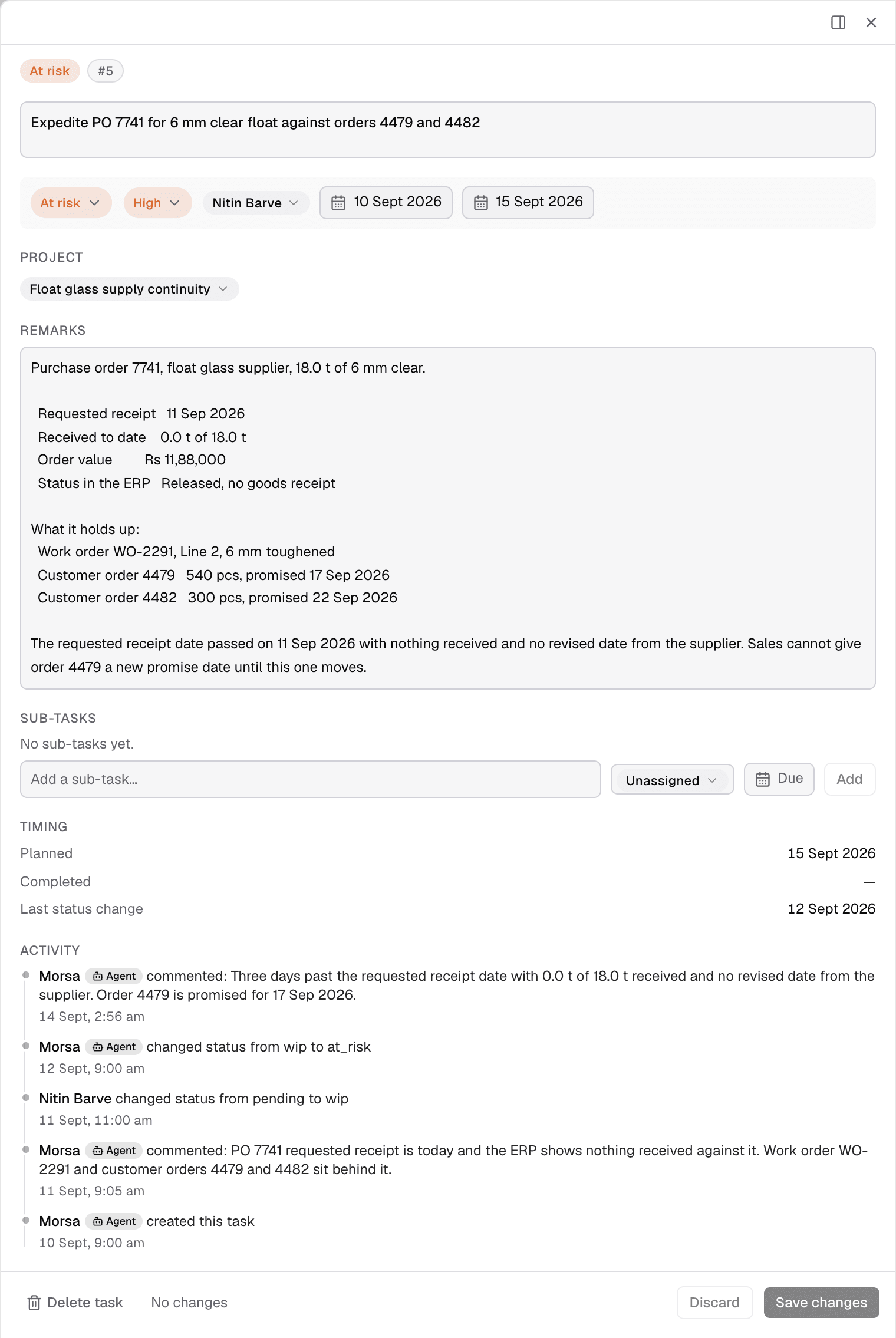
A purchasing commitment in Morsa, with the work order and customer orders behind it. Northline Glass, a demo plant.
What changes, from live plants:
A 120-person glass plant, onboarded in two days. On-time completion of operational commitments rose from about 30% to about 75% in the first four weeks, across about 900 commitments in the first month. Plant Head Sunil K Verma: “I used to spend the first hour of every morning reconstructing yesterday. Now the chasing happens in the WhatsApp groups my supervisors already use, whether or not I remember.” Production Head Anil Kohli: “Our people don’t have to learn any new software. People just message the way they always have. Morsa coordinates all the messages in the background.” The full account is in how a glass plant took on-time completion from 30% to 75% in four weeks.
JRG Automotive, running live. Morsa identified 5 of 8 production-stopping material shortages early enough to act, and saved the plant $2 million.
A night shift. Against an 8,000-part target, 4,131 parts were scheduled and 4,035 dispatched. Morsa connected the 96-piece shortage to its cause in under a minute, before the morning meeting.
If you are choosing an ERP this year, choose it for the plan and the money. Then decide, separately, who handles the day when the plan changes. That is the job Morsa does over any of the 12 systems on this page. See what an AI copilot for manufacturing actually does, or book a demo.
Sources
International Society of Automation, “ISA-95 Standard: Enterprise-Control System Integration.” https://www.isa.org/standards-and-publications/isa-standards/isa-95-standard
IBM, “What is Enterprise Resource Planning (ERP)?” https://www.ibm.com/think/topics/enterprise-resource-planning
Gartner, “Enterprise Resource Planning (ERP)” topic page, including the forecast that by 2027 more than 70 percent of recently implemented ERP initiatives will fail to fully meet their original business case goals and as many as 25 percent will fail catastrophically. The host blocks automated fetches; wording confirmed from an Internet Archive capture of 7 September 2026. https://www.gartner.com/en/information-technology/topics/enterprise-resource-planning
Gartner press release, “Gartner Predicts Embedded AI in Cloud ERP Applications will Drive a 30% Faster Financial Close by 2028,” February 24, 2026 (Mike Helsel quotes). Host bot-blocked; confirmed from an Internet Archive capture of 23 June 2026. https://www.gartner.com/en/newsroom/press-releases/2026-02-24-gartner-predicts-embedded-ai-in-cloud-erp-applications-will-drive-a-30-percent-faster-financial-close-by-2028
Panorama Consulting Group, “The 2026 ERP Report” (170 respondents, data collected January 2025 to January 2026, median revenue $200.5 million). https://4439340.fs1.hubspotusercontent-na1.net/hubfs/4439340/Reports/ERP%20Report/2026-erp-report-panorama-consulting-group.pdf
Panorama Consulting Group, “Panorama Consulting Group Releases Latest Study of ERP Implementation Outcomes,” March 4, 2026 (Chris Devault quote). https://www.panorama-consulting.com/panorama-consulting-group-releases-latest-study-of-erp-implementation-outcomes-across-the-globe/
Rockwell Automation, “93% of Manufacturers Have MES, But Only 23% Have Fully Integrated It,” press release for “Scaling MES Across the Enterprise,” July 14, 2026, 1,560 respondents in 17 countries (vendor research; Lorenzo Veronesi quote). https://www.rockwellautomation.com/en-us/company/news/press-releases/93-of-Manufacturers-Have-MES-But-Only-23-Have-Fully-Integrated-It-New-Rockwell-Automation-Report-Finds.html
IoT Analytics, “MES vendors replace pen, paper, and spreadsheets,” December 15, 2025. https://iot-analytics.com/mes-vendors-replace-pen-paper-spreadsheets/
Capterra, Shubham Gupta, “MRP software vs spreadsheets,” April 20, 2026, based on 1,848 buyer interactions, January 1, 2025 to January 1, 2026. https://www.capterra.com/resources/mrp-software-vs-spreadsheets/
National Association of Manufacturers, “Manufacturers’ Outlook Survey, First Quarter 2026,” March 12, 2026, 240 responses. https://nam.org/wp-content/uploads/securepdfs/2026/03/NAM_Q1_2026_Outlook_Write_Up.pdf
National Association of Manufacturers, “Manufacturers’ Outlook Survey, Third Quarter 2026,” September 14, 2026, 220 responses, fielded August 11 to 27, 2026. https://nam.org/wp-content/uploads/2026/09/Q3_2026_Writeup_Final.pdf
Institute for Supply Management, “Manufacturing PMI at 54.6%, August 2026,” via PR Newswire, September 1, 2026. https://www.prnewswire.com/news-releases/manufacturing-pmi-at-54-6-august-2026-ism-manufacturing-pmi-report-302865127.html
McKinsey & Company, Fernando Perez and Tyler Freeman, “Putting people first: A new imperative for manufacturing,” December 2024 (the one-third figure is asserted without a stated sample; host bot-blocked, confirmed from an Internet Archive capture of 12 May 2026). https://www.mckinsey.com/capabilities/operations/our-insights/operations-blog/putting-people-first-a-new-imperative-for-manufacturing (republished by the World Economic Forum, December 17, 2024: https://www.weforum.org/stories/2024/12/manufacturing-industrial-sites-talent/)
Microsoft Learn, “Sales Order Agent overview,” Dynamics 365 Business Central, updated July 2026. https://learn.microsoft.com/en-us/dynamics365/business-central/sales-order-agent
Microsoft Learn, “Run MPS and MRP,” Dynamics 365 Business Central, updated August 2025. https://learn.microsoft.com/en-us/dynamics365/business-central/production-how-to-run-mps-and-mrp
Microsoft Learn, “Manufacturing overview,” Dynamics 365 Business Central. https://learn.microsoft.com/en-us/dynamics365/business-central/production-manage-manufacturing
Microsoft Learn, “2026 release wave 1 plan, Dynamics 365 Business Central.” https://learn.microsoft.com/en-us/dynamics365/release-plan/2026wave1/smb/dynamics365-business-central/
Microsoft, Dynamics 365 Business Central pricing, read September 19, 2026. https://www.microsoft.com/en-us/dynamics-365/products/business-central/pricing
NetSuite, “Solving Manufacturing Complexity with NetSuite Work Orders & Assemblies, WIPs & Routings and Advanced Manufacturing,” October 13, 2021. Host bot-blocked; confirmed from an Internet Archive capture of 21 April 2026. https://www.netsuite.com/portal/resource/articles/erp/solving-manufacturing-complexity-with-netsuite-work-orders-assemblies-wips-routings-and-advanced-manufacturing.shtml
Oracle, “NetSuite Unveils NetSuite Next,” October 7, 2025. https://www.oracle.com/apac/news/announcement/sw25-netsuite-launches-netsuite-next-2025-10-07/
Futurum Group, “Epicor Prism Launches: A Major Shift for Supply Chain AI Integration,” August 6, 2026. https://futurumgroup.com/insights/epicor-prism-launches-a-major-shift-for-supply-chain-ai-integration/
IndustryWeek, Dennis Scimeca, “Switching from ERP to MES Drives Improvement for Plastics Manufacturer,” December 15, 2023 (Patrick Austin quote). https://www.industryweek.com/technology-and-iiot/digital-tools/article/21279333/switching-from-erp-to-mes-drives-improvement-for-plastics-manufacturer
Modern Machine Shop, Eli Plaskett, “Machine Monitoring Integrates With ERP to Reduce Errors,” March 24, 2025 (Jessica Covington quotes). https://www.mmsonline.com/articles/machine-monitoring-integrates-with-erp-to-reduce-errors
Modern Machine Shop, Evan Doran, “Aerospace Shop Thrives with Five-Axis, AI and a New ERP,” June 20, 2025 (Johnny Goode, MSP Manufacturing). https://www.mmsonline.com/articles/aerospace-shop-thrives-with-five-axis-ai-and-a-new-erp
Modern Machine Shop, Evan Doran, “Charting the Course Through Schedule Drift,” September 8, 2026. https://www.mmsonline.com/articles/charting-the-course-through-schedule-drift
r/manufacturing, “Anyone here using an ERP that actually works well for manufacturing?”, November 19, 2025, 177 comments; lines re-read through the Reddit API on September 19, 2026. https://www.reddit.com/r/manufacturing/comments/1p17fxp/anyone_here_using_an_erp_that_actually_works_well/
Vendor pages read September 12, 2026 and re-read September 19, 2026 where the host allowed it, linked inline where cited: Epicor Kinetic (host blocks re-checks; Internet Archive capture of August 23, 2026); Infor CloudSuite Industrial; Acumatica manufacturing management, advanced planning and scheduling, pricing, 2026 R1 and Vista press release; SAP Business One road map, March 2026 (PDF); Global Shop Solutions planning and scheduling; Plex homepage and MES; ECI JobBOSS² product and pricing; ProShop ERP; Odoo manufacturing, pricing (re-read September 19, 2026, prices changed) and Odoo 19 release notes; MRPeasy manufacturing software and pricing (re-read September 19, 2026, unchanged); Microsoft Business Central pricing (re-read September 19, 2026, unchanged).
Software Advice vendor profiles read September 12, 2026, linked inline where cited: Epicor Kinetic, SyteLine, Acumatica, Dynamics 365 Business Central, SAP Business One, NetSuite, Global Shop Solutions, Plex, JobBOSS², ProShop, Odoo and MRPeasy. Review counts drift daily; the figures on this page are as read that day.
Changelog
24 September 2026: corrected Odoo’s prices. The $31.10 Standard figure printed from 20 September (from a $38.90 list) is Odoo’s monthly-billing price; billed yearly, Standard is $24.90 per user per month ($31.10 list) and Custom $49.00 ($61.00 list). Added Acumatica’s published starting price for APEX for Manufacturing, under $2,185 a month.
20 September 2026: added two sections, “What goes wrong in manufacturing ERP projects?” (Panorama, Gartner, Chris Devault, Patrick Austin, Johnny Goode, Jessica Covington) and “How many plants actually run the floor from their ERP?” (Rockwell Automation July 2026, IDC’s Lorenzo Veronesi, IoT Analytics).
20 September 2026: replaced NAM’s second-quarter figures with the third-quarter survey published 14 September 2026, dated the first-quarter volatility figure to February 2026, and added ISM’s August 2026 Supplier Deliveries reading.
20 September 2026: added named quotations from Jessica Covington (Machine Specialties Inc.), Johnny Goode (MSP Manufacturing), Chris Devault (Panorama), Lorenzo Veronesi (IDC), Mike Helsel (Gartner), Anil Kohli and Sunil K Verma (J4S), and a schedule-drift example from Modern Machine Shop.
20 September 2026: re-read every r/manufacturing line against the thread; corrected the Epicor “in the middle” attribution (a reply, not the original poster), the Global Shop Solutions line (one commenter, not two), and the NetSuite plant’s details (400 customers, 3,000 part numbers, the routing-step point made in a reply).
20 September 2026: swapped the Gartner ERP definition for IBM’s fetchable one, qualified the Business Central Sales Order Agent point with its capable-to-promise option, labeled the McKinsey supervisor figure as asserted without a sample, and noted which vendor hosts block re-checks.
20 September 2026: rephrased every section heading as a buyer’s question, added the Rockwell integration figure to the introduction, added the changelog and dateModified.

