AI in supply chain is the use of predictive models, language models, and software agents to plan, watch, and adjust the flow of materials from suppliers to customers. Today it predicts demand, spots disruption early, recommends what to do, and increasingly carries out routine actions inside ERP (enterprise resource planning), planning, and messaging systems. For a plant, it comes down to three moments: a supplier date moves, material runs short on the floor, or inventory cover drops. Adoption is narrower than the headlines: in the US Census Bureau’s latest count, 23.2% of businesses used AI somewhere in the previous two weeks, but only 2.6% had used it in sourcing, supply chains and purchasing over six months. AI does not run a supply chain by itself, and it fails wherever the data it reads is wrong or missing.
In this guide
What is AI in supply chain, from a plant’s point of view?
What is AI supply chain planning, and what does it mean for a plant?
What does AI do when a supplier date moves?
What does AI do when material runs short on the floor?
What does AI do when inventory cover drops?
How is AI used across the supply chain, by function?
What results are companies actually seeing?
What can AI not do in a supply chain?
Will AI replace supply chain management?
How do you start with AI in your supply chain?
What does Morsa do when a supplier is late that the ERP cannot?
FAQ, Sources, Changelog, Related pages
What is AI in supply chain, from a plant’s point of view?
AI in supply chain is software that makes or supports supply chain decisions by learning from data instead of following fixed rules written by a person, and from a plant’s point of view it is judged by one thing: whether the plant knows about a change before the line does. A supply chain is the chain of decisions that turns a customer order into a shipped product: what to buy, from whom, how much to hold, when to make it, and how to move it. Most of that chain happens outside the plant. The part that stops a shift happens inside it.
That is the honest definition. The marketing definition (“autonomous, self-healing supply chains”) describes almost no plant in North America today. The US Census Bureau’s Business Trends and Outlook Survey asks businesses whether they used AI in any business function in the previous two weeks. For the two weeks ending 6 September 2026, 23.2% said yes, and manufacturers were at 23.4%, up from 12.7% in late November 2025 (US Census Bureau, BTOS). The Bureau’s six-month AI supplement, pooled across its 1.2 million business sample from November 2025 to February 2026, found only 2.6% of businesses, and 3.4% of manufacturers, had used AI in “sourcing, supply chains, and purchasing,” against 14.3% in sales and marketing (US Census Bureau, BTOS AI supplement, April 2026). Adoption is real and rising. In the supply chain specifically, it is still single digits.
Three kinds of AI show up in supply chain software, and they fail in different ways.
Predictive (machine learning)
What it does: Learns patterns in history and projects them forward: demand by item and week, lead-time drift, the chance a shipment is late
Where a plant meets it: Demand planning, safety stock, transportation ETAs, predictive maintenance
Where it breaks: Anything with no history: a new product, a tariff shock, a pandemic
Generative (language models)
What it does: Reads and writes text: summarizes supplier emails, drafts purchase orders and expedites, answers questions about stock
Where a plant meets it: Copilots in ERP and planning tools, procurement assistants, chat with your data
Where it breaks: Confident wrong answers when the underlying record is wrong or missing
Agentic (software agents)
What it does: Takes actions across systems within rules: opens a work order, moves a date, messages the owner, checks the result
Where a plant meets it: Coordination and follow-through, exception handling, order and expedite workflows
Where it breaks: Acting on bad context, acting without approval, and “agent washing” of ordinary automation
Gartner’s June 2026 list of supply chain technology trends names agentic AI, collaborative multiagent systems, domain-specific language models and physical AI next to “decision governance,” which it describes as “frameworks and guardrails to govern AI-enabled decision making.” Christian Titze, VP Analyst in Gartner’s Supply Chain practice: “leaders must focus not only on deploying advanced technologies, but also on ensuring they work together to deliver measurable value and long-term resilience” (Gartner, June 30, 2026; the host blocks automated fetches, wording confirmed from an Internet Archive capture).
THREE KINDS OF AI
Three kinds of AI, and the way each one fails
Vendors use one word for all three. A plant buys them for different jobs and should judge them by different failures.
01 · MACHINE LEARNING
Predictive
What it does: Learns patterns in history and projects them forward: demand by item and week, lead-time drift, late-shipment risk. Where you meet it: Demand planning, safety stock, transportation ETAs, predictive maintenance.
WHERE IT BREAKS
Anything with no history: a new product, a tariff shock, a pandemic.
02 · LANGUAGE MODELS
Generative
What it does: Reads and writes text: summarizes supplier emails, drafts purchase orders and expedites, answers questions about stock. Where you meet it: Copilots in ERP and planning tools, procurement assistants, chat with your data.
WHERE IT BREAKS
Confident wrong answers when the underlying record is wrong or missing.
03 · SOFTWARE AGENTS
Agentic
What it does: Perceives, decides, and takes actions across systems to reach a goal, inside rules a person sets and reviews. Where you meet it: Expedite and exception workflows, coordination across systems and people.
WHERE IT BREAKS
Bad context, no approval step, and “agent washing” of ordinary automation.
Agentic AI as Gartner defines it, June 2025. The failure modes are the ones a plant meets.
What is AI supply chain planning, and what does it mean for a plant?
AI supply chain planning is the use of predictive models inside the planning process to forecast demand, set inventory targets, and balance supply against capacity, with people approving the plan. For a plant it means one thing above all: planning against a reality that moves, because the forecast that reaches the floor is out of date by the first supplier email. IBM defines supply chain planning as “the process of managing and optimizing the flow of goods and services from supplier to customer,” and notes that demand planning “analyzes historical sales data, seasonal patterns, economic indicators and market trends to estimate future demand” (IBM, March 2026). AI changes the middle of that sentence: the model holds more variables, refreshes more often, and flags the forecasts that are drifting so a planner looks at those first.
Three planning layers get AI first. Demand planning, where the model forecasts by item, location and week. Inventory planning, where it sets reorder points and safety stock from the forecast, lead-time drift and a service target. And sales and operations planning, where it runs scenarios so the monthly consensus is built on numbers rather than opinions. One documented result: Hitachi Vantara’s plant in Norman, Oklahoma, named a World Economic Forum Lighthouse in July 2026, reports that applying agentic AI to global demand forecasting and inventory management improved forecast accuracy “by approximately 19%” and cut global inventory “by approximately 50%” (Hitachi, July 15, 2026; company-reported figures). The network planning vendors, Kinaxis, o9 and the ERP suites, sell that layer, and this page is not about choosing between them.
The plant’s problem starts where their plan ends. A better forecast still becomes a production schedule, and Modern Machine Shop’s name for what happens next is schedule drift, “how reality on the shop floor differs from the scheduled plan”; it reports one Florida shop whose on-time delivery slipped to 70% during a run of expedited orders (Modern Machine Shop, September 2026). AI supply chain planning, for a plant, is the loop that re-plans when the plan meets the floor: read the change, work out which work orders and customers it touches, re-sequence within approved rules, and confirm it happened. The tools that make the schedule, and what each does when it changes, are compared in production planning software.
What does AI do when a supplier date moves?
When a supplier date moves, AI can read the message, match it to the open purchase orders and work orders it touches, and route the consequence to the people who fix it; what it cannot do is make the parts arrive. Supplier lateness is measured, and it is rising. The Institute for Supply Management’s August 2026 report put the Supplier Deliveries Index at 59.3%, “slowing performance for the ninth month in a row,” while the Prices Index sat at 71.1% (ISM via PR Newswire, September 2026). In the National Association of Manufacturers’ third-quarter 2026 survey of 220 manufacturers, 44.6% named supply chain challenges among their biggest problems, 52.1% named transportation and logistics costs, and 33.2% said input and sourcing challenges had worsened in the quarter (NAM, September 2026).
Three kinds of software meet the moment. Supplier-risk tools watch the outside world and raise a flag: Microsoft’s copilot for Dynamics 365 Supply Chain Management flags “weather, financial, and geo-political news that may impact key supply chain processes” and drafts the email asking for a revised date (Microsoft, March 2023). Procurement tools handle the tail: Walmart “can’t possibly conduct focused negotiations with all of its 100,000-plus suppliers,” so it uses a negotiation bot for the roughly 20% on cookie-cutter terms (HBR, November 2022). And coordination tools, the newest kind, read the “sorry, Thursday now” message where it lands and connect it to the line.
The handoff is the whole question. Johnny Goode, owner and president of MSP Manufacturing, an aerospace job shop in Bloomington, Indiana, attributes most of the 3% of his orders that ship late to supplier delays, and told Modern Machine Shop his rule for customers: “bad news up front is better than bad news the day the part’s supposed to be there” (Modern Machine Shop, June 2025). A flag is only as accurate as your supplier master and open-PO list, and an alert is not a resolution. Someone still has to find an alternate, re-plan the line, and tell the customer. The tools for the supplier side are compared in supplier management software. The worked money math is on AI for supplier delays. Wholesale distributors face the same late supplier POs; the workflow-by-workflow view is in AI for distributors.
What does AI do when material runs short on the floor?
When material runs short on the floor, the useful AI is the kind that connects the shortage to the work order, shift, customer and owner it affects before the line stops, because the three systems that know about it do not talk to each other. The ERP knows the purchase order is open. The MES (manufacturing execution system) knows the work order is scheduled. The supplier’s message lives in a chat thread with a buyer. Nobody connects the three until the line stops. Most guides to AI in supply chain stop at the receiving dock; of the ten pages Google ranked for this topic when this one was written, none followed a late shipment inside the plant.
Here is what connecting them looks like, from a night shift at a Morsa customer plant (Morsa customer data). The target was 8,000 parts. The plan scheduled 4,131 for the shift, dispatch showed 4,035, and the 96-piece gap was tied to its cause and its owner in under a minute instead of at the morning meeting. That is not a forecasting problem. It is a coordination problem, the shape a supplier delay takes once it is inside the plant. The base rate matters too: at JRG Automotive, running Morsa live, the system identified 5 of 8 production-stopping material shortages early enough to act, and the other 3 got through.
The signal is mostly conversation, which is why software that only reads the systems misses it. Yung Fung, Managing Director and General Manager of Advanced Industrial Technology and Platforms at Ford, said at an MIT event in May 2026 that “the secret sauce for any plant” is “the conversations that go to problem solve and understand and triangulate the context,” and that it “goes into the ether,” because “it’s not captured in a database, it’s not captured in a report” (Manufacturing Dive, May 2026). The shortage case in full, from the first message to the closed job, is the subject of AI for material shortages in manufacturing. The factory-floor uses of AI beyond shortages are in AI in manufacturing.
THE PLANT SIDE
Where a late supplier becomes a production problem
Most guides stop at the receiving dock. Inside the plant the same message becomes a work order, a shift, and a customer promise.
OUTSIDE THE PLANT
Supplier, 11:00 AM
“400 valves are Thursday now.” One WhatsApp message to one buyer.
INSIDE THE PLANT
ERP
The purchase order is still open, due Tuesday. The record does not know.
INSIDE THE PLANT
MES
The work order for 1,000 pumps is still scheduled for Wednesday.
INSIDE THE PLANT
Line 3, night shift
Finds the shortage at 2 a.m. Runs the wrong job, or stops.
INSIDE THE PLANT
Customer
Friday’s shipment slips. Nobody has told the customer yet.
Receiving dock: where most guides stop.
WHAT CLOSING THE GAP LOOKS LIKE, THE SAME MORNING
Signal, context, consequence, decision, execution, verification
01
Signal
Supplier message and open PO read together.
02
Context
Valve, WO 2210, line 3, Wednesday. Owner: purchasing.
03
Consequence
Wednesday’s build 400 pumps short. Friday’s shipment at risk.
04
Decision
Expedite now. Propose a re-sequence, which needs approval.
05
Execution
Purchasing chased, planner re-sequenced, customer told a date.
06
Verification
Closed when the valves arrive, not when someone types done.
What does AI do when inventory cover drops?
When inventory cover drops, AI re-computes reorder points and safety stock from the forecast, the lead time and the service level you want, and predicts the stock-out before it happens, which turns a fire drill into a planned expedite. That is a real improvement over the once-a-year parameter review most ERPs get. A 2025 systematic review in Frontiers in Artificial Intelligence found that AI-powered systems “provide precise prediction of demand, optimisation of inventory, and greater visibility of the supply chain” (Frontiers in AI, January 2025). Hitachi’s Norman plant reports that “using AI to calculate the optimal safety stock level for each part” cut global inventory by about half “while mitigating the risk of stockouts” (Hitachi, July 2026; company-reported).
The limit is the one every plant manager knows: the system’s inventory and the shelf’s inventory are not the same number. If cycle counts are loose, every recommendation built on them is wrong in the same direction. The symptom on the floor is the ERP saying a part is in stock while the picker cannot find it, which stops more jobs than most buyers expect because the ERP still shows the material as available. Fix inventory accuracy first, then optimize. Where the record itself is the problem, the systems that hold it are compared in manufacturing ERP software.
How is AI used across the supply chain, by function?
AI is used by function, because a plant buys and measures by function. Each row below has a documented example and a limit you should know before you buy. Distributors use the same technology on the sell side, for AI order entry and AI quoting.
Demand forecasting and planning
What AI does today: Predicts demand by item, location, and week; flags items where the forecast is drifting
What it has to read: Order history, promotions, seasonality, external signals
Documented example: A 2025 systematic review found that AI integration “significantly improves” supply chain management by improving demand forecasting and inventory management (Frontiers in AI, Jan 2025)
Known limit: Shocks with no history; forecast quality caps at data quality
Procurement and sourcing
What AI does today: Negotiates tail-spend terms, drafts purchase orders (POs) and supplier outreach, scores quotes
What it has to read: Contracts, price history, supplier master data, email
Documented example: Walmart’s negotiation bot for the roughly 20% of its 100,000-plus suppliers on cookie-cutter terms (HBR, Nov 2022)
Known limit: Works on high-volume, low-stakes terms; strategic suppliers still need people
Supplier risk and monitoring
What AI does today: Watches news, weather, financials, and geography for events that touch your suppliers; drafts the outreach
What it has to read: Supplier master, open POs, external news feeds
Documented example: Copilot in Dynamics 365 Supply Chain Management flags “weather, financial, and geo-political news that may impact key supply chain processes” (Microsoft, Mar 2023)
Known limit: Only as good as your supplier and PO data; an alert is not a fix
Inventory optimization
What AI does today: Sets reorder points and safety stock per item; flags stock-outs before they happen
What it has to read: Inventory transactions, lead times, forecast, service targets
Documented example: Hitachi Norman: global inventory down about 50% through AI-set safety stock (Hitachi, Jul 2026, company-reported)
Known limit: Inventory records that are wrong at the bin make every recommendation wrong
Logistics and transportation
What AI does today: Routes and loads vehicles, predicts ETAs, automates customs paperwork
What it has to read: Orders, addresses, fleet data, carrier feeds, documents
Documented example: Walmart “avoided 94 million pounds of CO2 by eliminating 30 million unnecessary miles driven,” a cumulative figure with no period stated (Walmart, Mar 2024); Blue Yonder says DHL “saves 7% on transportation costs” with its network design tool, a vendor claim (Blue Yonder); WNS reports a “40 percent improvement in TAT” on customs declarations for Metro Shipping, a vendor case (WNS, Aug 2023)
Known limit: Gains are large for fleets and networks; a single plant sees them through its carriers
Production: the plant side
What AI does today: Connects a late supplier or a short pick to the work order, line, shift, and customer it affects, then chases the fix
What it has to read: ERP, MES, CMMS (maintenance), QMS (quality), and the messages where the plant actually talks
Documented example: Morsa at a night shift: an 8,000-part target, 4,131 scheduled against 4,035 dispatched, the 96-piece shortage connected to its cause in under a minute (Morsa customer data)
Known limit: Needs access to the messages, not only the systems; must verify on proof, not on “done”
What results are companies actually seeing?
Adoption and pressure are both up, documented wins are real, and most projects still do not get there. Most pages on this topic publish only the first half.
The first half. US business AI use reached 23.2% for the two weeks ending 6 September 2026 by the Census Bureau’s count. The New York Fed’s Global Supply Chain Pressure Index read 1.06 in August 2026, its latest reading, down from 1.85 in April and 1.83 in May 2026 and still above every month of 2025, whose high was 0.58 in December (Federal Reserve Bank of New York, GSCPI; the Fed notes the index “is being published with limited data” since November 2025). Pressure that high is why the demand for tools is real. On the plant side, Deloitte’s 2026 outlook cites a Manufacturing Leadership Council survey from early 2025 in which 9% of manufacturers use physical AI today and 22% plan to within two years, and Deloitte’s own survey of 600 executives in which 80% “plan to invest 20% or more of their improvement budgets in smart manufacturing initiatives” (Deloitte, Nov 2025).
The second half. MIT’s Project NANDA report, “The GenAI Divide: State of AI in Business 2025,” found that “about 5% of AI pilot programs achieve rapid revenue acceleration; the vast majority stall,” based on an analysis of 300 public AI deployments, as Fortune reported it (Fortune, Aug 2025). The reason the authors give is a “learning gap,” not model quality. Gartner predicts that “over 40% of agentic AI projects will be canceled by the end of 2027, due to escalating costs, unclear business value or inadequate risk controls,” and estimates “only about 130 of the thousands of agentic AI vendors are real”; its January 2025 poll of 3,412 webinar attendees found 19% had made significant investments in agentic AI and 42% conservative ones (Gartner, June 2025; host bot-blocked, confirmed from an Internet Archive capture).
AI IN SUPPLY CHAIN, 2026, FOUR NUMBERS
Adoption is real. Pressure is high. Most projects still stall.
Two numbers on adoption and pressure. Two on where projects die.
23.2%
of US businesses used AI in the two weeks ending 6 September 2026
US Census Bureau, BTOS
1.06
Global Supply Chain Pressure Index, August 2026, above all of 2025
Federal Reserve Bank of New York
40%
or more of agentic AI projects will be canceled by the end of 2027
Gartner, June 2025
5%
of enterprise AI pilots reach rapid revenue acceleration
MIT NANDA, via Fortune, August 2025
Full citations in the guide.
The same MIT report found that “purchasing AI tools from specialized vendors and building partnerships succeed about 67% of the time, while internal builds succeed only one-third as often.” If you are a plant, not a software company, that number should shape your first decision.
What can AI not do in a supply chain?
AI cannot fix bad data, predict what has never happened, or resolve a disruption by itself, and it cannot see the messages where most supplier news actually arrives. Read this section before you read any vendor’s page, including ours.
It cannot fix bad data. It amplifies it. A forecast built on a wrong item master, a reorder point built on a loose cycle count, a supplier alert built on the wrong source plant: each is confidently wrong. Srinivas Chippagiri, a Senior Member of Technical Staff at Tableau (a Salesforce company, so a vendor voice), put it this way to Manufacturing Dive: “The biggest pitfall is trusting probabilistic output in a system people treat as authoritative” (Manufacturing Dive, September 14, 2026).
It cannot predict what has never happened. Predictive models project history. A tariff change, a new customer, or a supplier bankruptcy has no pattern to learn until it is already hurting you.
It cannot resolve a disruption by itself. An alert says “this shipment will be late.” The resolution is a re-sequenced line, an alternate supplier, an honest date to the customer, and someone checking that each of those actually happened. Most tools stop at the alert.
It cannot see the messages. In most plants the real state of a supplier order lives in a chat thread or an email, not in the ERP. AI that only reads the systems is reading a stale copy of reality.
It cannot replace a relationship on a strategic part. Negotiation bots work on the tail. The three suppliers your plant cannot run without still need a buyer who knows them.
It will not tell you it is uncertain unless it is built to. Language models produce fluent text whether or not the underlying record exists. Any AI that acts in your supply chain needs a rule for when to ask a person instead of proceeding.
Even a system built for the plant misses things. The 5 of 8 shortages caught at JRG Automotive, and the 3 that got through, are the kind of base rate to ask any vendor for, including us.
Will AI replace supply chain management?
No. It is replacing a specific kind of work inside supply chain management: the reading, matching, chasing, and re-checking that fills a planner’s or buyer’s day. Gartner predicts “at least 15% of day-to-day work decisions will be made autonomously through agentic AI by 2028, up from 0% in 2024” (Gartner, June 2025). Deloitte expects “more than 81% of task hours in manufacturing” to remain human-driven (Deloitte, Nov 2025). That is a large change to how the job feels and a small change to who is accountable.
Erik Syrjanen, senior vice president of supply chain at Briggs and Stratton, described the shift at IMTS in September 2026: “We have employees spending far too much time focusing on data analysis,” and those people “are going to [eventually] be focused on ‘What do I do with the information?‘” (Manufacturing Dive, September 17, 2026). What stays with people: setting the service level, deciding which customer gets the short lot, choosing the supplier you will bet the quarter on, and owning the outcome when the model is wrong. What moves to software: noticing the drift, connecting the dots across systems, drafting the message, following up, and confirming the fix landed. The chasing moves. The judgment, and the accountability for it, stays.
How do you start with AI in your supply chain?
Start with one recurring failure that has a dollar figure, because Gartner’s three cancellation reasons, escalating costs, unclear business value, and inadequate risk controls, are usually decided before the software arrives: wrong problem, wrong data, no owner.
Pick one recurring failure with a dollar figure. Not “improve visibility.” Something like “we discover material shortages at the morning meeting, and each one costs a shift.” If you cannot name the failure and its cost, you are not ready to buy.
Audit the data that failure depends on. For shortages that is inventory accuracy, open-PO dates, and the messages where suppliers actually confirm. If the records are wrong, fix the records first.
Match the kind of AI to the job. Anushree Verma, Senior Director Analyst at Gartner, gives the rule: “start by using AI agents when decisions are needed, automation for routine workflows and assistants for simple retrieval” (Gartner, June 2025). Most “agentic” pitches are one of the other two.
Buy before you build, unless you are a software company. MIT’s finding that purchased, specialized tools succeed about 67% of the time and internal builds one-third as often is the strongest evidence on this question. Ask a vendor which of your systems it reads, which actions it takes, and what it does when unsure.
Run it in shadow mode first. Let the system read everything and recommend, and let people act. Compare what it would have done to what happened. Two to four weeks of this tells you more than any demo.
Measure one number and let it earn the next workflow. On-time completion of commitments, shortages caught before the shift, hours of chasing removed. When the number moves, add the next line. Kathie Mahoney, President of MassMEP, a NIST Manufacturing Extension Partnership center, describes where mid-size plants actually are: “It’s a lot of they don’t know what they don’t know. It’s how do we implement the technologies in the most efficient way for each facility, and it may not be the same for every facility” (Manufacturing Dive, September 9, 2026).
A six-question checklist before any AI purchase for the supply chain
Which recurring failure does this fix, and what does that failure cost per month?
Which of our systems and message channels does it read, and which does it write to?
What does it do when the data it needs is missing or contradictory?
Which actions can it take without a person approving, and who sets that rule?
How does it confirm an action actually happened, rather than that someone said “done”?
What is the one metric we will judge it by in week four?
If you are weighing the wider set of plant systems that would feed an AI, the manufacturing management software guide compares fourteen of them with prices, and manufacturing software: the 12 types maps which system owns which record.
What does Morsa do when a supplier is late that the ERP cannot?
Morsa, the AI that operates the factory for you, works on the part of the supply chain the other tools leave open: the gap between the plan and what actually happens on the floor when a supplier, a machine, or a person does not deliver. It does not forecast demand and it does not replace the ERP, the MES, or the planning tool.
Concretely:
What it reads. The ERP (SAP Business One, Dynamics 365 Business Central, Odoo, and others), the MES, the maintenance (CMMS), quality (QMS), and warehouse (WMS) systems, and the channels where the plant talks, whatever they are. WhatsApp, Teams, email and SMS are examples, not the list, and any system with an API, a database, a file export, a message stream or an email trail can be connected, machines and sensors included. The supplier’s “Thursday now” message and the open PO are read together.
What it works out. Which part, which work order, which line, which shift, which customer, and which person owns the next step. Then the consequence: what a two-day slip on this part does to this week’s dispatch.
What it decides. Within rules the plant approved. A routine expedite and a re-sequence proposal are different tiers, and the plant sets which tier needs a person.
What it does. Routes the work to the owner in the channel they already use, follows up when a date passes, and escalates when it is ignored. It does not mark anything done because someone typed “done.”
What the plant sees. In the groups it already uses, the chase itself: who owns what, by when, and what is late. On one board, plan versus reality by line and shift, open commitments and who holds them, supplier and internal reliability over time, and the shortages caught before they stopped a line.
What changes. At a 120-person glass plant, onboarded in two days, on-time completion of operational commitments rose from about 30% to about 75% in the first four weeks, across about 900 commitments in the first month. Plant Head Sunil K Verma: “I used to spend the first hour of every morning reconstructing yesterday. Now the chasing happens in the WhatsApp groups my supervisors already use, whether or not I remember.” Production Head Anil Kohli: “Our people don’t have to learn any new software. People just message the way they always have. Morsa coordinates all the messages in the background.” The full account is in how a glass plant took on-time completion from 30% to 75% in four weeks.
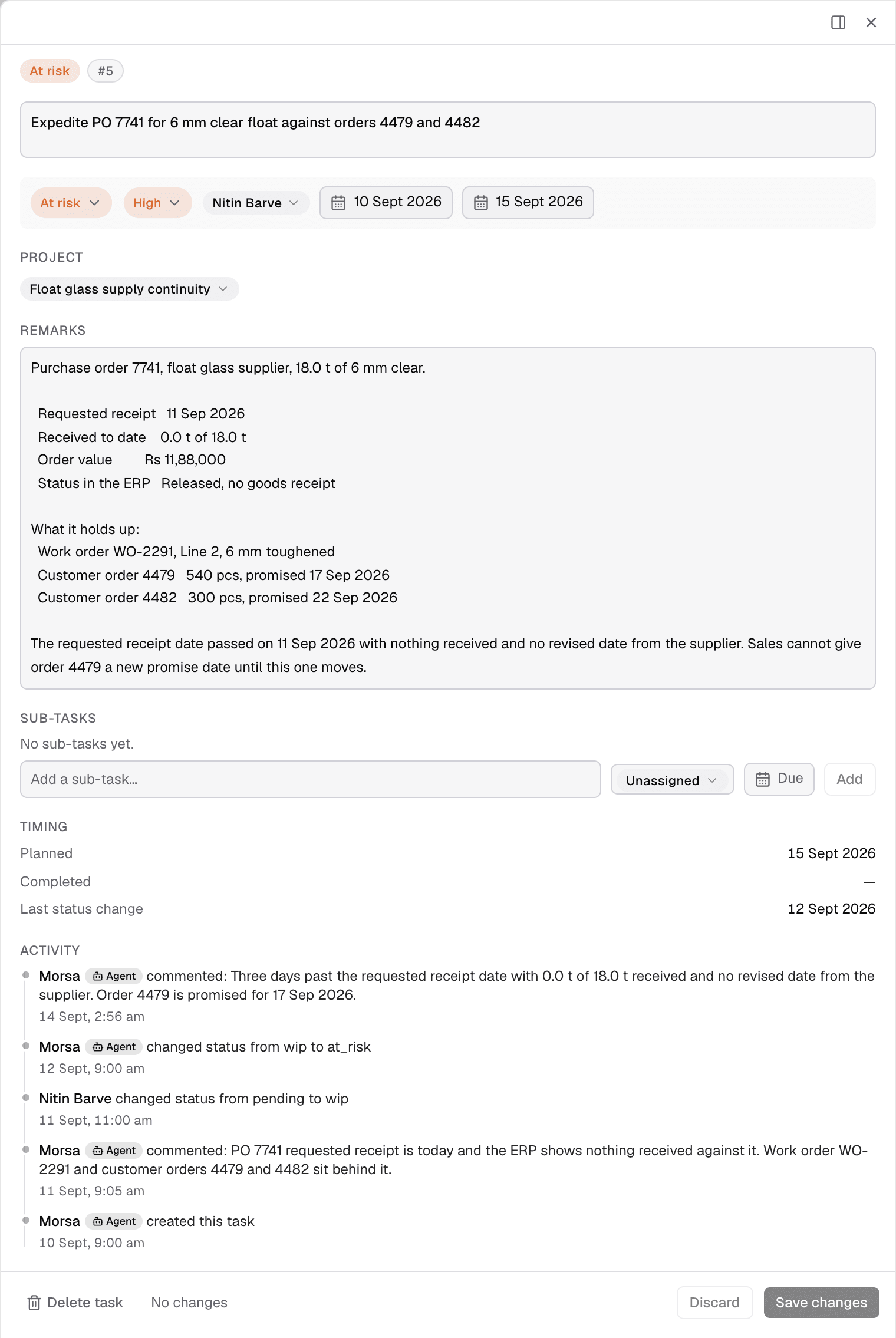
A late supplier order and the commitments behind it. Northline Glass, a demo plant.
Deployment is cloud, private cloud, or fully on-premise including the AI models and databases, in four steps: Connect, Configure, Shadow, Live. Pilots start on one line or one workflow, which is the same advice given above for any AI in the supply chain. Read how the loop works end to end on the AI copilot for manufacturing page, or book a demo.
Sources
US Census Bureau, Business Trends and Outlook Survey, question “In the last two weeks, did this business use Artificial Intelligence (AI) in any of its business functions?”, period 202618 (reference weeks August 24 to September 6, 2026; published September 10, 2026), national and manufacturing series; and the BTOS AI supplement published April 23, 2026 (six-month function use, pooled sample of 1.2 million businesses, November 17, 2025 to February 8, 2026). Figures read from the data files the BTOS page loads. https://www.census.gov/hfp/btos/
Federal Reserve Bank of New York, Global Supply Chain Pressure Index, monthly data through August 2026, with the limited-data notice of November 6, 2025. https://www.newyorkfed.org/research/policy/gscpi
Gartner, “Gartner Identifies Top Supply Chain Technology Trends for 2026,” press release, June 30, 2026 (Christian Titze quotes). Host blocks automated fetches; wording confirmed from an Internet Archive capture. https://www.gartner.com/en/newsroom/press-releases/2026-06-30-gartner-identifies-top-supply-chain-technology-trends-for-2026
Gartner, “Gartner Predicts Over 40% of Agentic AI Projects Will Be Canceled by End of 2027,” press release, June 25, 2025 (Anushree Verma quotes; January 2025 poll of 3,412 webinar attendees). Host blocks automated fetches; wording confirmed from an Internet Archive capture. https://www.gartner.com/en/newsroom/press-releases/2025-06-25-gartner-predicts-over-40-percent-of-agentic-ai-projects-will-be-canceled-by-end-of-2027
Deloitte, “2026 Manufacturing Industry Outlook,” November 13, 2025, 600 executives; the physical AI figures are from a Manufacturing Leadership Council survey of early 2025 cited within it. https://www.deloitte.com/us/en/insights/industry/manufacturing-industrial-products/manufacturing-industry-outlook.html
MIT Project NANDA, “The GenAI Divide: State of AI in Business 2025,” as reported by Fortune, August 18, 2025. https://fortune.com/2025/08/18/mit-report-95-percent-generative-ai-pilots-at-companies-failing-cfo/
Samuels, A., “Examining the integration of artificial intelligence in supply chain management from Industry 4.0 to 6.0: a systematic literature review,” Frontiers in Artificial Intelligence, January 20, 2025. https://pmc.ncbi.nlm.nih.gov/articles/PMC11788849/
IBM, Amanda McGrath and Ian Smalley, “What is supply chain planning?”, March 13, 2026. https://www.ibm.com/think/topics/supply-chain-planning
Hitachi, “A Hitachi Group site selected as Global Lighthouse Factory by the World Economic Forum,” July 15, 2026 (company-reported figures). https://www.hitachi.com/en/press/articles/2026/07/0715/
Modern Machine Shop, Evan Doran, “Charting the Course Through Schedule Drift,” September 8, 2026. https://www.mmsonline.com/articles/charting-the-course-through-schedule-drift
Institute for Supply Management, “Manufacturing PMI at 54.6%, August 2026,” via PR Newswire, September 1, 2026. https://www.prnewswire.com/news-releases/manufacturing-pmi-at-54-6-august-2026-ism-manufacturing-pmi-report-302865127.html
National Association of Manufacturers, “Manufacturers’ Outlook Survey, Third Quarter 2026,” September 14, 2026, 220 responses, fielded August 11 to 27, 2026. https://nam.org/wp-content/uploads/2026/09/Q3_2026_Writeup_Final.pdf
Walmart, “Walmart Commerce Technologies Launches AI-Powered Logistics Product,” March 14, 2024. https://corporate.walmart.com/news/2024/03/14/walmart-commerce-technologies-launches-ai-powered-logistics-product
Microsoft, “Introducing Microsoft Dynamics 365 Copilot,” March 6, 2023. https://www.microsoft.com/en-us/dynamics-365/blog/business-leader/2023/03/06/introducing-microsoft-dynamics-365-copilot/
Harvard Business Review, Van Hoek, DeWitt, Lacity and Johnson, “How Walmart Automated Supplier Negotiations,” November 8, 2022. https://hbr.org/2022/11/how-walmart-automated-supplier-negotiations
Modern Machine Shop, Evan Doran, “Aerospace Shop Thrives with Five-Axis, AI and a New ERP,” June 20, 2025 (Johnny Goode). https://www.mmsonline.com/articles/aerospace-shop-thrives-with-five-axis-ai-and-a-new-erp
Manufacturing Dive, Cole Rosengren, “MIT manufacturing event: Ford, Amgen, GE, ArcelorMittal on data and automation,” May 22, 2026 (Yung Fung). https://www.manufacturingdive.com/news/mit-manufacturing-data-automation-ford-amgen-ge-arcelormittal/820681/
Manufacturing Dive, Sakshi Udavant, “Advances in AI, ERP systems,” September 14, 2026 (Srinivas Chippagiri, Tableau; vendor voice). https://www.manufacturingdive.com/news/advances-ai-erp-systems-manufacturing-automation/829448/
Manufacturing Dive, Nathan Owens, “‘We’re going to stop talking about AI,‘ and other industrial predictions,” September 17, 2026 (Erik Syrjanen, Briggs and Stratton). https://www.manufacturingdive.com/news/ai-industrial-forecast-fanuc-generac-briggs-stratton-google-cloud-honeywell/830656/
Manufacturing Dive, “5 manufacturing professionals talk AI, technology,” September 9, 2026 (Kathie Mahoney, MassMEP). https://www.manufacturingdive.com/news/5-manufacturing-professionals-talk-ai-technology/829855/
Vendor case material cited inline: Blue Yonder (DHL transportation cost claim), WNS (Metro Shipping customs case, August 2023). Morsa customer figures (J4S, JRG Automotive, night-shift example) are Morsa customer data.
Changelog
20 September 2026: reframed the page to the plant’s point of view. The four query variants this page is shown for (AI in supply chain, AI for supply chain, AI supply chain planning, AI in supply chain planning) are now answered in the first two sections, and three new sections follow the three moments a plant meets: a supplier date moves, material runs short, inventory cover drops. The by-function table is kept as one section.
20 September 2026: corrected the Census reference period (23.2% covers the two weeks ending 6 September 2026, not 10 to 23 August), and added the manufacturing series (23.4%) and the six-month AI supplement (2.6% of businesses, 3.4% of manufacturers, used AI in sourcing, supply chains and purchasing).
20 September 2026: corrected the MIT purchased-versus-built comparison to Fortune’s wording (about 67% versus “one-third as often”), and attributed the 9% and 22% physical AI figures to the Manufacturing Leadership Council survey Deloitte cites rather than to Deloitte’s own survey.
20 September 2026: added ISM’s August 2026 Supplier Deliveries and Prices indexes, NAM’s third-quarter 2026 survey (published 14 September 2026), Gartner’s January 2025 poll of 3,412 attendees, Deloitte’s 81% human task hours, Hitachi’s July 2026 Lighthouse figures, and Modern Machine Shop’s schedule-drift case.
20 September 2026: added named quotations from Christian Titze and Anushree Verma (Gartner), Johnny Goode (MSP Manufacturing), Yung Fung (Ford), Erik Syrjanen (Briggs and Stratton), Kathie Mahoney (MassMEP), Srinivas Chippagiri (Tableau, labeled as a vendor voice), Anil Kohli and Sunil K Verma (J4S).
20 September 2026: added a link to the material-shortage guide, added anchors to the table of contents, replaced the WNS paraphrase with its own wording, added the changelog and dateModified.

