~900
commitments captured, routed, chased, and closed in the four weeks
120
people in the plant, messaging in the WhatsApp groups they already used
2 days
from first connection to live actions. No migration, no rollout
0
new apps, dashboards, or training programs for the floor
ON-TIME COMPLETION
Operational commitments: about 30% before Morsa, about 75% after four weeks. Roughly 900 commitments. Closed on proof, not on a reply.
J4S is a 120-person glass manufacturing plant. The percentages and the commitment count are as reported by J4S for its first four weeks with Morsa; ~ marks an approximate value. The ERP stayed in place.

Anil Kohli, Production Head at J4S, filmed at the plant.
“I used to spend the first hour of every morning reconstructing yesterday. Now the chasing happens in the WhatsApp groups my supervisors already use, whether or not I remember.”
Sunil K Verma, Plant Head, J4S
In this story
The plant: 120 people, one ERP, and WhatsApp on the floor
Before: every handoff was a person remembering
The turning point: the obvious fix was a task app. J4S did not take it
How Morsa works at J4S
What the floor sees: the same groups, a few more messages from Morsa
The results: three in four commitments kept, up from fewer than one in three
What changed for the people
How J4S went live
What J4S does next
Questions people ask about the J4S results
The plant: 120 people, one ERP, and WhatsApp on the floor
Customer | J4S |
What it makes | Processed glass: tempered and laminated glass for architectural and industrial customers |
People | 120 across production, stores, quality, dispatch, and maintenance |
Where the floor talks | WhatsApp groups, one per department and one per line |
System of record | An ERP for sales orders, stock, purchase orders, and dispatch |
Where Morsa runs | Inside the plant’s existing WhatsApp groups, connected to the ERP |
First workflow | Material availability and dispatch commitments |
Setup to live | Two days, before the four weeks measured below |
Before: every handoff was a person remembering
At 6:40 in the morning, Anil Kohli, Production Head at J4S, opened WhatsApp before he opened anything else. Three groups mattered: Production, Stores, and Dispatch. Between them, forty to sixty messages had arrived since he last looked.
One of them, posted at 9:10 the night before by the stores in-charge, said the 6 mm clear stock was enough until Wednesday. Nobody had replied. Below it, the dispatch planner asked whether the Line 2 order would go out on Friday. Above it, the sales coordinator had already confirmed Friday to the customer. The three messages sat within a screen of each other. Nobody had connected them.
That was Anil’s first hour: connect them. Call stores to confirm the count. Call purchasing to find out the float glass supplier had moved delivery by three days. Walk to Line 2 to tell the supervisor that Friday was now at risk. Tell sales. Then do it again for the tempering furnace. It was stopping for a roller change at 11, which the shift supervisor had mentioned in a message the previous afternoon. That meant a customer lot needed to move forward, and the stores team needed to stage it by 9.
Anil had a word for that hour: switchboard. Every change in the plant came through him, and he plugged it into whoever needed to act.
“Managers had to figure out what had changed in the plant, and who needed to take what action,” Anil says.
Every handoff on the floor was manual. When something changed, a manager had to notice it, work out who owned it, and chase it. If the manager did not notice, nothing happened until the consequence showed up: a short dispatch, an idle line, a customer call.
J4S counted. Over one week it checked every commitment made in its groups against the date given: “material by Tuesday”, “dispatch on Friday”, “quality clearance today”. Fewer than one in three were completed on that date. The rest were not ignored. They were forgotten, reassigned in conversation, or done late by whoever noticed first.
Sunil K Verma, the Plant Head, spent his first hour differently but on the same problem. He reconstructed yesterday: what was promised, what moved, and what had gone quiet. The morning review started once he had rebuilt the picture from the groups.
Follow-up was a full-time job. Nobody held it.
The turning point: the obvious fix was a task app. J4S did not take it
The usual answer to a plant like this is a task tool: a project board, a ticketing app, a shared sheet. J4S had tried versions of that. Each one lasted a few weeks. The supervisors’ language was WhatsApp, in the groups, on a phone in a shirt pocket, at the line. A tool that lived somewhere else was a second place to look, and the second place lost.
Anil set one condition for anything new: the floor could not be asked to change how it worked. No app to install. No training session for 120 people. No dashboard that a supervisor would have to open at the line.
Morsa fit that condition. It joined the WhatsApp groups J4S already ran and connected to the plant’s ERP. J4S started with one workflow, material availability and dispatch commitments, on one line. The floor kept messaging the way it always had.
How Morsa works at J4S
Morsa is the AI COO for manufacturing plants. At J4S it reads the plant’s WhatsApp groups and its ERP, works out what each change affects, and makes sure the right person does the next thing before the date. It does not replace the ERP. The ERP records the factory. Morsa operates it.
A change can start anywhere. A stores message at 21:10 is one signal. A supplier’s delivery date moving on a purchase order in the ERP is another, and nobody has to post about it for Morsa to see it. Both end up the same way: as work with an owner, a date, and a way out if it goes quiet.
HOW MORSA WORKS AT J4S
The same WhatsApp message at J4S, before and after Morsa
Stores in-charge, Stores group, Mon 21:10: “6 mm clear stock enough till Wednesday.”
BEFORE
A message in a group
Seen by 38 people in the group. Replied by nobody. Owner: nobody. Due: no date. Affects: unknown until someone checks the ERP.
FOUND OUT FRIDAY MORNING, WHEN LINE 2 DISPATCH CAME UP SHORT
AFTER MORSA
The same message, owned
Owner: the purchasing head, in the Purchase group. Due Tuesday 12:00. Affects orders 4471, 4473, 4478 on Line 2, dispatching Thursday and Friday. If quiet: nudge Tuesday 10:00, escalate to the Production Head Tuesday 13:00 with the dispatch at risk. Closes on the goods receipt in the ERP, not a done message.
FOUND OUT WEDNESDAY 11:40, CLOSED. FRIDAY’S DISPATCH WENT OUT ON FRIDAY
Illustrative times and order numbers; the mechanism is what runs at J4S. Nobody typed anything into a form. The message is the input, the ERP entry is the proof.
Capture: nothing is missed
Every commitment made in a J4S group becomes a piece of work with an owner and a due date. “Material by Tuesday” from the stores in-charge is now work owned by purchasing, due Tuesday. A photo of a cracked lot with “hold this” from a quality inspector is now a hold owned by the quality head. Nothing has to be typed into a form. The message is one input; a change in the ERP is another.
Route: nothing sits unowned
Work goes to the person who can do it, not to the group that saw it. A shortage raised in the Production group reaches the purchasing head directly, in the Purchase group, with the ERP context attached: which open orders it affects, and when they dispatch. Anil no longer has to be the switchboard.
“After Morsa, if anything changes in the plant, any change, in any department, that information goes straight to the department concerned,” Anil says.
Chase: nothing goes quiet
Morsa watches each commitment against its date. Work that is idle gets a nudge in the group. Work that stays idle gets escalated up the reporting line, before the date, with the consequence spelled out: what dispatch it puts at risk, which customer, how many pieces. The escalation goes to the person who can unblock it, not to everyone.
Close on proof, not on “done”
A commitment closes when the evidence shows up: a goods receipt entry in the ERP, a photo of the staged lot, a dispatch note. A “done” message in the group does not close it. Before, “done” meant someone said so. Now it means the ERP or a photo says so.
One commitment, end to end
Here is what the stores message from the opening scene looks like with Morsa in the group. The times are illustrative. The mechanism is what runs at J4S.
When | What happened | Who acted |
|---|---|---|
Mon 21:10 | Stores in-charge posts in the Stores group: “6 mm clear stock enough till Wednesday.” | Stores in-charge |
Mon 21:10 | Morsa reads it, checks the ERP for open orders using 6 mm clear, finds three orders on Line 2 dispatching Thursday and Friday, and creates work: “Cover 6 mm clear for Line 2 orders 4471, 4473, 4478”, owner purchasing head, due Tuesday 12:00. Posts it in the Purchase group with the three orders and their dispatch dates. | Morsa |
Tue 10:00 | No reply from purchasing. Morsa nudges in the Purchase group: two hours to the due time, three orders depend on it. | Morsa |
Tue 13:00 | Still quiet. Morsa escalates to Anil in a direct message: purchasing has not responded, Friday’s Line 2 dispatch of 1,200 pieces is at risk. | Morsa |
Tue 15:20 | Purchasing head posts the supplier’s confirmation: delivery Wednesday morning. Morsa moves the due date to Wednesday 11:00 and notes who moved it and why. | Purchasing head, Morsa |
Wed 11:40 | The goods receipt for the 6 mm clear appears in the ERP. Morsa closes the work, posts the closure in the Stores and Production groups, and tells the Line 2 supervisor that Friday’s dispatch is covered. | ERP, Morsa |
Nobody on the floor opened anything but WhatsApp. The ERP recorded the receipt. Morsa made sure the receipt happened before Friday.
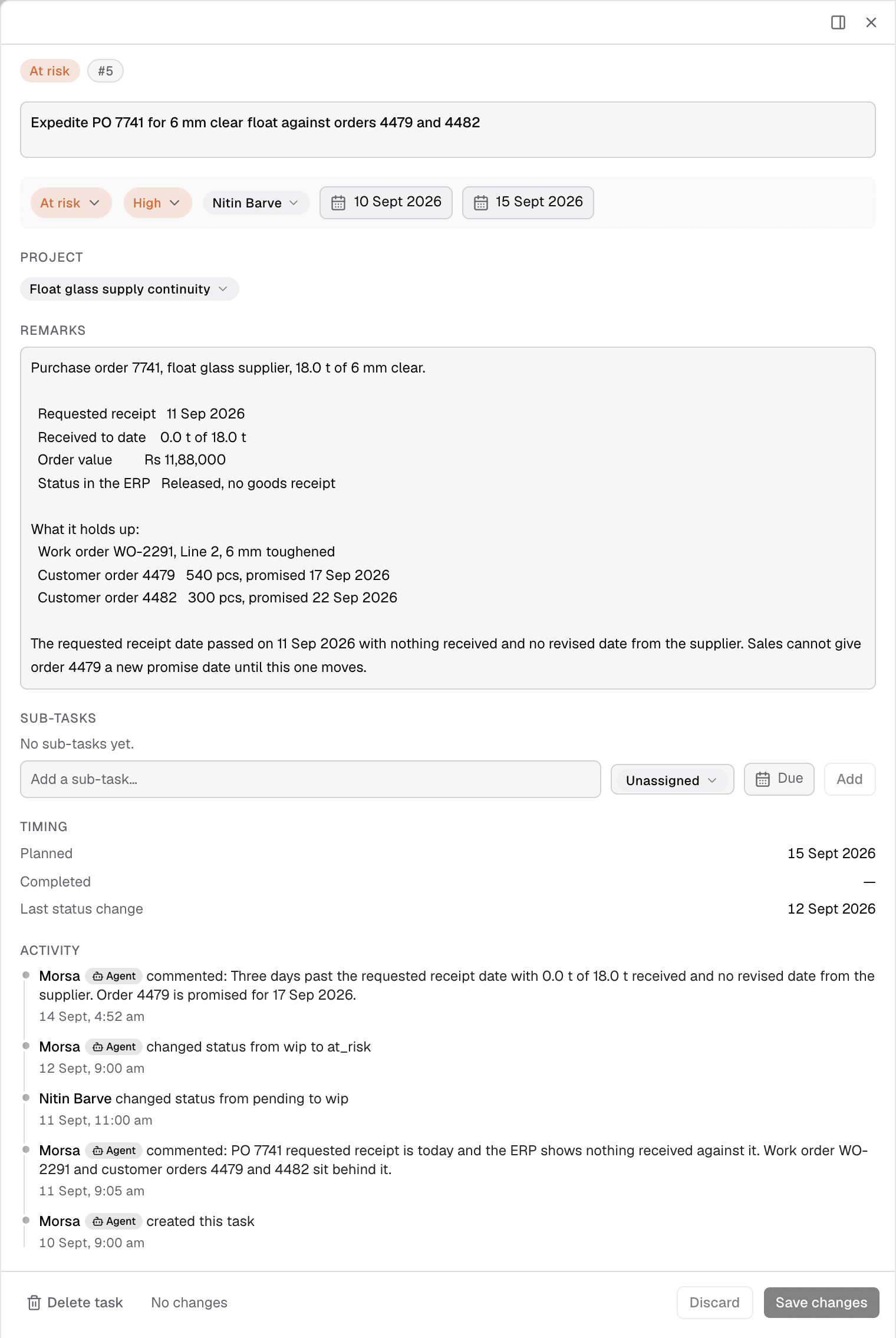
A purchasing commitment in Morsa at J4S. Names and order numbers on these screens are illustrative.
What the floor sees: the same groups, a few more messages from Morsa
Almost nothing new. That was the condition.
A supervisor sees the same groups, with a few more messages in them from Morsa. A confirmation that a commitment was captured, with the owner and the date. A reminder when it is close. A closure when the proof arrives. The groups are quieter, not busier, because the “any update on this?” messages have mostly stopped. That question was the group’s way of chasing. Morsa chases before anyone has to ask.
The stores in-charge sees requests arrive with context: which orders, which line, which date, instead of “need 6 mm urgent” with no number and no deadline.
Dispatch sees whether Friday is covered on Wednesday, not on Friday morning.
Anil gets a short note in WhatsApp each morning: what is open, what is late, who has gone quiet on something that is about to slip. He reads it in the time it used to take him to find the first problem.
Sunil starts the morning review with the picture already built. The carry-overs, the open commitments, and the blockers are on the board before anyone speaks.
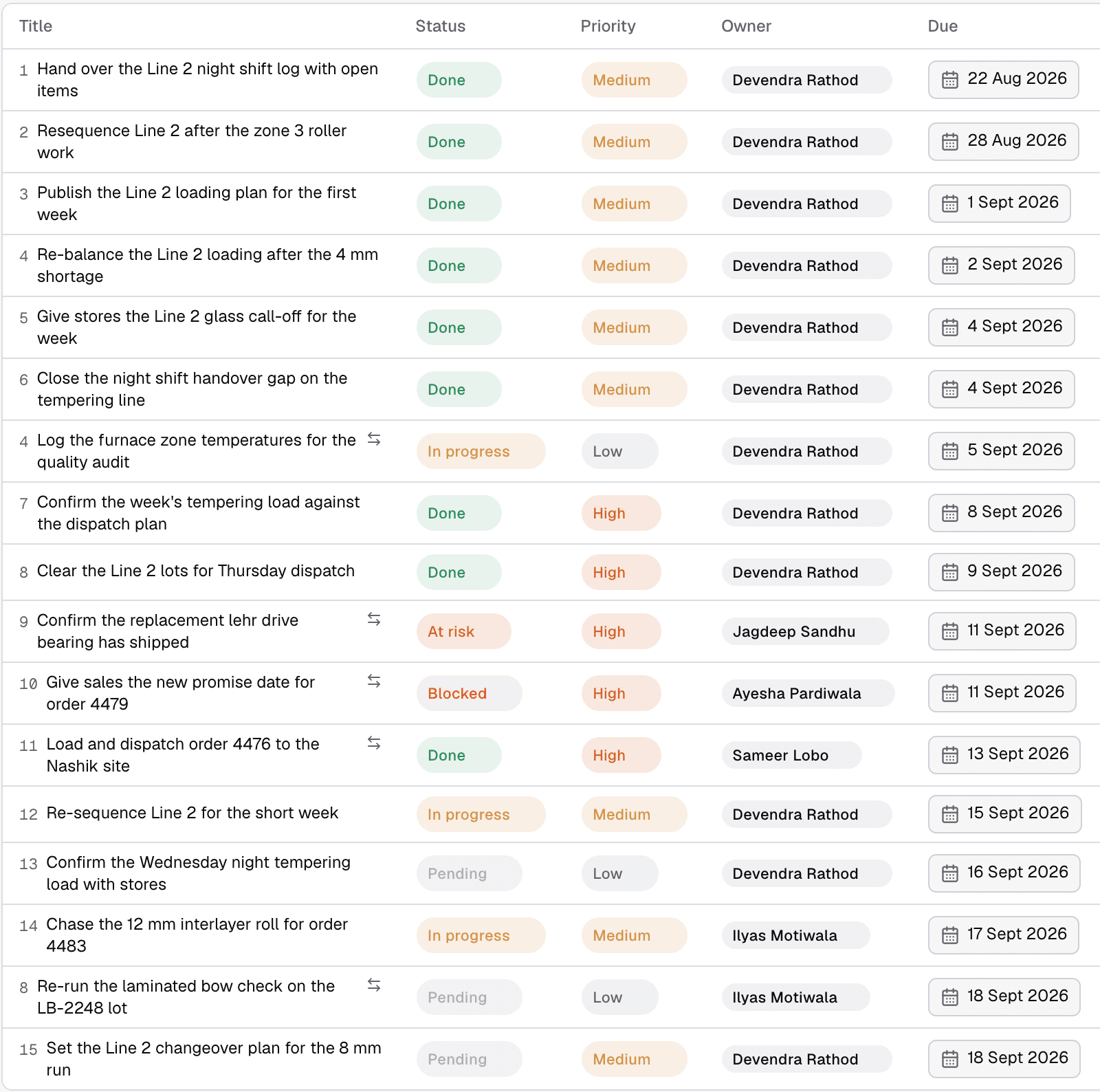
The department work board in Morsa at J4S. Names and order numbers on these screens are illustrative.
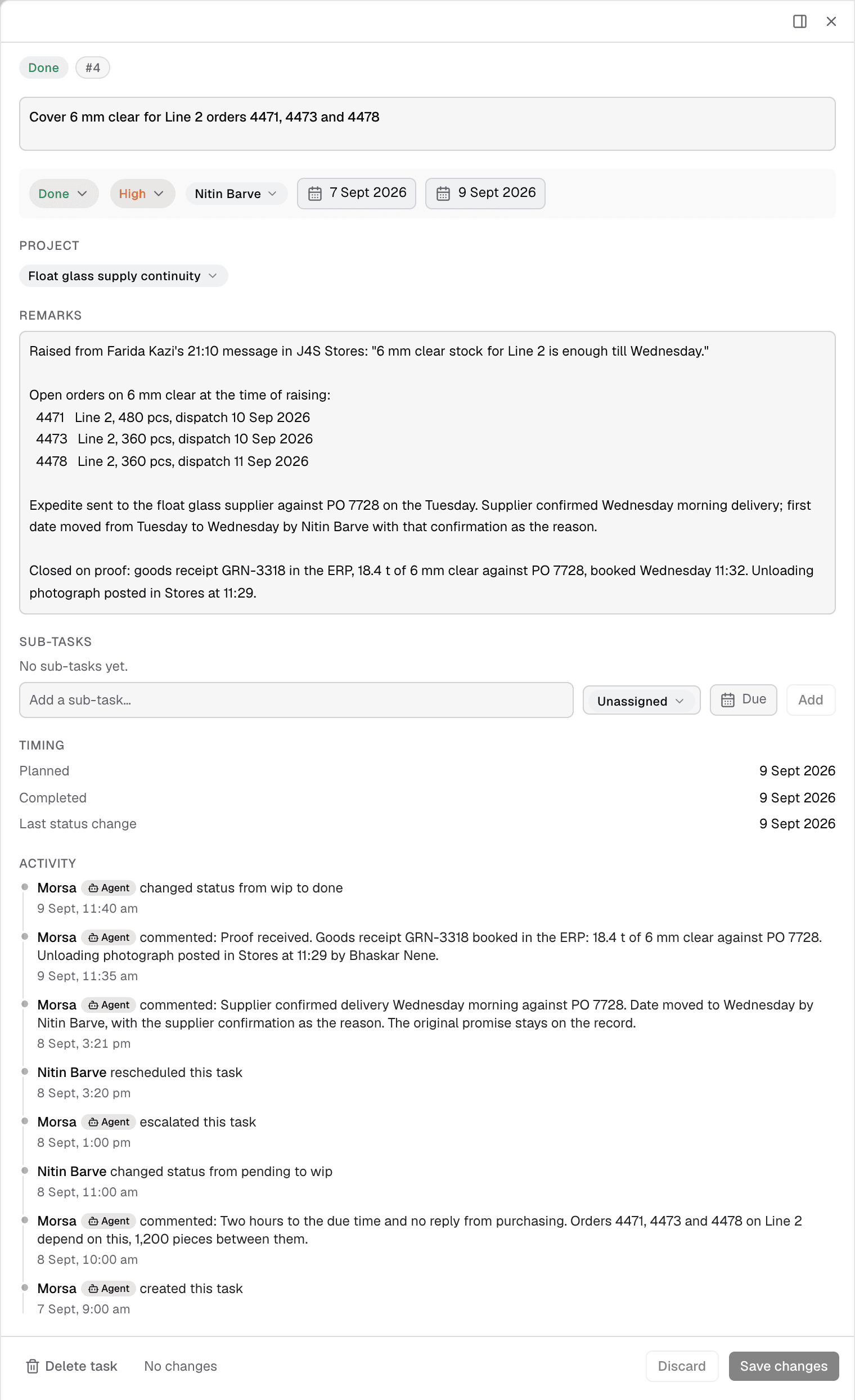
A commitment closed on proof in Morsa at J4S. Names and order numbers on these screens are illustrative.
The results: three in four commitments kept, up from fewer than one in three
Week four. The float glass supplier slid a delivery again, three days, same as before. This time the stores message at 21:10 became purchasing’s work at 21:10. The supplier’s new date was in the group by the next afternoon. The Line 2 supervisor resequenced the same day, moving the lot that had material forward. Friday’s dispatch went out on Friday. Anil found out about the delay from a note that said it was already handled.
Across the first four weeks, J4S made roughly 900 operational commitments in its groups: material requests, dispatch dates, quality clearances, maintenance windows, handover items. About 75% were completed on time, up from about 30% before Morsa.
THE J4S TIMELINE
Onboarded in two days, then four weeks live
About 30% on time going in. About 75% on time at the end of week four. Roughly 900 commitments in between.
DAY 1
Connect
Morsa joined the Production, Stores, Purchase, and Dispatch groups and connected to the ERP.
DAYS 1 TO 2
Configure
Who owns what, which commitments escalate to whom, and what counts as proof for each kind of work.
DAY 2
Live
Owners assigned in the groups, chasing and escalation on, closure on proof. The four-week count starts here.
WEEK 4
Result
About 75% of commitments closed on the first date given, up from about 30%.
The two percentages are the before figure and the four-week figure as reported by J4S, not weekly readings. The floor was not asked to change anything at any step.
Here is what those numbers mean in the plant’s own units.
Number | What it means at J4S |
|---|---|
About 30% to about 75% on time | Three in four commitments kept, up from fewer than one in three |
Roughly 900 commitments in four weeks | More than 30 a day, every one with an owner and a date |
45 percentage points on 900 commitments | Roughly 400 commitments completed on the date given that, at the old rate, would have slipped |
The Plant Head’s first hour each morning | About 20 hours a month that Sunil no longer spends reconstructing yesterday |
Two days to live | No migration, no training program, no rollout |
New software on the floor | None |
Part of the improvement is attention. When every commitment is visible with a name and a date next to it, people keep more of them. This was not a controlled test, and the two cannot be separated. J4S did not need them separated. The chasing now happens whether or not a manager notices, and that is what the plant was paying for.
Two things the numbers do not say. First, the ERP did not change. Nothing was migrated, and no one at J4S learned a new screen. Second, the on-time rate is measured against the date the person gave, closed on proof. It is not a rate of “done” messages.
What changed for the people
Anil Kohli, Production Head. The switchboard hour is gone. The changes in the plant reach the department concerned without passing through him. What reaches him is the short list: what is late, what has gone quiet, what needs a decision only he can make. He spends more of the morning on the floor and less of it on the phone.
The part Anil keeps coming back to is what did not change.

Anil Kohli, Production Head at J4S, on the plant floor in front of the glass processing line
“Our people don’t have to learn any new software. People just message the way they always have. Morsa coordinates all the messages in the background.”
Anil Kohli, Production Head, J4S
Sunil K Verma, Plant Head. The morning review starts from a built picture instead of a reconstructed one. Escalations reach him with the consequence attached, so the decision is faster and rarer. He knows which commitments are at risk before they are late, and which supervisors and suppliers keep their dates.
Shift supervisors. Nothing to install, nothing to learn. The two-line handover note at the end of a shift now carries into the next shift as open work with owners, instead of scrolling away in the group by morning. The calls from the office asking what they already posted have mostly stopped.
Stores. The 21:10 message is now the last time the stores in-charge has to say it. It leaves the Stores group as purchasing’s work with a deadline, and the confirmation comes back into the same group. Nothing has to be repeated until someone reacts.
Dispatch. On the Wednesday of the fourth week, the dispatch planner asked the group nothing about Friday. The material was closed on the goods receipt, the quality clearance was closed on the inspector’s photo, and the order showed as covered two days before it shipped.
One thing nobody expected. In the second week, Morsa flagged that a supplier’s delivery date on a purchase order had moved twice in the ERP, and nobody in the Stores or Production groups had been told. The lot it fed was due on Line 1 that Thursday. It became a re-plan on Tuesday instead of a stoppage on Thursday. That was the kind of change the ERP had always recorded and nobody had ever read in time.
How J4S went live
At J4S the whole of setup and configuration took two days. The four weeks measured above started when Morsa went live.
Step | What it means | What happened at J4S |
|---|---|---|
Connect | Read the plant’s systems and one live workflow | Morsa joined the Production, Stores, Purchase, and Dispatch groups and connected to the ERP. Day 1. |
Configure | Map owners, rules, and approval boundaries. Configuration, not code | Who owns what, which commitments escalate to whom, and what counts as proof for each kind of work. Days 1 to 2. |
Live | Turn on approved actions and verification | Owners assigned in the groups, chasing and escalation on, closure on proof. Day 2. The four-week count starts here. |
The floor was not told to do anything differently at any step, because there was nothing for it to do differently.
What J4S does next
The same loop now runs across production, stores, quality, dispatch, and maintenance. Supplier follow-up is next: the same chase-and-close on purchase orders, so a supplier’s slip shows up as an early warning rather than as a stores message at 21:10.
“Morsa coordinates all the messages in the background and handles them,” Anil says. The ERP is the system that records the factory. Morsa is the intelligence that operates it.
See what your plant’s on-time rate is
Most plants have never measured it, because the commitments live in chat. Book 15 minutes with the Morsa team and bring one group chat from whatever your plant runs on. We will walk through what Morsa would have captured, routed, and chased in your last four weeks. Book a demo.

