Manufacturing management software is the set of systems a plant uses to plan, run and control production. In practice it means an ERP or MRP system for orders, materials and the plan, an MES for what is happening on the floor, and specialist tools for scheduling, maintenance, quality and inventory around them. The phrase is a category, not a product: no single system does all of it. Most plants have less of it than the vendors suggest. IoT Analytics estimates that 54% of plants worldwide still ran manufacturing operations on pen, paper or spreadsheets in 2024, and only 8% use a commercial MES.
In this guide
What is manufacturing management software?
What are the 7 types of software used in manufacturing?
What do ERP, MRP and MES each manage?
What do APS, CMMS, QMS and WMS add?
Which software is best for manufacturing?
Who is each type of manufacturing software for?
What is the best ERP for manufacturing?
What are the most popular MES systems?
How does ERP software solve manufacturing problems?
Where does ERP software stop?
Why is the gap between plan and floor getting wider?
How do you choose manufacturing management software?
What should you ask a vendor before you buy?
What happens after the plan changes?
Where does Morsa fit?
What changed at plants running Morsa above their systems?
Frequently asked questions
Sources, Changelog, Related pages
What is manufacturing management software?
Manufacturing management software is any system that helps a plant plan, manage and control production from raw material to shipped product. The term is an umbrella; underneath it sit several distinct categories, each managing a different layer of the plant.
The cleanest way to sort them is the ANSI/ISA-95 standard, which describes the levels of a manufacturing enterprise. ISA’s own summary puts enterprise resource planning (ERP) at Level 4, “all the activities related to running a business,” and manufacturing execution systems (MES) at Level 3, systems “that manage manufacturing operations” (ISA-95). Everything a plant calls manufacturing management software lives on one of those two levels, or on the line between them.
Manufacturing management software
What it is: The umbrella: any system that plans, runs or controls production
ISA-95 level: 3 and 4
How the ranking pages use it: The buyer’s search phrase. Vendors of ERP, MRP and MES all claim it.
Manufacturing ERP
What it is: The business record: orders, purchasing, inventory, costing, finance, plus MRP for material planning
ISA-95 level: 4
How the ranking pages use it: “Manufacturing management software with finance and customer records attached”
MES
What it is: The floor record: work orders in progress, machine and labor data, traceability
ISA-95 level: 3
How the ranking pages use it: “The execution layer beneath the ERP”
Gartner draws the same line: cloud ERP for product-centric enterprises “supports the automation of operational activities for the manufacturing, distribution, delivery and servicing of goods,” while MES is “a specialist class of production-oriented software that manages, monitors and synchronizes the execution of real-time physical processes” (Gartner Peer Insights, ERP and MES; verified 12 September 2026, host blocks re-checks). If you are deciding between the two, MES vs ERP goes deeper. For every category a manufacturer buys, including CAD, PLM and CRM, see manufacturing software.
THE PLANT SOFTWARE STACK
Seven systems, two ISA-95 levels, and the gap between them
Every system a plant calls manufacturing management software keeps a record. None of them owns the gap between two records that disagree.
LEVEL 4
ERP, MRP
Business record
ERP, enterprise resource planning. MRP, material requirements planning.
ANSI/ISA-95
THE GAP
What neither level records, and who chases the difference
Spreadsheets. Group chats. Phone calls. The morning meeting. Photos in WhatsApp.
LEVEL 3
MES, APS
Floor record
MES, manufacturing execution system. APS, advanced planning and scheduling. CMMS, computerized maintenance management system. QMS, quality management system. WMS, warehouse management system.
COORDINATION LAYER
Reads every record and every chat
Works out what a change affects, decides within the rules the plant approved, gets the response moving across systems and people, and closes on proof.
WHERE MORSA SITS
Level 4 holds the plan and the money. Level 3 holds the work as it happens. The gap between them is paper, chat and memory, and it belongs to nobody. Source: ANSI/ISA-95 level descriptions, isa.org
What are the 7 types of software used in manufacturing?
Seven types cover almost every plant with 50 to 1,000 employees: ERP, MRP, MES, APS, CMMS, QMS and WMS. People search for “the 5 types of software used in manufacturing”; there are more than five, and each one answers a different question.
ERP (enterprise resource planning)
What it manages: Customer orders, purchasing, inventory records, costing, finance
Level: 4
The question it answers: What did we promise, what do we own, what did it cost?
MRP (material requirements planning)
What it manages: Material and capacity needs calculated from the bill of materials (BOM) and demand
Level: 4
The question it answers: What do we need to buy or make, and by when?
MES (manufacturing execution system)
What it manages: Work orders in progress, machine and labor data, genealogy and traceability
Level: 3
The question it answers: What is running right now, and what did it produce?
APS (advanced planning and scheduling)
What it manages: Finite-capacity sequencing of work orders across lines and shifts
Level: 3 to 4
The question it answers: In what order should the lines run this week?
CMMS (computerized maintenance management system)
What it manages: Maintenance work orders, assets, spares, preventive schedules
Level: 3
The question it answers: Which machine is due, what broke, what did it cost?
QMS (quality management system)
What it manages: Inspections, nonconformance, corrective action, supplier quality
Level: 3 to 4
The question it answers: Did it meet spec, and what do we do when it did not?
WMS (warehouse management system)
What it manages: Locations, lots, movements, picking and receiving
Level: 3 to 4
The question it answers: Where is it, how much is there, which lot?
The market behind those seven is large and fragmented. IoT Analytics sizes the MES slice alone at $5.5 billion in 2024, about 6.5% of an $85 billion industrial software market, with more than 300 MES vendors and the global leader holding under 10% share. Across the 13 industries it analyzed, nine different vendors lead their segments. That is the evidence behind the rest of this page: there is no single best system, only the right one for a plant’s size and mode.
What do ERP, MRP and MES each manage?
ERP manages the business record, MRP manages the material plan inside it, and MES manages the record of the floor. ERP holds orders in, purchase orders out, inventory on hand, cost per job, and a general ledger. MRP is the planning calculation inside most ERPs, and the whole product at the small end of the market, where MRPeasy and Katana sell it standalone. It takes demand and the BOM and produces a list of what to buy and what to make. It does not know what happened on the floor an hour ago.
Running MRP by hand is a full-time job. Gardner Swindall, Senior Supply Chain Manager at CoachComm, a 100-person headset maker, described spreadsheet MRP in an Acumatica customer story (vendor case study, 2025): “Every day we were running this manually. We got to the point where we were trying to run it three times a week, but if we did that, we might miss orders so we had somebody running that every day.”
MES is the record of the floor: which work order is on which machine, how many pieces came off, who ran it, which lot went into which part. Most plants do not have one. IoT Analytics estimates that 54% of plants globally used pen and paper or spreadsheets to manage operations in 2024, that only 8% run a commercial MES, and that the other 46% use a lightweight ERP or SCADA extension, a homegrown MES, or a commercial one (IoT Analytics, December 2025). Which vendors sell one is covered in manufacturing execution system software; the plain-English explainer is what is an MES system.
What do APS, CMMS, QMS and WMS add?
APS sequences, CMMS keeps the machines running, QMS holds the spec, and WMS knows where things are. APS: an ERP knows a work order is due Friday; an APS decides it runs on line 2 after the changeover, because line 1 is full. Gartner calls this market “detailed manufacturing scheduling” (Gartner). Tools and the Excel alternative are compared in production planning software.
CMMS holds maintenance work orders, preventive schedules and spare parts. Siemens’ downtime study of 181 large industrial firms found plants “now suffer an average of 25 downtime incidents a month per facility,” down from 42 in 2019, but that recovery per incident rose from 49 minutes to 81 (Siemens, True Cost of Downtime 2024, vendor research). The twelve predictive maintenance tools compared on the sibling guide are the ones that try to predict the next incident.
QMS holds the spec and what happens when a part misses it. WMS knows where things are; plants under 1,000 employees usually run it as an ERP module.
One more phrase shows up in searches: manufacturing project management software. That is a different need, tracking engineer-to-order jobs as projects with milestones and budgets. Acumatica names “project-centric” manufacturers and Infor names engineer-to-order and configure-to-order modes. Treat it as a mode your ERP must support, not a separate purchase.
Which software is best for manufacturing?
There is no best manufacturing software, only a best fit for your size, your production mode and what you already run. The table below compares 14 systems that appear across the pages ranking for this query and in the manufacturer forum threads Google shows alongside them. Every price, deployment option and limit is quoted from the vendor’s own page, re-read on 21 September 2026. All 14 were read that day, including NetSuite, Epicor and SAP Business One, whose sites refuse automated fetches and were read in a browser instead. No published price changed since the earlier September reads. One correction: Katana prices manufacturing management as a paid add-on above its Core plan, which this table had not recorded, and the Katana row below now says so.
MRPeasy
Type: MRP
Fits best (vendor’s words): “Small and medium-sized manufacturers and distributors (up to 200 employees)”
Deployment: Cloud
Published price: From $49 per user per month (Starter); above 10 users, each bundle of 10 is a flat $79 per month
Limit to know before you call: The vendor caps its own fit at 200 employees
Katana Cloud Inventory
Type: Inventory and MRP
Fits best (vendor’s words): Positioned for “growing businesses” across manufacturing, e-commerce and wholesale
Deployment: Cloud
Published price: Free up to 30 SKUs; Core “Starts at $299/month”, unlimited users; manufacturing management is a $199 per month add-on
Limit to know before you call: Manufacturing management is a $199 per month add-on, so a manufacturer’s real floor is $498 per month, not $299. Accounting is a QuickBooks Online or Xero integration, not a module
Odoo Manufacturing
Type: Open-source MRP with MES, PLM, quality and maintenance apps
Fits best (vendor’s words): Plants that want one suite at one price
Deployment: Odoo Online; Odoo.sh or on-premise on the Custom plan
Published price: $24.90 per user per month billed yearly, or $31.10 billed monthly (Standard, all apps; 12-month discounted rates, list $31.10 and $38.90), read 24 September 2026 (Odoo pricing)
Limit to know before you call: On-premise needs the Custom plan at $61.00 per user per month yearly (list $76.20)
ProShop ERP
Type: ERP, MES and QMS in one
Fits best (vendor’s words): “Every other ERP is a system of record, but ProShop is a system of execution”; aerospace, defense, medical, space
Deployment: Not stated on the vendor pages
Published price: Quote only, “based on Users”
Limit to know before you call: Narrow by design; a separate government version is offered
ECI JobBOSS²
Type: Job-shop ERP
Fits best (vendor’s words): “Small and mid-sized manufacturers”; “high-mix, low-volume job shops”
Deployment: Multi-tenant SaaS, private hosted cloud, or on-premise
Published price: Quote only
Limit to know before you call: Finance through “a seamless integration with QuickBooks”; no ledger module listed
Microsoft Dynamics 365 Business Central
Type: SMB ERP
Fits best (vendor’s words): Plants already on the Microsoft stack; production BOMs, routings, work centers, subcontracting
Deployment: Cloud SKUs on the pricing page
Published price: Premium $110 per user per month, paid yearly
Limit to know before you call: Manufacturing is Premium only. Essentials at $80 does not include it (Microsoft Learn: “available only if you have the Premium experience”)
Acumatica Manufacturing Edition
Type: Manufacturing ERP
Fits best (vendor’s words): “Multi-modal discrete and process manufacturing”, including project-centric
Deployment: SaaS for the APEX package; partner-chosen otherwise
Published price: APEX for Manufacturing “under USD 2,185 monthly,” implementation included
Limit to know before you call: Pricing runs through a partner; “APEX is only available via SaaS”
Oracle NetSuite
Type: Cloud ERP
Fits best (vendor’s words): “Companies of every size”
Deployment: Cloud
Published price: Quote only: annual fee for platform plus modules plus users, and a one-time implementation fee
Limit to know before you call: Modules are priced separately; implementation is an extra line (12 September check)
Epicor Kinetic
Type: Cloud ERP for manufacturers
Fits best (vendor’s words): “Specialized for discrete, make-to-order manufacturing”
Deployment: Cloud, on-premises, or hybrid
Published price: Quote only, by platform core, cloud package and concurrent users
Limit to know before you call: The vendor’s own narrowing: discrete make-to-order first (12 September check)
SAP Business One
Type: SMB ERP
Fits best (vendor’s words): “Small and midsize businesses”
Deployment: “Regardless of deployment method” per SAP
Published price: Quote only
Limit to know before you call: Manufacturing appears under industry-specific capabilities, not as a named module (12 September check)
Infor CloudSuite Industrial
Type: Industry cloud ERP
Fits best (vendor’s words): “Purpose-built for small and midsize industrial manufacturers”; discrete and process, engineer-to-order, configure-to-order, repetitive, mixed-mode
Deployment: Multi-tenant cloud on AWS
Published price: Quote only
Limit to know before you call: “MES, WMS, PLM, and CPQ” are add-on modules, not core
DELMIAWorks
Type: Manufacturing ERP with MES
Fits best (vendor’s words): “Modern ERP for small to mid-size manufacturing businesses”
Deployment: Not stated on the pages we could reach
Published price: Quote only
Limit to know before you call: The vendor page states size, not production mode; ask which modes the reference customers run
Plex Smart Manufacturing Platform
Type: MES, positioned by Rockwell within cloud ERP
Fits best (vendor’s words): “Discrete, hybrid, and regulated industries”
Deployment: Multi-tenant SaaS
Published price: Quote only
Limit to know before you call: The product page describes floor execution and cites a cloud ERP shortlist; confirm which orders, costing and finance functions you would keep in your ERP
Tulip
Type: Frontline operations platform (apps, not a record system)
Fits best (vendor’s words): Pharmaceutical, medical device, aerospace and defense, discrete
Deployment: Cloud, with an on-premise connector host from the Professional tier
Published price: Essentials $100 and Professional $250 per interface per month, billed annually, 10-interface minimum
Limit to know before you call: Priced per interface, not per user; the minimums set floors of $1,000 and $2,500 per month
What manufacturers say to each other. In the r/manufacturing thread “What factory-floor software do you swear by?” (July 2025), one member wrote of quality and MES seat pricing: “3-5k/user/year which is bananas to me, especially since you then have to go in and still configure everything.” The systems people recommend to each other are the small MRPs (Katana, MRPeasy), the job-shop ERPs (JobBOSS², ProShop) and the Microsoft stack. Half of them are missing from the commercial pages that rank for this query.
Who is each type of manufacturing software for?
Start with the layer that is broken today, and match the system to your headcount and production mode, not to the vendor’s size. The table sorts the fourteen systems above by who should start where.
If you are | Start with | Not yet |
|---|---|---|
Under 50 people, no ERP, planning in spreadsheets | A standalone MRP (MRPeasy, Katana, Odoo) | A full ERP. The implementation cost will exceed the license, and you do not need the ledger yet. |
50 to 250 people with an ERP, but the floor runs on paper and group chats | Fix the floor record first: an MES, or the ERP’s shop-floor module, plus a way to keep the plan and the floor in sync | A second ERP. The problem is what happens between systems, not the system. |
A job shop quoting custom work | A job-shop ERP (JobBOSS², ProShop) that quotes, routes and costs each job | A repetitive-manufacturing MES. Its data model assumes stable BOMs. |
High-volume discrete with tight OEM delivery windows | An ERP with an integrated MES (Epicor Kinetic, Infor CloudSuite Industrial, DELMIAWorks), or an MES like Plex on the ERP you have | A tool that only reports. You need the record and the response. |
Regulated (medical, aerospace, defense) | Systems with traceability and document control built in (ProShop, Plex, Tulip for frontline apps) | A general SMB ERP without genealogy |
The spreadsheet stage is where most small plants start. In Capterra’s 2025 interactions with 1,848 prospective MRP buyers, 23% relied on spreadsheets for planning and 25% on manual methods instead of software (Capterra, April 2026, a software marketplace’s own buyer data, not a random sample). Adrian Perkins, Operations Director of Venture Engineering, a 40-person motorsport parts maker, described the end of that stage in an Acumatica customer story (vendor case study, December 2025): “Trying to track some of the bigger projects was just becoming an absolute nightmare.”
For the same systems sorted by headcount and production mode, with the six that publish a price named, see the best manufacturing management software by plant size.
What is the best ERP for manufacturing?
The best ERP for manufacturing depends on size and mode more than on brand. Business Central, Acumatica, SAP Business One and NetSuite are general SMB ERPs with manufacturing editions. Epicor Kinetic, Infor CloudSuite Industrial and DELMIAWorks are built for manufacturers first. The job-shop ERPs are their own class.
Whichever you pick, budget for the organization as much as the software. Panorama Consulting’s 2026 ERP Report, based on 170 organizations with a median revenue of $200.5 million, found the median project took nine months, more than a quarter ran over budget, and almost a quarter over schedule. The most common reason for overspend was “the unexpected need for additional technology”; the most common reason for delay was “organizational issues.” Chris Devault, Senior Manager of Client Services at Panorama, explained the pattern: “Organizations often discover fatal misfits late in the project, so they turn to additional technology, scope expansion, and custom builds.”
The pros and cons of each system are in manufacturing ERP software.
What are the most popular MES systems?
For plants under 1,000 employees, Plex, DELMIAWorks and the MES modules inside Epicor, Infor and Odoo cover most of the market; Siemens Opcenter and SAP Digital Manufacturing appear at the enterprise end. Tulip is often listed as an MES but positions itself as a frontline operations platform: apps that people use on the floor, not a system of record. IoT Analytics names Korber, Rockwell Automation, Siemens, Applied Materials, SAP, Honeywell, ABB, Dassault Systemes and Schneider Electric as the market’s leaders, and no one of them holds 10% (IoT Analytics).
Popularity is not integration. Rockwell Automation’s July 2026 survey of 1,560 manufacturers found “93% of manufacturers have MES in place, yet only 28% have deployed it enterprise-wide and just 23% report full integration” with ERP, PLM, quality and OT systems, and 44% ranked integration as their top MES buying requirement (Rockwell, 14 July 2026, vendor research). The vendor guide is at manufacturing execution system software.
How does ERP software solve manufacturing problems?
An ERP solves the record-keeping problem: before it, orders live in email, inventory lives in a spreadsheet, costs live in the controller’s head, and the material plan is whatever purchasing remembers. An ERP puts all of that in one place, runs MRP nightly, and gives every department the same numbers. For most plants it is the first system worth buying.
The measured benefit is real. In Panorama’s 2026 report, the share of organizations realizing benefits from “removing silos” rose year on year from 55.2% to 77.4%, while “benefits related to new operating models were the most difficult to realize.” The record gets unified; the way decisions are made does not.
Two warnings from people who have done it. Laura Philips, Vice President of Engineering and Procurement at Pella, told IndustryWeek in February 2026: “We have gotten custom happy in the past and had to redo work because we have custom [solutions]…and we don’t have enough resources then to maintain and continue to scale solutions.” Patrick Austin, President of Midwest Precision Molding, put it more bluntly: “I’ve never heard anybody in any ERP system that says, ‘Yeah, customizations are great!‘”
Where does ERP software stop?
An ERP stops at the record: it does not make the implementation succeed, and it does not respond when reality diverges from the plan. Gartner has predicted that “by 2027, more than 70% of recently implemented ERP initiatives will fail to fully meet their original business case goals,” with as many as 25% failing catastrophically (Gartner; the host blocks automated re-checks, corroborated by ERP Today). The cause is usually the same: the system was configured for the plant as the vendor imagined it, and the plant does not run that way.
The second limit costs more. The ERP records that 4,131 units were scheduled. Dispatch photos in a group chat show 4,035 shipped. The ERP does not read the chat, does not connect the 96-piece gap to tonight’s 8,000-part target, and does not tell anyone. Siemens puts the cost of a lost hour at $36,000 in fast-moving consumer goods and $2.3 million in automotive (Siemens, 2024, 181 interviews). Rockwell’s 2026 State of Smart Manufacturing survey of 1,560 manufacturers found only 43% of the data they collect is used effectively (Rockwell, May 2026).
THREE NUMBERS
Three numbers behind the gap
What the records hold, and what they leave for people to chase.
54%
of plants globally track production on pen and paper or spreadsheets, not an MES
IoT Analytics, December 2025
70%+
of recently implemented ERP initiatives will miss their business case goals by 2027
Gartner, ERP insights
1.9M
manufacturing jobs that could go unfilled through 2033: fewer people to do the chasing
The Manufacturing Institute and Deloitte, 2024
Systems of record answer what the plan said and what was logged. Closing the difference is still a person’s job, and there are fewer of them.
Sources: IoT Analytics (analyst estimate); Gartner; The Manufacturing Institute and Deloitte
Systems of record answer “what did the plan say?” and “what did we log?” Nothing in the seven categories above answers “the plan just changed, what do we do now, and who is on it?” That is the gap the last sections of this page are about.
Why is the gap between plan and floor getting wider?
The gap is getting wider because there are fewer people to fill it. The labor picture is the reason. The Manufacturing Institute and Deloitte project that “1.9 million jobs could remain unfilled” in manufacturing through 2033 (The Manufacturing Institute, 2024). In NAM’s Q3 2026 survey of 220 manufacturers, 54.9% named attracting and retaining a workforce as a top challenge, and Deloitte’s 2026 outlook expects “more than 81% of task hours in manufacturing” to remain human-driven (Deloitte, November 2025, 600 executives). Fewer people are available to do the chasing the systems leave undone.
How do you choose manufacturing management software?
Choose the layer before the vendor, then name your production mode and price at your real headcount. Eight steps, in order; most failed selections skipped step 1 or step 6. The first four:
Write down what breaks today, in the words the floor uses. “We find out about shortages when the line stops.” “The morning meeting is an hour of reconstruction.” Each points at a different layer of the stack.
Decide the layer before the vendor. Is the gap in the record (no ERP), in the floor data (no MES), in the sequence (no APS), or in what happens between them? Buying an ERP for a floor-data problem is the expensive mistake.
Name your production mode. Make-to-stock, make-to-order, engineer-to-order, job shop, repetitive, mixed. Cross off every vendor that does not name yours.
Price at your real headcount. Per-user pricing at 80 users is a different number from the starting price, and tiers bend: MRPeasy charges a flat $79 per bundle of 10 users above the first 10. Ask for the implementation fee as a separate line; NetSuite and Acumatica both say it is one.
What should you ask a vendor before you buy?
Ask to see the system handle a real disruption, not a demo dataset; the answer tells you more than any feature list. Steps five to eight:
Check the deployment you are allowed to run. Defense, aerospace and some OEM contracts require on-premise or private cloud. Half the vendors above are cloud only.
Ask what happens after the plan changes. Give the vendor a real scenario: a supplier ships short at 2 pm, three work orders depend on the part, the truck is booked for Thursday. Ask who finds out, how, and what the system does next. Most will show you a report.
Insist the plan and the floor reconcile. Ask how the schedule in the ERP and the output on the floor get compared, how often, and who sees the difference. If the answer is “someone exports both to Excel,” you have found the next problem.
Pilot on one line or one workflow. Measure before and after with the same numbers: on-time completion, shortages caught before the line stopped, hours in the morning meeting.
Travis Turnbull, Vice President and CIO at Pella, described the test that separates a system plants adopt from one they tolerate: “We’ve had some other solutions that, to get it to scale to other manufacturing sites, it was almost a push. … This [technology] was different. There was quickly a pull, everybody was raising their hand.”
What happens after the plan changes?
After the plan changes, every system in the table above records the change correctly and none of them does anything about it. “Supplier X is late” is an alert. “Supplier X is late, so Jobs A and B are at risk, Tuesday’s schedule should change, purchasing should expedite, and production needs the new sequence” is the work that follows, and it is done by a supervisor, a phone call, and the first hour of the next morning.
The numbers say that hour is getting longer, not shorter. Siemens found the average large plant’s downtime incidents fell from 42 to 25 a month since 2019, but recovery per incident rose from 49 minutes to 81. NIST’s survey of US discrete manufacturers puts the cost where it lands: of $119.1 billion a year in preventable maintenance losses, $100.2 billion is “lost sales from delays and defects,” not the repair itself (NIST AMS 100-34, 2016 data). Patrick Austin of Midwest Precision Molding described the manual version of the response: “We’d have had to guess or go out [on the floor], count parts, figure out how many parts we have, how many do we have to make, what’s the cycle time and then guess at what it’s going to take to finish that run.”
Demand is not slowing to let plants catch up. ISM’s Manufacturing PMI registered 54.6% in August 2026, an eighth month of expansion (ISM via PR Newswire); manufacturing employment rose by 16,000 in August (BLS, September 2026); and 80.8% of manufacturers in NAM’s Q3 survey named raw material costs their top challenge. More orders and higher costs reach the floor as substitutions, resequences and expedites. The late-supplier case is worked through in supplier management software.
Where does Morsa fit?
Morsa, the AI that operates the factory for you, is the layer that works across the records when reality diverges from the plan. It does not replace the ERP, the MES or any of the other five. The ERP stays the business record. Morsa reads it and does the second part: the work that follows the alert.
What Morsa reads. The ERP, MES, CMMS, QMS and WMS the plant already runs, and the places where people actually report what happened, whatever they are: WhatsApp, Microsoft Teams, email, SMS, photos posted in a group. Integrations shown on morsa.ai include SAP Business One, Business Central, Odoo, Zoho, QuickBooks, Excel and Google Sheets, and those are examples, not the list: any platform with an API, a database, a file export, a message stream or an email trail can be connected, machines, PLCs, SCADA systems and sensors included.
What Morsa works out. For each change, which part, work order, machine, supplier, customer order and owner it touches, and what it affects downstream: “this 96-piece shortage blocks tonight’s 8,000-part target.”
What Morsa decides and does. Within the rules the plant approves: expedite, resequence, substitute material, escalate, request an approval, notify the owner, open and route the work. It updates records, creates and assigns jobs, messages the owner in the channel they already use, chases before the due date, escalates when work goes quiet. A production-plan change or a commitment to a supplier follows the plant’s approval rules.
What the user sees. Nothing new to log into. The supervisor gets the message in the group they already use, with the job, the owner and the due date. Managers see the open commitments, the drift between plan and output, and who is reliable, already filled in when the morning review starts.
What closes the loop. Work closes on proof, not on a “done” message: a photo, a document, a system entry, a confirmed receipt.
AFTER THE PLAN CHANGES
What none of the seven systems does after the plan changes
One shortage, followed from the first signal to the closed job. The records hold the pieces. Someone still has to run the loop. Plant systems: ERP, MES, CMMS, QMS, WMS: orders, inventory, schedules, machine status, quality. People and channels: WhatsApp, Teams, email and photos: what people know before any system is updated.
01
Signal
Reads the change
IN THE EXAMPLE
Dispatch posts photos: 4,035 shipped. The schedule says 4,131.
02
Context
Connects it to plant state
IN THE EXAMPLE
The part, the work order, the line, and tonight’s 8,000-part target.
03
Consequence
What it affects downstream
IN THE EXAMPLE
The plant is 96 pieces short, and the night-shift target is blocked by supply.
04
Decision
Next action, within approved rules
IN THE EXAMPLE
Expedite the parts and tell production the target is blocked.
05
Execution
Acts across systems and people
IN THE EXAMPLE
The message lands in the group people already use, with an owner and a due date.
06
Verification
Closes on proof
IN THE EXAMPLE
The job closes when the parts show up on the record, not on a “done” reply.
KEEPS WATCHING UNTIL THE PROOF SHOWS UP
Consequential actions, such as a production-plan change or a commitment to a supplier, follow the plant’s own approval rules. The response lands in the channels people already use. The example is a live Morsa run on a customer plant’s night shift; the figures are as recorded.
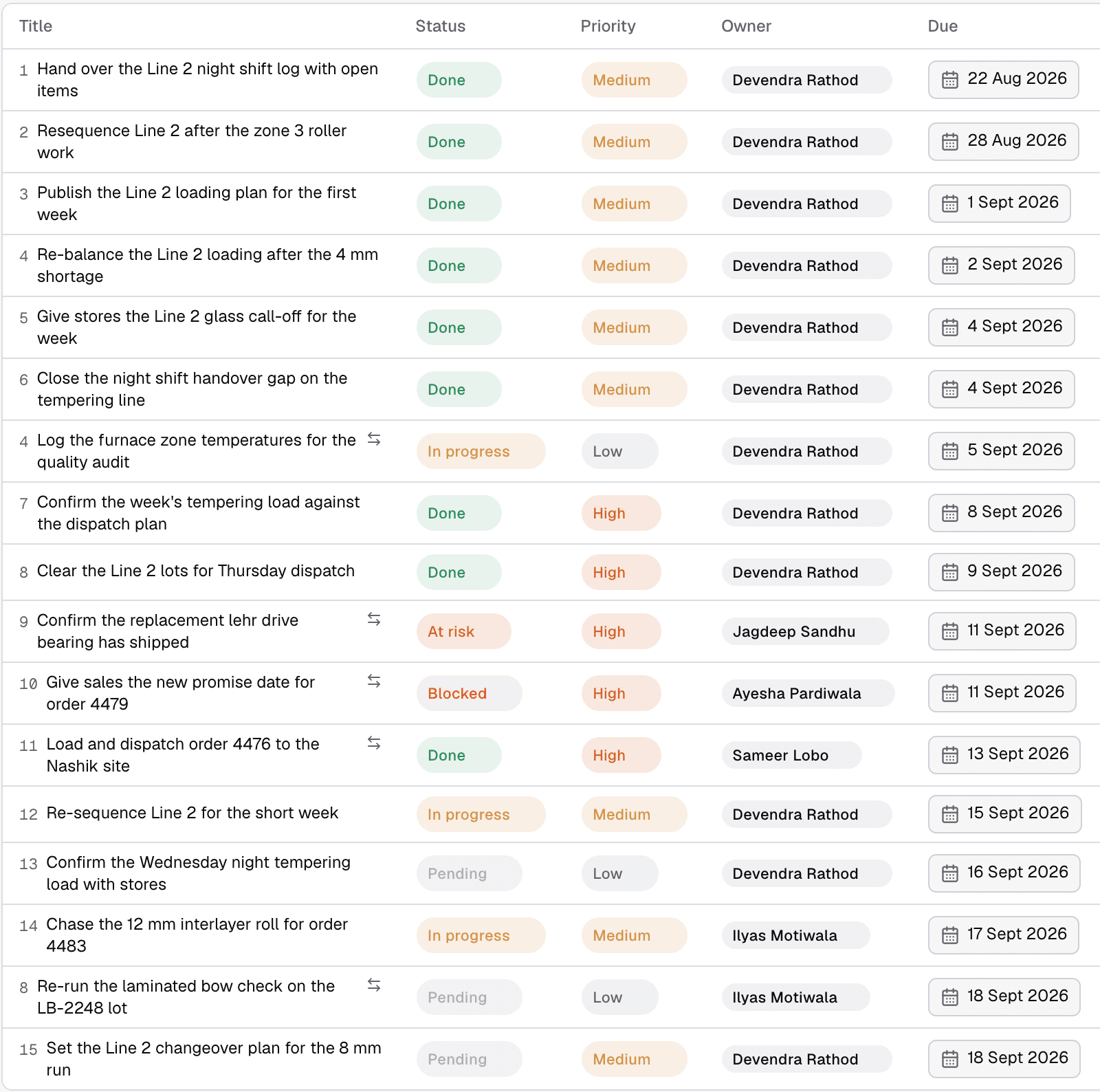
Morsa’s work board for one plant. Northline Glass, a demo plant.
What changed at plants running Morsa above their systems?
At J4S, a 120-person glass manufacturing plant onboarded in two days, on-time completion of operational commitments rose from about 30% to about 75% in the first four weeks, across about 900 commitments in the first month (how the plant did it with no new software). Plant Head Sunil K Verma: “I used to spend the first hour of every morning reconstructing yesterday. Now the chasing happens in the WhatsApp groups my supervisors already use, whether or not I remember.” Production Head Anil Kohli: “Our people don’t have to learn any new software. People just message the way they always have. Morsa coordinates all the messages in the background.” At JRG Automotive, an automotive and plastic body-parts manufacturer serving OEMs, Morsa identified 5 of 8 production-stopping material shortages early enough to act and saved the plant $2 million.
How it deploys. Cloud, private cloud, or fully on-premise including the AI models and databases, which fits ITAR and CMMC plants. Four steps: Connect, Configure, Shadow, Live. Pilots start on one line or one workflow, typically material availability and supplier recovery. What an AI that operates the factory does, and how it differs from a copilot or a chatbot for the ERP, is on AI copilot for manufacturing. To see it on your plant’s data, book a demo.
Sources
International Society of Automation, ISA-95 Series of Standards. Level 3 and Level 4 descriptions. Re-verified 19 September 2026.
Gartner Peer Insights, Manufacturing Execution Systems, Cloud ERP for Product-Centric Enterprises and Detailed Manufacturing Scheduling. Definitions verified 12 September 2026; gartner.com returned 403 to automated re-checks on 19 September 2026.
Gartner, Latest Enterprise Resource Planning (ERP) Insights. The 70% and 25% predictions for 2027; host blocks automated fetches, corroborated by ERP Today.
IoT Analytics, MES vendors replace pen, paper, and spreadsheets, 15 December 2025, and the MES Market Report 2025-2031 product page. 54% of plants globally in 2024; 8% commercial MES; 46% other methods; $5.5 billion; 6.5% of $85 billion; 300+ vendors; leader under 10%; nine leaders across 13 industries. Analyst estimates from a paid report; sample not disclosed on the public page.
Panorama Consulting Group, The 2026 ERP Report, 170 respondents, January 2025 to January 2026, and the 4 March 2026 release (Chris Devault quote).
Rockwell Automation, 93% of Manufacturers Have MES, But Only 23% Have Fully Integrated It, 14 July 2026, 1,560 respondents in 17 countries; and 90% of Manufacturers Say Digital Transformation Is Now Essential, 19 May 2026, 11th State of Smart Manufacturing Report, 1,560 respondents. Vendor research.
Rockwell Automation, State of Smart Manufacturing 2025 press release, 3 June 2025 (the 95% figure in the FAQ).
Siemens, The True Cost of Downtime 2024. 181 interviews at large industrial organizations, April 2019 to March 2023. Vendor research.
NIST, Economics of Manufacturing Machinery Maintenance, AMS 100-34, Thomas and Weiss, June 2020, 2016 data.
The Manufacturing Institute and Deloitte, Manufacturers Need as Many as 3.8 Million New Employees by 2033, 3 April 2024.
Deloitte, 2026 Manufacturing Industry Outlook, 13 November 2025, 600 manufacturing executives.
National Association of Manufacturers, 2026 Third Quarter Manufacturers’ Outlook Survey, 14 September 2026, 220 responses, fielded 11 to 27 August 2026.
Bureau of Labor Statistics, The Employment Situation, August 2026, released 4 September 2026.
Institute for Supply Management, Manufacturing PMI at 54.6%, August 2026, via PR Newswire, 1 September 2026 (ismworld.org requires a login).
Capterra, MRP Software vs. Spreadsheets, 20 April 2026. 1,848 buyer interactions, 1 January 2025 to 1 January 2026. A software marketplace’s own data, labeled as such.
IndustryWeek, Dennis Scimeca, Pella connected worker story, 20 February 2026 (Travis Turnbull and Laura Philips quotes); and Switching from ERP to MES Drives Improvement for Plastics Manufacturer, 15 December 2023 (Patrick Austin quotes).
Acumatica customer stories (vendor case studies): CoachComm, 2025 (Gardner Swindall); Venture Engineering, December 2025 (Adrian Perkins).
Microsoft Learn, Manufacturing in Business Central, updated 15 July 2026. “The features described in this article are available only if you have the Premium experience.”
r/manufacturing, What factory-floor software do you swear by?, 10 July 2025. The seat-pricing quote in the callout, verified verbatim through the Reddit API on 19 September 2026.
Vendor pricing and product pages, linked in the comparison table, fetched 12 September 2026, re-fetched 19 September 2026 and re-read in full on 21 September 2026. On the 19 September re-fetch Odoo’s Standard moved to $31.10 per user per month and Custom to $61.00, the 12-month discounted rates on its pricing page, against list prices of $38.90 and $76.20. On 21 September all 14 pages were read again and no published headline price had changed; Katana’s pricing page shows manufacturing management as a $199 per month add-on above the Core plan. NetSuite, Epicor and SAP Business One return 403 to automated fetches and were read in a browser on 21 September.
A note on MESA International: the MESA-11 model was for thirty years the other standard reference for MES functions. MESA ceased operations effective 30 June 2026 and ISA assumed its educational programs and content (ISA announcement). This guide cites ISA-95 instead.
Changelog
24 September 2026: Odoo prices re-read. Billed yearly, Standard is $24.90 and Custom $49.00 per user per month for the first 12 months (lists $31.10 and $61.00); billed monthly they are $31.10 and $61.10 (lists $38.90 and $76.20). Every current Odoo price on this page now names its billing term.
20 September 2026: re-read all 14 vendor pricing pages; only Odoo’s changed, and the page now says so. Added Tulip’s Professional tier, MRPeasy’s 10-user bundle pricing, and the current Microsoft Learn wording; softened the Plex limitation and corrected Katana’s fit wording to what the vendor says today.
20 September 2026: added Panorama’s 2026 ERP Report (budget, schedule, duration, causes, benefits), Rockwell’s May and July 2026 surveys, IoT Analytics’ full MES market figures, NAM Q3 2026, BLS August employment, ISM August PMI, Deloitte’s 2026 outlook and Capterra’s spreadsheet figure, so every claim about the market carries a dated number.
20 September 2026: added named quotations from Chris Devault (Panorama), Laura Philips and Travis Turnbull (Pella), Patrick Austin (Midwest Precision Molding), Gardner Swindall (CoachComm) and Adrian Perkins (Venture Engineering), and Sunil K Verma and Anil Kohli (J4S).
20 September 2026: removed one Reddit quote (“I need to understand WHY…”) that could not be found in the thread on re-check; the seat-pricing quote was verified verbatim and stays.
20 September 2026: rephrased every section heading as a buyer’s question, split the types, ERP and Morsa sections so each answers one question in its first sentence, and matched the table of contents.
20 September 2026: corrected the IoT Analytics 54% figure to “plants globally” (the source does not restrict it to small and medium plants), in the text and in the stat-block figure.
20 September 2026: corrected Odoo’s published prices to the figures read on 19 September 2026, Standard $31.10 per user per month in the first year ($38.90 list) and Custom $61.00 ($76.20 list), in the vendor row and in two FAQ answers, and dropped the claim that no published price changed on the re-read.
Prices re-read 21 September 2026: all 14 vendor pages, including NetSuite, Epicor and SAP Business One, which block automated fetches and were read in a browser. No published price changed. Katana prices manufacturing management as a $199 per month add-on above its $299 Core plan, which this page had not recorded; the Katana row and the small-manufacturer answer now say so. The add-on is not new: the production planning guide recorded it on 20 September 2026. Also corrected the cost answer, which said nine of the 14 vendors publish no price when the table shows eight.

