AI in manufacturing is software that learns from a plant’s own data to find problems, predict what happens next, and increasingly decide and act on them. Artificial intelligence in manufacturing shows up in quality inspection, maintenance, scheduling, supply, energy, safety and design, learning from machine signals, camera images, orders, schedules and messages. Most deployments today detect and alert. A person still carries the finding the rest of the way. The numbers agree: Rockwell Automation’s 2026 survey of 1,560 manufacturers puts 34% of operations as AI-augmented today, while Stanford’s AI Index 2026 finds “AI agent deployment was in the single digits across nearly all business functions.”
In this guide
What is AI in manufacturing?
How many manufacturers actually use AI?
Why do the AI adoption numbers disagree?
How is AI used in manufacturing?
What are the benefits of AI in manufacturing?
Why do most AI projects in manufacturing stall?
What stops AI projects at the last mile?
What does AI mean for manufacturing jobs?
Detect, decide, act: what AI in manufacturing does not do yet
What does AI that acts on the plant floor need to do?
How do you govern AI in a plant? Approval boundaries
Where does Morsa fit?
How do you start with AI in a plant?
FAQ
Sources, Changelog, Related pages
What is AI in manufacturing?
AI in manufacturing means using models trained on the plant’s own data to do work that used to need a person looking at a screen, a gauge or a message. The models come in a few families, and it helps to name them, because “AI” on a vendor slide can mean any of them. AI grew out of the ‘big data and analytics’ item in the nine pillars of Industry 4.0.
Machine learning (ML)
What it learns from: Sensor history, quality records, orders
What it produces: A prediction or a score
Typical plant use: Predict a bearing failure, forecast demand, flag a batch likely to fail
Computer vision
What it learns from: Camera and scanner images
What it produces: A classification or a measurement
Typical plant use: Find scratches, missing parts, wrong labels, unsafe acts
Optimization and simulation
What it learns from: Constraints, capacities, costs
What it produces: A schedule or a design
Typical plant use: Sequence jobs, balance a line, generate a lighter bracket
Large language models (LLMs)
What it learns from: Documents, manuals, chat, email
What it produces: Text: answers, summaries, code
Typical plant use: Answer “how do I reset this drive”, write a shift summary, draft PLC code
AI agents
What it learns from: All of the above plus access to live systems
What it produces: A recommendation, and in a few products an approved action
Typical plant use: Read a supplier email, find the affected order, propose an expedite
For the academic treatment of these families, see the 2024 review by Gao and colleagues in CIRP Annals. Source 22
Two things separate AI from the automation plants have run for decades. Automation follows rules a person wrote; AI learns the rules from examples. And AI fails differently: a rule fails loudly, a model fails quietly and confidently, which is why governance matters as much as the use cases. AI in manufacturing sits inside the larger shift of connected machines, data that flows between systems, and software that acts on it. Industry 4.0 is the era, smart manufacturing is the practice, a smart factory is the place. AI is the part of that shift that learns.
How many manufacturers actually use AI?
Fewer than the headlines suggest, and the honest number depends on who is asked. Government data on all US businesses says roughly one in five. Executive surveys of manufacturers say seven to nine in ten. Production-floor surveys say about a third. Both ends are true, because they measure different things.
THREE HONEST NUMBERS
Three honest numbers, and why they disagree
17 to 20%
of all US businesses used AI, Dec 2025 to May 2026. 37% at firms with 250 or more employees. Asks whether AI is used to produce goods or services. The floor.
US Census Bureau, BTOS, May 2026
5%
of industrial companies have deployed AI in manufacturing at scale. 45% are in first implementation phases. 25% are partially advanced and still fighting data silos. The middle.
Capgemini and Microsoft, 2025
40%
average labor productivity gain at the 12 sites named Global Lighthouses in 2025. Lead time down 48%. AI enables up to 50% of their top use cases. They join a network of 201 of the best-run sites on earth. The ceiling.
World Economic Forum, Sept 2025
READ TOGETHER
Most manufacturers have touched AI, a minority run it in a production process, very few run it across the plant.
Three adoption numbers that disagree. Government data counts every business, executive surveys count any use anywhere, and only one source asks about production at scale.
US Census Bureau, Business Trends and Outlook Survey (December 2025 to May 2026): overall AI use “hovered between 17% and 20%” of US businesses. Use rises with size: 37% of firms with 250 or more employees and 32% of firms with 100 to 249 employees reported using AI as of 3 May 2026. A Census working paper covering November 2025 to January 2026 puts firm-level use at 18%, or 32% weighted by employment, with the highest rates among very large firms in information, professional services and finance. Source 1 Source 2
Rockwell Automation, 2026 State of Smart Manufacturing Report (1,560 respondents, 17 countries): “one-third of operations (34%)” are AI-augmented today, and manufacturers expect “more than half of operations to be AI-supported by 2030.” Vendor research with a stated sample. Source 23
Manufacturing Leadership Council, Industrial AI survey (April 2026, member survey, sample size not published): “more than 70% of manufacturers surveyed say they are currently using generative AI products such as OpenAI’s ChatGPT and Microsoft’s Copilot,” up from 46% in 2024; 66% are using or plan to use agentic AI; and “more than 75% of respondents placed themselves at below five” on a ten-point maturity scale. Source 24
McKinsey, State of AI 2026 survey (1,719 respondents), as reported by The Register: only 37% attribute at least some EBIT impact to AI, about the same as in 2025, even though 80% of respondents who use AI in their roles say it improved their own productivity. Among companies with more than $1 billion in revenue, 40% are scaling AI agents, up from 27% a year earlier. Source 3
Deloitte, 2026 Manufacturing Industry Outlook (November 2025, citing a 2025 Deloitte survey of 600 manufacturing executives): 80% plan to invest 20% or more of their improvement budgets in smart manufacturing initiatives. Citing a Manufacturing Leadership Council survey from early 2025, 22% of manufacturers plan to use physical AI within two years, up from 9% today. Source 4
Capgemini and Microsoft, The New AI Imperative in Manufacturing (2025), citing Capgemini and Everest Group research from 2024 with no published sample: only 5% of industrial companies have deployed AI in manufacturing at scale; 45% are in first implementation phases and 25% are partially advanced and still facing data silos and mixed standards. Source 5
RSM Middle Market AI Survey 2026 (129 manufacturing respondents, July 2026): 88% say AI is at least partially integrated; 32% report full integration across core operations. Source 8
Why do the AI adoption numbers disagree?
Because each survey asks a different question of a different population. The Census asks every business, including four-person shops, whether AI is used in any function. RSM asks executives whether AI is used anywhere, which a single copilot license satisfies. McKinsey asks whether it shows up in earnings. Rockwell asks about operations. Capgemini asks about production at scale. Read together: most manufacturers have touched AI, about a third have it in a production process, and very few run it across the plant. The floor itself is often not yet digital at all: IoT Analytics estimates 54% of plants globally still managed production with pen, paper or spreadsheets in 2024. Source 25
The number that matters for a plant leader is not “do we use AI” but “how many of our decisions does it change”. By that measure almost every plant is early.
How is AI used in manufacturing?
The clearest way to answer “how is AI used in manufacturing” is by plant function: what the AI reads, what it produces, who acts on the output, a named site, and the result as reported. Vendor-reported numbers are marked as such.
Quality
What the AI reads: Camera images of every part
What it produces: Defect flag, missing part, wrong label
Named example: BMW Group, Dingolfing press shop
Result as reported: Pseudo-defects from dust and oil eliminated; about 100 images per feature
Source: BMW Group, 2019 Source 11
Maintenance
What the AI reads: Vibration, temperature, current
What it produces: Fault, likely cause, urgency
Named example: Frito-Lay pilot plants (Augury)
Result as reported: Zero breakdowns in the pilot year; plan to scale to almost all plants
Source: Augury, 2021, vendor Source 12
Planning
What the AI reads: Orders, routings, capacity, materials
What it produces: A feasible schedule; a re-plan
Named example: Tüpraş, İzmit (WEF Lighthouse)
Result as reported: Delivery reliability 85% to 95%; truck loading time down 75%
Source: WEF, September 2025 Source 6
Supply
What the AI reads: Supplier emails, POs, stock, lead times
What it produces: Orders at risk and what they hit
Named example: Lenovo, Monterrey, Mexico
Result as reported: Lead time down 85%; logistics cost down 42%
Source: WEF, September 2025 Source 6
Energy
What the AI reads: Power meters, process parameters
What it produces: Waste found; setpoints suggested
Named example: Schneider Electric, Lexington, Kentucky
Result as reported: Energy down 26%; net CO2 down 30%; water down 20%
Source: Smart Industry, 2021 Source 16
Safety
What the AI reads: Existing plant cameras
What it produces: PPE, zone and posture alerts
Named example: Piston Automotive (Voxel)
Result as reported: Vehicle safety incidents down 86% in three months
Source: Voxel, 2026, vendor Source 17
Design
What the AI reads: Loads, materials, method, budget
What it produces: Hundreds of part geometries
Named example: General Motors seat bracket (Autodesk)
Result as reported: One part instead of eight; 40% lighter, 20% stronger
Source: Autodesk customer story Source 14
Copilots
What the AI reads: Manuals, tickets, engineering docs
What it produces: Answers, PLC code, visualizations
Named example: Siemens Industrial Copilot, 100+ companies
Result as reported: Panel visualizations in 30 seconds; code needing 20% adaptation
Source: Microsoft, October 2024 Source 19
The same eight use cases as a styled table. “Vendor” marks a customer result published by the vendor.
Quality: machine vision that inspects every part
What it does. A vision model compares each part’s image with hundreds of reference images and flags deviations, missing components, wrong labels or surface defects in milliseconds; quality staff review the flagged units. It also learns what is not a defect, which is what makes it usable.
BMW Group, Dingolfing and Steyr. In the Dingolfing press shop a neural network trained on around 100 real images per feature, including parts with dust or oil residue, eliminated pseudo-defects. At the Steyr engine plant an AI reads cold-test torque data to separate real errors from presumed ones, cutting unnecessary manual checks. Christian Patron, Head of Innovation, Digitalization and Data Analytics at BMW Group Production, in the release: “It helps us maintain our high quality standards and at the same time relieves our people of repetitive tasks.” BMW Group press release, 15 July 2019. Source 11
Foxconn, smart PV controller line, China. AI inspection checks silicone grease color and quantity and nameplate placement; more than 6,000 devices a month can be inspected at above 99% accuracy. Reported by the vision vendor, Huawei. Source 18
Maintenance: predicting failures from vibration and current
What it does. Wireless sensors stream vibration, temperature and magnetic data from motors, pumps, gearboxes and fans; models trained on the fault signatures of similar machines detect a developing fault, name the likely cause and estimate urgency. This is the most mature AI use case in manufacturing and the one with the oldest public benchmark: the US Department of Energy’s O&M Best Practices Guide cites past studies estimating that a working predictive maintenance program saves 8% to 12% over preventive maintenance alone, and the independent surveys it cites put the return on investment at 10 times. Source 9
Frito-Lay (PepsiCo), pilot plants. After a one-year pilot of Augury’s machine-health sensors and AI diagnostics, the pilot plants reported zero breakdowns, interruptions or incremental costs, and PepsiCo said it would scale the program to almost all Frito-Lay plants over the following year. Vendor-published, July 2021. Source 12
Colgate-Palmolive, North America. Warren Pruitt, Vice President, Global Engineering Services at Colgate-Palmolive, on one flagged tube-maker drive: “We figure the savings at 192 hours of downtime and an output of 2.8 million tubes of toothpaste, plus $12,000 for a new motor and $27,000 in variable conversion costs.” At Hill’s Pet Nutrition the savings in six plants paid for the annual program within four months. Automation World, July 2021. Source 13
For the software layer, see twelve predictive maintenance tools compared.
Production planning and scheduling: schedules that re-plan when constraints move
What it does. Optimization models take orders, routings, capacities, changeover rules and material availability and produce a feasible sequence; planners approve and release. The hard part is not the first schedule but the fifth re-plan of the day, when a machine goes down or a truck is late, and that is where most plants still fall back to a spreadsheet.
Tüpraş, İzmit refinery, Türkiye (Global Lighthouse 2025). AI-driven forecasting and optimization across planning, inventory and logistics raised delivery reliability from 85% to 95% and cut average truck loading time by 75%. Source 6
Eaton, Changzhou, China (Global Lighthouse 2025). With 164,000 SKUs and over 5,000 new custom designs a year, AI and simulation shortened the design cycle, and together with robotics and digital twins the site reduced lead time by 39%. Source 6
For the software category, see production planning software.
Supply chain and materials: seeing the shortage before the line does
What it does. Models read supplier messages, purchase orders, inventory positions and lead-time history to flag which orders are at risk and what they will hit downstream. In our reading this is the function where AI agents are moving fastest, because the inputs are mostly text.
Lenovo, Monterrey, Mexico (Global Lighthouse 2025). Managing 2,000 overseas suppliers and 52,000 SKUs, the site deployed more than 60 solutions, over half AI-enabled, and reports lead time down 85%, logistics costs down 42% and quality losses down 56%. Source 6
Microsoft Procurement Agent (public preview, April 2026). In Microsoft’s words, the agent helps teams “by decoding supplier communications and identifying which production orders, inventory positions, and customer commitments are at risk, while keeping humans in control.” Sean Barrett, Inventory and Analytics Manager at Farmlands Cooperative, quoted by Microsoft: “the agent has read the email, found the order, found the lines affected, decoded what the vendor is trying to say, and recommended actions,” and he expects Dynamics 365 to save the team 20 hours a week. Vendor case study. Source 15
For the wider picture see AI in supply chain.
Energy and process optimization: tuning the plant, not just measuring it
Schneider Electric, Lexington, Kentucky (WEF Sustainability Lighthouse, 2021). IoT power meters plus predictive analytics delivered a 26% energy reduction, 30% net CO2 reduction and 20% water reduction, and Platinum Superior Energy Performance 50001 certification from the US Department of Energy. Smart Industry, 28 September 2021. Source 16
Tongwei Solar, Meishan, China (Global Lighthouse 2025). Over 50 use cases, mostly AI, for process optimization and defect analysis: power conversion efficiency up 12%, defect rate down 41%, conversion cost down 37%. Source 6
Safety and ergonomics: cameras that watch for the near miss
Piston Automotive (Voxel customer). An 86% reduction in vehicle safety incidents over three months. NSG Group, US facility: a 62% reduction in safety-vest incidents. Both vendor-reported, still on the vendor’s page on 19 September 2026. Source 17
Design and engineering: generating the part instead of drawing it
General Motors, seat bracket. Using Autodesk Fusion 360 generative design, GM engineers replaced an eight-piece welded bracket with one stainless-steel 3D-printed part that is 40% lighter and 20% stronger; the software produced more than 150 alternative designs. Kevin Quinn, GM Director of Additive Design and Manufacturing, in the same story: “On average, there are 30,000 parts in every vehicle. We’re not looking to print all 30,000 pieces. Instead, we’re being very realistic.” Autodesk customer story, undated. Source 14
Generative AI in manufacturing: copilots that answer, agents that act
LLM copilots answer questions against manuals, tickets and engineering documents, generate PLC code and visualizations, and summarize a shift. Agents go one step further and query live systems, but in most shipped products they still stop at a recommendation.
Siemens Industrial Copilot. Siemens reports that customers create panel visualizations in 30 seconds and generate code that needs only 20% adaptation. Over 100 companies, including Schaeffler and thyssenkrupp Automation Engineering, were using it by October 2024, and thyssenkrupp planned to use it “at scale,” engineering machines “at thyssenkrupp’s global locations from 2025 onwards,” starting with a battery quality-inspection machine. At Siemens’ own Erlangen electronics plant, the Copilot for Operations helps operators “understand a machine’s error codes by translating its messages into natural language.” Siemens and Microsoft, 24 October 2024 and 12 November 2024. Source 19 Source 20
Microsoft Factory Operations Agent (preview November 2024, general availability June 2025). Lets frontline workers ask natural-language questions over unified IT and OT data, including MES and quality data. It answers; it does not act. Microsoft Learn. Source 21
Across all eight functions, the examples with hard numbers are detection and prediction systems where a person still carries the finding to the next system and the next person. For AI copilots and agents specifically, see AI copilot for manufacturing.
What are the benefits of AI in manufacturing?
Four benefits have public evidence behind them: fewer unplanned stops, less scrap and rework from catching defects earlier, better schedules and inventory from forecasting, and lower energy use. The best public benchmark for the size of the prize comes from the World Economic Forum’s Global Lighthouse Network, which reached 223 sites and “1,150+ solutions” by January 2026, designated by an independent panel of experts. The 12 sites added in September 2025 reported, on average, a 40% labor productivity increase and a 48% lead-time reduction; AI and generative AI enabled up to 50% of their top use cases, with a 41% decrease in product defects, 28% decrease in energy consumption and 44% decrease in cycle time. Source 6 Source 26 Kiva Allgood, who heads the Forum’s Centre for Advanced Manufacturing and Supply Chains: “The organizations that will shape the future are those driving holistic transformation today.”
Three caveats make those numbers usable rather than misleading.
Lighthouses are the top of the distribution. They are 223 sites out of hundreds of thousands, chosen because they succeeded. The median plant’s results are not in any report.
Vendor case studies are marketing. The Augury, Voxel and Huawei numbers above are real customers but selected ones. Treat them as ceilings, not expectations.
The oldest benchmark is the most conservative. The Department of Energy’s predictive-maintenance figure above is the most conservative public number, and the one a controller is most likely to accept. Source 9
Where the money shows up is measured too. In Stanford’s AI Index 2026, drawing on McKinsey’s 2025 survey, respondents “more often associated AI with the highest cost savings in software engineering and manufacturing functions (56%),” the joint-highest of any function. Source 27 McKinsey’s 2026 survey adds the sober enterprise view: 80% of respondents who use AI in their roles say it improved their own productivity, but only 37% attribute at least some EBIT impact to it. Source 3
Why do most AI projects in manufacturing stall?
Because the plant’s data was never built for it, and because a prediction is not an outcome. MIT’s The GenAI Divide: State of AI in Business 2025, as quoted by Fortune, found that “about 5% of AI pilot programs achieve rapid revenue acceleration; the vast majority stall, delivering little to no measurable impact on P&L.” The World Economic Forum repeated the 95% figure in January 2026 with its own diagnosis: “The challenge is not a lack of technological potential, but the absence of stable operating conditions required to translate that potential into durable, enterprise-level value.” Source 26 Manufacturing AI projects fail on foundations, skills and the last mile more often than on the model. Most AI projects stall for the reasons in the challenges of digital transformation in manufacturing.
Data foundations. The Manufacturing Leadership Council’s 2026 survey ranks data quality the top barrier at 63.2%, “more than 20 points ahead of the second biggest challenge,” skills; only 31.7% link their AI strategy to a data governance strategy, and half “don’t have a specific set of metrics in place to measure the effectiveness and impact of AI.” Source 24 Capgemini names the causes: legacy IT and OT not built for connectivity, different data standards across factories, weak data engineering, and security requirements, and reports 80% of industrial data and AI initiatives need foundation work first (2024 research). Source 5
Pilot purgatory. Capgemini puts 45% of manufacturers in first implementation phases and only 5% at industrialized, end-to-end scale. MIT Sloan Executive Education’s experts observe that “the majority of companies exploring Industry 4.0 either struggle to reach their objectives or fail to do so outright.” Source 10 For agents specifically, Gartner predicted in June 2025 that “over 40% of agentic AI projects will be canceled by the end of 2027, due to escalating costs, unclear business value or inadequate risk controls.” Anushree Verma, Senior Director Analyst at Gartner: “Most agentic AI projects right now are early stage experiments or proof of concepts that are mostly driven by hype and are often misapplied.” Source 28
What stops AI projects at the last mile?
People and ownership: the skills to run the tool and a named person to act on what it finds.
Skills. Equipping workers with skills for smart manufacturing was the top concern for more than a third of the 600 executives in Deloitte’s 2025 survey. Source 4 Kathie Mahoney, president of MassMEP, the Massachusetts Manufacturing Extension Partnership, told Manufacturing Dive in June 2026 what she hears from small plants: “It’s a lot of they don’t know what they don’t know. It’s how do we implement the technologies in the most efficient way for each facility, and it may not be the same for every facility.”
The last mile. An alert that nobody owns is a notification. The Colgate-Palmolive case above worked because, in Warren Pruitt’s words, “reliability professionals remotely alert and collaborate with our plant teams as needed.” Source 13 Most plants do not have that role, so the finding dies in an inbox.
What does AI mean for manufacturing jobs?
It changes them faster than it removes them, and the constraint manufacturers name is skills, not surplus labor. Deloitte’s 2026 outlook expects “more than 81% of task hours in manufacturing” to remain human-driven. Source 4 The Census Bureau’s AI supplement found that among firms using AI, “most users (66%) rely on AI solely to augment tasks, while AI-related employment decreases are rare, occurring in only 2% of firms,” and that workers use AI in their tasks at 23% of firms (41% weighted by employment). Source 2 The Manufacturing Institute and Deloitte project that “as many as 3.8 million additional employees could be needed in manufacturing between 2024 and 2033,” with 1.9 million at risk of going unfilled. Source 29
Expectations are shifting, though. In the Manufacturing Leadership Council’s 2026 survey, 47.4% expect plant headcount to fall by 2030, up from 36% in 2024, while 51.2% say their company has no dedicated budget for AI training. Source 24 NAM’s second-quarter 2026 survey found 55.2% of manufacturers provide AI-related training to frontline workers, most of it introductory, and 41.4% provide none. Source 7 AI skills appeared in 4.7% of US manufacturing job postings in 2025, up 39% in a year. Source 27 Erik Syrjanen, senior vice president of supply chain at Briggs and Stratton, at IMTS in September 2026: “We have employees spending far too much time focusing on data analysis. Those same employees are going to [eventually] be focused on ‘What do I do with the information?’”
Detect, decide, act: what AI in manufacturing does not do yet
It does not carry its own findings anywhere. Sort every example above by what happens after the model produces its output, and almost all of them stop at the first of three levels.
DETECT, DECIDE, ACT
The gap between detect and act is not the model. It is context, rules, write access and proof.
01 DETECT
ALMOST ALL DEPLOYMENTS STOP HERE
Finds the defect, the fault, the risk
Needs data and a model. Lives in almost every shipped deployment. Examples: vision inspection, vibration monitoring, safety cameras.
02 DECIDE
MOSTLY IN PREVIEW
Chooses what happens next, within the plant’s rules
Needs context: part, order, machine, customer, owner; and the rules. Lives in a few planning and procurement agents, mostly in preview. Examples: an agent naming which orders a supplier delay puts at risk.
03 ACT
RARE, EARLY DEPLOYMENTS
Carries it out across systems and people, and confirms it
Needs write access, a channel to people, approval boundaries, verification. Lives in rare, early deployments. Examples: re-plan the shift, tell the supplier, move the stock, confirm the fix.
Detect, decide, act. The gap between the first level and the third is not the model. It is context, rules, write access and proof.
Detect
What the AI does: Finds the defect, the fault, the risk
What it needs: Data and a model
Where it lives today: Almost all shipped deployments
Example: Vision inspection, vibration monitoring, safety cameras
Decide
What the AI does: Chooses what should happen next, within rules
What it needs: Context: which part, order, machine, customer, owner; and the plant’s rules
Where it lives today: A few planning and procurement agents, in preview
Example: Procurement Agent identifying which orders are at risk
Act
What the AI does: Carries it out across systems and people, and confirms it is done
What it needs: Write access to systems, a channel to people, and approval boundaries
Where it lives today: Rare; early deployments such as Morsa, covered below
Example: Re-plan the shift, tell the supplier, move the truck, confirm the fix
The gap between detect and act is not a model problem. The model that finds a bearing fault does not know the work order running on that machine, the customer waiting on it, who owns the decision to swap the job, or whether the swap was done. That knowledge is spread across the ERP, the MES, the CMMS, three group chats and the planner’s head. Today a person stitches it together, and on a bad shift the stitching is what breaks. The Lighthouse data shows how early the act level is even at the best plants: AI agents enabled 5% of Lighthouse solutions in 2025, against 62% for analytical AI and machine learning. Source 26 Mike Cicco, president and CEO of Fanuc America, at IMTS: “I really think we’re still at the starting line when it comes to where AI and these agents can affect the physical robots and machines.”
What does AI that acts on the plant floor need to do?
Six things, in order, and every one of them is work a plant does by hand today. The enterprise resource planning system (ERP), manufacturing execution system (MES), maintenance system (CMMS), quality system (QMS) and warehouse system (WMS) each hold part of the answer; the people channels hold the rest. Which system owns which record is mapped in manufacturing management software.
THE LOOP
From a signal to a verified outcome
01
Signal
A machine alarm, a supplier email, a night-shift message, a quality hold.
READS
MES · EMAIL · WHATSAPP · QMS
02
Context
Which part, work order, machine, customer and owner does it touch?
READS
ERP · MES · CMMS · ORG CHART
03
Consequence
What it hits downstream: the shift target, the ship date, the commitment.
COMPARES
PLAN VS REALITY
04
Decision
What should happen, within approved rules. Above the boundary: ask the owner.
CHECKS
APPROVAL BOUNDARIES
05
Execution
Update the order, message the supplier, assign the task, tell the supervisor.
WRITES
SYSTEMS · PEOPLE
06
Verification
Close on proof, not a “done” message.
PROOF NOT PROMISES
Receipt, photo, system entry, confirmation.
BACK TO 01. THE LOOP RUNS ALL DAY, NOT ONLY ON EXCEPTIONS.
Above the boundary: the owner approves first.
The loop from a signal to a verified outcome. Most AI in manufacturing stops after step 1.
Signal. Something changes: a machine alarm in the MES, a supplier email saying the shipment slipped, a message from the night shift, a quality hold in the QMS.
Context. Which part, work order, machine, customer and owner does it touch? The answer lives in the ERP, MES, CMMS, QMS and WMS, and in the people channels.
Consequence. What does it hit downstream: the shift target, the ship date, the next operation, the customer commitment?
Decision. Within rules the plant approved, what should happen: swap the job, expedite the alternate supplier, pull stock from the other line, or ask the owner because this one is above the boundary?
Execution. Do it across systems and people: update the order, message the supplier, assign the task, tell the supervisor.
Verification. Close on proof, not on a “done” message: the stock actually moved, the supplier actually confirmed, the part actually shipped.
Microsoft’s Procurement Agent is the clearest shipped example of steps 1 to 3: it decodes supplier communications, identifies the production orders and customer commitments at risk, and hands the decision to a person. Source 15 Steps 4 to 6 are where almost every product stops. Mehul Patel, chief technology officer at Honeywell Technologies, described the destination at IMTS: “Our systems will not only be predicting as to what will happen, but they will tell us what is going to happen, why it is happening and what we need to do.”
How do you govern AI in a plant? Approval boundaries
By treating it like a role with a scope, not like a tool with a switch. An agent that can change anything is a liability, and no plant should run one. The rules that make action safe are the same ones a good plant manager already applies to a new supervisor.
Action | Typical boundary | Who approves above it |
|---|---|---|
Ask a person a question, chase an update | Always allowed | Nobody |
Record a commitment, assign a task, update a status | Allowed within the person’s own area | The area owner |
Re-sequence jobs on a line | Allowed within the shift plan’s tolerance | The planner |
Expedite a purchase, change a supplier | Allowed up to a value limit | Purchasing |
Change a customer ship date | Never without approval | Sales and the plant head |
Anything touching safety, compliance or a quality release | Never without approval | The accountable function |
Boundaries are set per plant, in plain language, and the AI’s log shows every decision against them. That log is also how the plant governs the AI. NIST’s AI Risk Management Framework states the principle in two sentences: “Trustworthy AI depends upon accountability. Accountability presupposes transparency.” Source 30 The Lighthouses have reached the same place from practice: the Forum’s 2026 report says they “embed human oversight as a core design principle, moving beyond passive ‘human-in-the-loop’ models.” Stanford’s AI Index puts security and risk concerns as the top barrier to scaling agents, named by 62% of respondents, ahead of technical limits; a written boundary table is the cheapest answer to that concern.
Where does Morsa fit?
Morsa, the AI that operates the factory for you, is built for the act level of the table above. It connects to the ERP, MES and other plant systems, catches a problem, works out the production impact, replans within the plant’s rules, and coordinates the response through the channels the plant already uses. It does not replace the ERP or the MES, it is not a dashboard, and it is not a chatbot for the ERP.
What it reads. The ERP (SAP Business One, SAP Ariba, Microsoft Dynamics 365 Business Central, Odoo, Zoho, QuickBooks), the MES, CMMS, QMS and WMS, spreadsheets (Excel, Google Sheets), and the channels where the plant actually talks, whatever those are. WhatsApp, Microsoft Teams, Gmail, Outlook, Slack and SMS are examples, not the list. Any platform with an API, a database, a file export, a message stream or an email trail can be connected, machines, PLCs, SCADA systems and sensors included.
What it decides, in one sequence. A supplier emails that 400 valves will arrive two days late. Morsa finds the work orders that consume those valves and the two customer shipments they feed, sees that Tuesday’s schedule cannot run as planned, and checks the plant’s boundaries: re-sequencing within the shift plan is allowed, an expedite above the value limit is not. It asks Purchasing to approve the expedite, proposes the resequence to the planner, and tells the two account owners which promise dates are at risk.
What it does. Every question, request and promise in that exchange becomes a job with an owner and a date. Morsa chases before the date, escalates when a job goes quiet, and runs the same loop all day for shift handovers, plan-versus-reality checks and the follow-through that otherwise lives in group chats.
What the user sees. Their own channel. The buyer gets the approval request in the chat app they use, the planner gets the resequence in theirs, the plant head sees commitments by owner and who is on time.
What changes. Jobs close on proof: the receipt, the photo, the system entry, not a “done” message. At J4S, a 120-person glass plant onboarded in two days, on-time completion of operational commitments rose from about 30% to about 75% in the first four weeks, across about 900 commitments in the first month (how the glass plant did it with no new software). Plant Head Sunil K Verma: “I used to spend the first hour of every morning reconstructing yesterday. Now the chasing happens in the WhatsApp groups my supervisors already use, whether or not I remember.” Production Head Anil Kohli: “Our people don’t have to learn any new software. People just message the way they always have. Morsa coordinates all the messages in the background.”
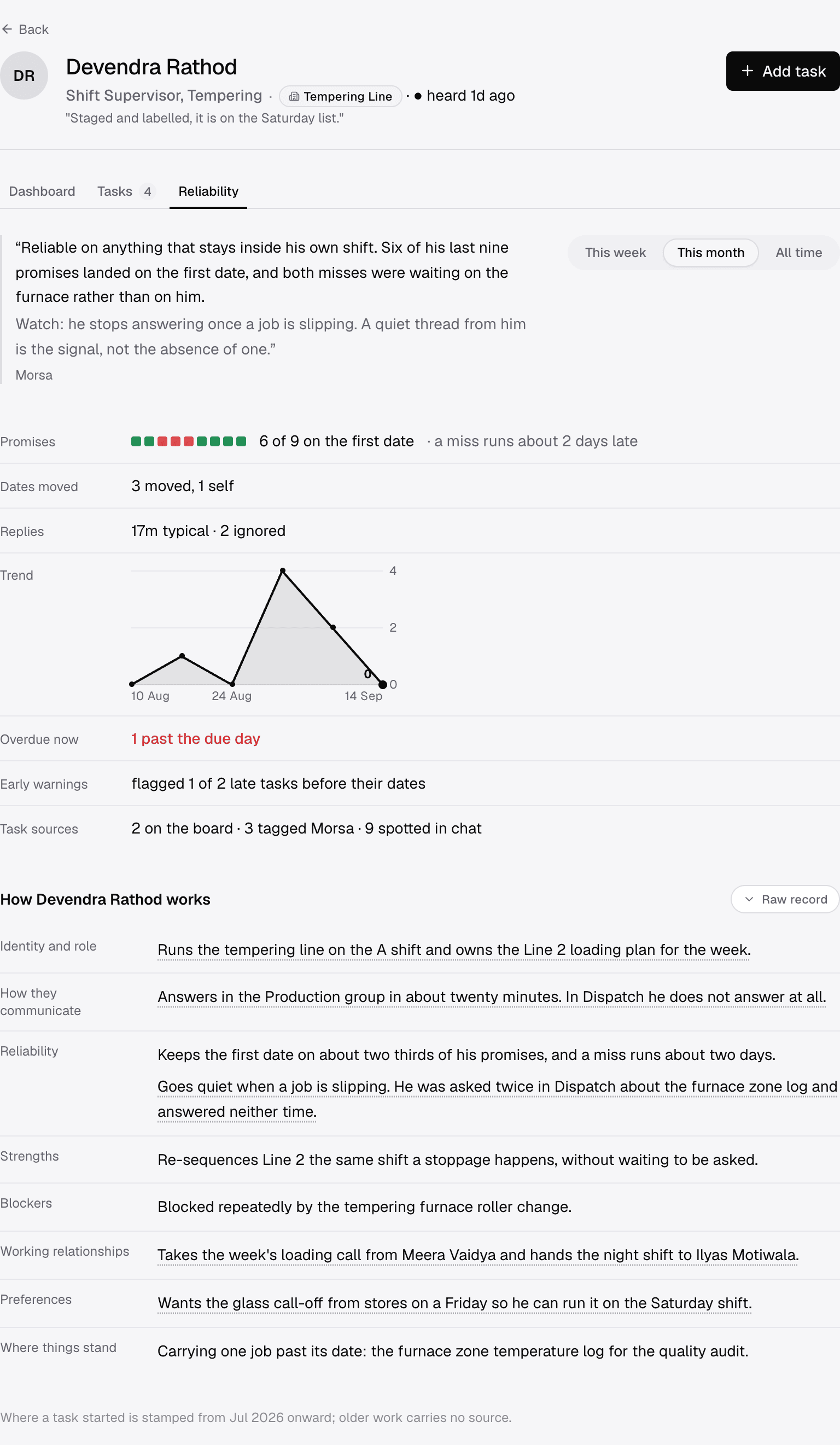
The reliability view in Morsa, shown here for a demo plant.
Two live examples. At JRG Automotive, an automotive and plastic body-parts manufacturer, Morsa identified 5 of 8 production-stopping material shortages early enough to act and saved the plant $2 million. At a Morsa customer plant, a manager set an 8,000-part night-shift target; seven hours later dispatch posted photos of parts that were unavailable, and nobody connected the two. Morsa compared the schedule (4,131 units) with dispatch (4,035), found the 96-piece shortage, linked it to the target, told dispatch to arrange the parts, told production the target was blocked by supply, and created a high-priority dependency, in under a minute.
Deployment. Cloud, private cloud, or fully on-premise including the AI models and databases. Four steps: Connect, Configure, Shadow, Live. Pilots start on one line or one workflow. Morsa is built in the United States by Lunar Inc. for North American discrete manufacturers. Read AI copilot for manufacturing for the full picture, or book a demo.
How do you start with AI in a plant?
One function, one measurable loss, real data, a named owner, and a plan for what happens after the alert. That is the pattern in every credible case above.
Pick one loss you already measure. Unplanned downtime on one line, scrap on one product, late shipments to one customer, or shortages that stop production. If nobody tracks it today, it is not the first project.
Check the data exists and is trusted. A vibration sensor on the critical motor, images of the defect, order and inventory records that match reality. Data quality is the barrier 63.2% of manufacturers name first, and 54% of plants worldwide still run production on paper or spreadsheets. Source 24 Source 25
Buy the detection, do not build it. Machine-health, vision and copilot products are mature, and the public benchmarks above tell you what a working deployment returns. The categories are mapped in the twelve types of manufacturing software.
Design the action before you turn on the alert. Who receives it, on what channel, what they may do, and how the plant knows it was done. This is the step most pilots skip.
Run in shadow, then go live on one line. Compare what the AI would have done with what people did for a few weeks, set the approval boundaries from what you learn, then let it act.
Measure the decision, not the model. Accuracy is the vendor’s metric. Yours is on-time commitments, downtime hours avoided, shortages caught before the line stopped. Half of manufacturers in the MLC survey have no AI metrics at all; pick yours before the pilot, not after.
Sources
US Census Bureau, Grundy, Breaux and Khatiwoda, “Large Firms With at Least 20 Employees Biggest AI Users”, 26 May 2026, Business Trends and Outlook Survey, 14 December 2025 to 3 May 2026. https://www.census.gov/library/stories/2026/05/ai-use-businesses.html
US Census Bureau Center for Economic Studies, Bonney, Breaux, Dinlersoz, Foster, Haltiwanger and Pande, “The Microstructure of AI Diffusion: Evidence from Firms, Business Functions, and Worker Tasks”, working paper CES-26-25, April 2026. https://www.census.gov/library/working-papers/2026/adrm/CES-WP-26-25.html
The Register, Brandon Vigliarolo, “McKinsey says enterprise AI is finally on the road to ROI”, 25 August 2026, reporting McKinsey’s State of AI 2026 survey of 1,719 respondents (McKinsey’s own page could not be fetched). https://www.theregister.com/ai-and-ml/2026/08/25/mckinsey-says-enterprise-ai-is-finally-on-the-road-to-roi/5292388
Deloitte Insights, “2026 Manufacturing Industry Outlook”, 13 November 2025. https://www.deloitte.com/us/en/insights/industry/manufacturing-industrial-products/manufacturing-industry-outlook.html
Capgemini and Microsoft, “The New AI Imperative in Manufacturing”, 2025; the 5%, 45%, 25% and 80% figures are footnoted to Capgemini and Everest Group, “Making brownfield factories smarter and greener”, 2024, with no published sample. https://www.capgemini.com/wp-content/uploads/2025/10/Capgemini-Microsoft-The-New-AI-Imperative-in-Manufacturing-10.pdf
World Economic Forum, “Global Lighthouse Network 2025: World Economic Forum Recognizes 12 New Sites”, press release, Geneva, 16 September 2025 (Kiva Allgood quote; weforum.org blocks automated readers, text verified through a text render of the page on 19 September 2026). https://www.weforum.org/press/2025/09/global-lighthouse-network-2025-world-economic-forum-recognizes-12-new-sites-driving-holistic-transformation-in-manufacturing/
National Association of Manufacturers, “Manufacturers’ Outlook Survey, Second Quarter 2026”, 10 June 2026, 215 responses, fielded 12 to 28 May 2026 (the third-quarter survey of 14 September 2026 asked no AI question). https://nam.org/wp-content/uploads/securepdfs/2026/06/NAM_2026_Q2_Outlook_Survey_Writeup.pdf
RSM US, “How manufacturers are using AI in 2026”, RSM Middle Market AI Survey 2026, 21 July 2026. https://rsmus.com/insights/industries/manufacturing/manufacturers-using-ai-2026.html
US Department of Energy, Federal Energy Management Program, “Operations and Maintenance Best Practices Guide, Release 3.0”, August 2010, chapter 5. https://www.energy.gov/sites/prod/files/2020/04/f74/omguide_complete_w-eo-disclaimer.pdf
MIT Sloan Executive Education, “How is AI Used in the Manufacturing Industry”, 29 April 2025 (no individual author named). https://executive.mit.edu/How-is-AI-used-in-the-manufacturing-industry.html
BMW Group, “Fast, efficient, reliable: artificial intelligence in BMW Group production”, press release, 15 July 2019 (Christian Patron quote). https://www.press.bmwgroup.com/global/article/detail/T0298650EN/
Augury, “Watch How Augury Helped Frito-Lay Save a Mountain of Snacks”, 13 July 2021 (vendor; no PepsiCo individual quoted). https://www.augury.com/blog/customers-partners/watch-how-augury-helped-frito-lay-save-a-mountain-of-snacks/
Automation World, David Greenfield, “Colgate-Palmolive Focuses on Machine Health to Improve Supply Chain Operations”, 7 July 2021 (Warren Pruitt quotes). https://www.automationworld.com/process/plant-maintenance/article/21549899/colgate-palmolive-focuses-on-machine-health-to-improve-supply-chain-operations
Autodesk, “General Motors: Driving a lighter, more efficient future of automotive part design”, customer story, undated (Kevin Quinn quote; the host blocks automated readers, text verified through a text render of the page). https://www.autodesk.com/customer-stories/general-motors-generative-design
Microsoft Dynamics 365 blog, Raghav Jandhyala, “Becoming a Frontier Manufacturing Firm: Agentic decisions across the manufacturing value chain”, 16 April 2026 (Sean Barrett quote, vendor case study). https://www.microsoft.com/en-us/dynamics-365/blog/business-leader/2026/04/16/becoming-a-frontier-manufacturing-firm-agentic-decisions-across-the-manufacturing-value-chain/
Smart Industry, “Schneider Smart Factory named a Sustainability Lighthouse by WEF”, 28 September 2021. https://www.smartindustry.com/benefits-of-transformation/process-innovation/news/11290107/schneider-smart-factory-named-a-sustainability-lighthouse-by-wef
Voxel AI, “Best Predictive Safety Analytics Software for Manufacturing in 2026” (vendor-reported customer results), 2 August 2026, re-read 19 September 2026. https://www.voxelai.com/industry-insights/predictive-safety-analytics-software-manufacturing
Huawei Enterprise, “Intelligent Manufacturing: Keeping a Sharper Eye on Industrial Quality Inspection with Smart Technologies” (vendor-reported case study, undated; host blocks automated readers, verified through a text render). https://e.huawei.com/en/case-studies/industries/manufacturing/ai-quality-inspection-2023
Microsoft Source, “Siemens and Microsoft scale industrial AI”, 24 October 2024. https://news.microsoft.com/source/2024/10/24/siemens-and-microsoft-scale-industrial-ai/
Siemens, “Siemens Industrial Copilot expanded, adopted by thyssenkrupp”, press release, 12 November 2024. https://press.siemens.com/global/en/pressrelease/siemens-industrial-copilot-expanded-adopted-thyssenkrupp
Microsoft Learn, “Use Factory Operations Agent in Azure AI”, release plan 2024 wave 2 (public preview 18 November 2024, general availability June 2025; now archived). https://learn.microsoft.com/en-us/industry/release-plan/2024wave2/cloud-manufacturing/use-factory-operations-agent-azure-ai
Gao, Krüger, Merklein, Möhring and Váncza, “Artificial Intelligence in manufacturing: State of the art, perspectives, and future directions”, CIRP Annals, volume 73, issue 2, 2024, pages 723 to 749, DOI 10.1016/j.cirp.2024.04.101 (record verified via Crossref; the publisher’s page blocks automated readers). https://www.sciencedirect.com/science/article/pii/S000785062400115X
Rockwell Automation, “90% of Manufacturers Say Digital Transformation Is Now Essential”, 2026 State of Smart Manufacturing Report, 19 May 2026, 1,560 respondents in 17 countries (vendor research). https://www.rockwellautomation.com/en-us/company/news/press-releases/90-of-Manufacturers-Say-Digital-Transformation-Is-Now-Essential-According-to-New-Global-Study.html
Manufacturing Leadership Council, “Survey: GenAI Adoption Surges as Manufacturers Continue to Grapple with Data, Skills Issues”, 1 April 2026 (member survey, sample size not published). https://manufacturingleadershipcouncil.com/survey-genai-adoption-surges-as-manufacturers-continue-to-grapple-with-data-skills-issues/
IoT Analytics, Anand Taparia, “MES vendors replace pen, paper, and spreadsheets”, 15 December 2025. https://iot-analytics.com/mes-vendors-replace-pen-paper-spreadsheets/
World Economic Forum with McKinsey and Company, “Global Lighthouse Network: Rewiring Operations for Resilience and Impact at Scale”, January 2026. https://www3.weforum.org/docs/WEF_Global_Lighthouse_Network_2026.pdf
Stanford Institute for Human-Centered AI, “The AI Index 2026 Annual Report”, April 2026 (corporate figures drawn from a McKinsey 2025 survey; job-posting figures from Lightcast). https://hai.stanford.edu/assets/files/ai_index_report_2026.pdf
Gartner, “Gartner Predicts Over 40% of Agentic AI Projects Will Be Canceled by End of 2027”, press release, 25 June 2025 (Anushree Verma quote; gartner.com blocks automated readers, text verified against an archived copy of the release on 19 September 2026). https://www.gartner.com/en/newsroom/press-releases/2025-06-25-gartner-predicts-over-40-percent-of-agentic-ai-projects-will-be-canceled-by-end-of-2027
The Manufacturing Institute and Deloitte, “Manufacturers Need as Many as 3.8 Million New Employees by 2033”, April 2024. https://themanufacturinginstitute.org/manufacturers-need-as-many-as-3-8-million-new-employees-by-2033/
NIST, “Artificial Intelligence Risk Management Framework (AI RMF 1.0)”, NIST AI 100-1, January 2023, section 3.4. https://nvlpubs.nist.gov/nistpubs/ai/NIST.AI.100-1.pdf
Manufacturing Dive, Nathan Owens, “‘We’re going to stop talking about AI,’ and other industrial predictions”, 17 September 2026 (Erik Syrjanen, Mike Cicco, Mehul Patel quotes from IMTS). https://www.manufacturingdive.com/news/ai-industrial-forecast-fanuc-generac-briggs-stratton-google-cloud-honeywell/830656/
Manufacturing Dive, Cole Rosengren, “MassMEP president talks AI adoption, funding and the evolving industry”, 16 June 2026 (Kathie Mahoney quote). https://www.manufacturingdive.com/news/massachusetts-mep-president-mahoney-manufacturing-technology-evolution/822723/
Changelog
20 September 2026: updated the Lighthouse network to the Forum’s January 2026 report (223 sites, 34 new in 2025, 1,150-plus solutions, AI mix of 62% analytical, 23% generative and 5% agents) while keeping the September 2025 cohort’s per-site results; added Rockwell’s May 2026 figures (34% of operations AI-augmented), the Manufacturing Leadership Council’s April 2026 survey, Stanford’s AI Index 2026, IoT Analytics’ 54% and Gartner’s June 2025 agentic-AI prediction.
20 September 2026: added a section on AI and manufacturing jobs (Deloitte, Census, Manufacturing Institute, MLC, NAM, Stanford) and made the approval-boundaries block its own question section with NIST’s accountability principle.
20 September 2026: added named quotations from Kiva Allgood (World Economic Forum), Warren Pruitt (Colgate-Palmolive), Christian Patron (BMW Group), Anushree Verma (Gartner), Kathie Mahoney (MassMEP), Erik Syrjanen (Briggs and Stratton), Mike Cicco (Fanuc America), Mehul Patel (Honeywell), Kevin Quinn (General Motors), Sean Barrett (Farmlands Cooperative, vendor case study) and Anil Kohli (J4S).
20 September 2026: corrected the Capgemini attribution (the 5%, 45%, 25% and 80% figures are 2024 Capgemini and Everest Group research republished in the 2025 paper, with no published sample), two thyssenkrupp claims not supported by Siemens’ release (“global locations from 2025 onwards,” and error-code translation only), the Procurement Agent description (Microsoft’s sentence separated from the customer’s quote), the Autodesk story’s unsupported date, and the Lighthouse selection wording (“designated by an independent panel of experts”).
20 September 2026: rephrased the remaining statement headings as questions, matched the table of contents, and gave the J4S link a descriptive anchor.

