A smart factory is a manufacturing plant where the machines, the software systems, and the people are connected, so the plant can see what is happening as it happens. It understands what a change means for orders and schedules, and acts on it without waiting for someone to notice. The sensors, the software, and the AI are the means. The test is whether the plant responds faster, with fewer surprises, when reality departs from the plan. Most plants are not there yet: in Rockwell Automation’s 2026 survey of 1,560 manufacturing respondents, 59% actively use smart manufacturing technologies, and only 43% of the data they collect is used effectively.
In this guide
What is a smart factory?
What makes a factory smart?
What technology does a smart factory use?
What does a smart factory look like in practice?
What are the advantages of a smart factory?
What is the difference between a smart factory, smart manufacturing and Industry 4.0?
How does a mid-size plant become a smart factory?
Why do smart factory projects stall?
Where does Morsa fit in a smart factory?
FAQ, Sources, Changelog, Related pages
What is a smart factory?
A smart factory is a plant that uses a constant stream of data from its connected machines, systems and people to see, understand and act on what is happening, as it happens. Ask five vendors and you get five definitions that end in the same place: connected equipment, data collected and shared, decisions “informed.” The one most of them paraphrase is Deloitte’s from 2017, which calls the smart factory “a fully connected and flexible system” that “can use a constant stream of data from connected operations and production systems to learn and adapt to new demands” (Deloitte, 2017). NIST, the US standards body, describes smart manufacturing systems as ones that use “advanced technologies that promote rapid flow and widespread use of digital information within and between manufacturing systems” (NIST IR 8107).
Both definitions are about the flow of information, not the hardware. A plant with four hundred sensors and nobody acting on the readings is instrumented, not smart. A plant with an ERP (enterprise resource planning, the system that holds orders, inventory, and purchasing), two supervisors in a group chat, and a habit of turning a short shipment into a resequenced schedule within the hour is doing what the definitions describe.
A working definition. A smart factory can see what is happening, understand what it means for this order and this machine, decide what to do inside the plant’s rules, get it done through systems and people, and confirm it happened. Most factories that call themselves smart do the first two. Smart is not seeing. Smart is acting, and proving it.
THE SMART FACTORY LOOP
See, understand, decide, act, verify
01
See
Sensors, systems, and the group chat report what is happening.
02
Understand
Which part, order, machine, customer, and owner it touches.
03
Decide
The next action, inside the plant’s approved rules.
04
Act
A job, an owner, a due time, an escalation path.
05
Verify
Closed on proof: a photo, a document, a system entry.
AND THE NEXT CHANGE STARTS THE LOOP AGAIN
Working definition, built on Deloitte (2017) and NIST IR 8107. 43%: Rockwell Automation, 2026 State of Smart Manufacturing Report.
WHERE MOST SMART FACTORIES STOP
Data is collected and shown on a screen. Nobody is named, and nothing moves. Rockwell’s 2026 survey: only 43% of collected data is used effectively.
DATA ON A SCREEN
WHERE THE PLAN GETS RESCUED
The finding becomes work with an owner and a deadline, and the plant checks it was done. This is the part no sensor provides.
WORK WITH AN OWNER
What makes a factory smart?
A factory is smart when its data reaches someone or something that acts on it, and the plant can show the action happened. How much of that loop runs without a person is the subject of autonomous manufacturing. Deloitte’s 2017 paper lists the smart factory’s major features as connectivity, optimization, transparency, proactivity and agility (Deloitte, 2017). Vendor pages usually collapse those into a four-rung ladder from raw data to action. Here is that ladder in plant terms, as this guide draws it.
1
Name: Data available
What the plant can do: Machines and systems produce data, but it stays where it was made: in the PLC, in the ERP, on the clipboard
What it looks like on a Tuesday: Someone walks the floor to find out why Line 3 is behind
2
Name: Data accessible
What the plant can do: Data from machines and systems is collected in one place and visible in near real time
What it looks like on a Tuesday: A screen shows Line 3 at 71% of plan. A supervisor sees it when they look at the screen
3
Name: Data analyzed
What the plant can do: Software finds the pattern: the press slows every time a certain resin lot is loaded
What it looks like on a Tuesday: An alert names the resin lot as the likely cause before the operator has worked it out
4
Name: Action-oriented
What the plant can do: The finding triggers work with an owner and a deadline: a hold, a purchase, a schedule change. The plant checks it was done
What it looks like on a Tuesday: The lot is quarantined, the schedule is resequenced, the customer date is protected, and the plant head sees it closed by 3 pm
Most plants that describe themselves as smart look like level 2 from where we sit: the data is collected and shown, and the acting is still manual. Two 2026 surveys point the same way. Rockwell Automation’s 2026 State of Smart Manufacturing Report, 1,560 respondents in 17 countries fielded by Sapio Research, finds that of the data plants collect, only 43% is used effectively (Rockwell Automation, May 2026; Rockwell is a vendor, so read it as vendor research with a stated sample). In Deloitte’s survey of 600 executives at large US manufacturers, 92% “believe smart manufacturing will be the main driver for competitiveness over the next three years,” yet as Manufacturing Dive reported from the same survey, “only about 29% of manufacturers reported already using AI or machine learning at the facility or network level, and only 24% had deployed generative AI” (Deloitte, May 2025; Manufacturing Dive, May 2026). The distance between level 2 and level 4 is not more sensors. It is a named owner acting on what the sensors say.
What technology does a smart factory use?
A smart factory runs the same five-level stack as any plant, from machines up to business systems, with connectivity, analytics and AI cut across the levels. The industry organizes the stack with ISA-95, published internationally as IEC 62264, whose purpose is “to create a standard that will define the interface between control functions and other enterprise functions” (ISA; IEC). It is built on the Purdue reference model, which runs from level 0, the physical process, to level 4, the business systems (Purdue Enterprise Reference Architecture, a secondary source standing in for the paid standard). In plain words:
0
What sits there: The physical process
Plain words: The machines, the material, and the people running them
Typical products: Presses, CNC machines, assembly lines, ovens
1
What sits there: Sensing and actuating
Plain words: The parts that measure and the parts that move
Typical products: Temperature probes, vibration sensors, counters, valves, drives
2
What sits there: Control
Plain words: The computers that run the machines minute to minute
Typical products: PLC (programmable logic controller), HMI (the operator’s screen), SCADA (supervisory control and data acquisition)
3
What sits there: Manufacturing operations
Plain words: Software that manages production work: what runs where, in what order, with what result
Typical products: MES (manufacturing execution system), MOM (manufacturing operations management), QMS (quality management), CMMS (maintenance management)
4
What sits there: Business
Plain words: Software that manages the business of the plant: orders, inventory, purchasing, money
Typical products: ERP, MRP (material requirements planning), WMS (warehouse management), planning and scheduling tools
No level
What sits there: People
Plain words: Where most plan changes in a mid-size plant are actually decided; not in the standard
Typical products: WhatsApp, Microsoft Teams, email, SMS, radios, the morning meeting
The “smart” additions cut across those levels rather than adding a new one:
IIoT (the industrial internet of things). Sensors and gateways that put level 0 to 2 data on the network, so a press built in 1998 can report cycle counts. acatech notes “it is not unusual to see machines that are 50 or more years old still in use on the shop floor,” and that they can be connected with new sensors (acatech, 2020).
Edge computing. Processing at or near the machine, so a decision such as “reject this part” does not wait for a round trip to the cloud.
Data platform or historian. Where the data lands, time-stamped, so it can be compared.
Analytics and AI. Software that finds patterns: a bearing that is going to fail, a station whose reject rate rises with a supplier lot, a schedule that will miss Friday.
Digital twin. A virtual model of a machine or line, fed by its sensor data. Useful for trying a line change before making it.
Robots, cobots, and automated material handling. Level 0 and 1 equipment that takes instructions from level 3.
Connected worker tools. Tablets, work instructions, and the chat apps the floor already uses.
Then there is the layer nobody draws. In a mid-size plant, the biggest source of information above level 3 is people: the supervisor’s text about the short shipment, the photo of the failed part, the “can we push job 4471 to Thursday” in the group chat. Yung Fung, Managing Director and General Manager of Advanced Industrial Technology and Platforms at Ford, said at an MIT event in May 2026 that “the secret sauce for any plant” is “the conversations that go to problem solve and understand and triangulate the context,” and that it “goes into the ether,” because “it’s not captured in a database, it’s not captured in a report” (Manufacturing Dive, May 2026). In an ISA-95 diagram that traffic has no level. In a real plant it is where most plan changes are decided. The twelve system types themselves, and what record each owns, are laid out in manufacturing software: the 12 types.
THE PLANT TECHNOLOGY STACK
ISA-95 levels 0 to 4 in plain words, with the people layer alongside
IIoT, edge computing, analytics, AI, and digital twins cut across levels 0 to 4. They do not add a level.
LEVEL 4
ERP
Business
Orders, inventory, purchasing, money.
MRP, WMS, PLANNING TOOLS
LEVEL 3
MES
Manufacturing operations
What runs where, in what order, with what result.
MOM, QMS, CMMS
LEVEL 2
PLC
Control
The computers that run the machines minute to minute.
HMI, SCADA
LEVEL 1
SENSE
Sensing and actuating
The parts that measure and the parts that move.
SENSORS, COUNTERS, VALVES, DRIVES
LEVEL 0
PLANT
The physical process
The machines, the material, and the people running them.
PRESSES, CNC, LINES, OVENS
NO LEVEL
PEOPLE
People
WhatsApp, Teams, email, SMS, radios, photos posted in groups, the morning meeting. The supervisor’s text about the short shipment. The photo of the failed part. “Can we push 4471 to Thursday?”
NOT IN THE STANDARD
Levels: ISA-95 / IEC 62264, on the Purdue reference model. People layer: not in the standard. In a mid-size plant, this is where most plan changes are decided.
What does a smart factory look like in practice?
In practice a smart factory is an ordinary chain of events that runs to the end instead of stopping at a screen. The technology in each of these examples is ordinary.
Maintenance. A vibration sensor on a stamping press shows a bearing trend on Monday. The CMMS opens a work order, the planner moves the die change into Wednesday’s planned stop, and purchasing confirms the bearing is on the shelf. The press never goes down unplanned. Every link exists today (predictive maintenance software is the first one); the hard part is the handoffs between the maintenance system, the schedule, and the person who has to move the job.
Data from the machine, not the clipboard. Alexandria Industries, a Minnesota manufacturer in business since 1966, spent years trying to collect run-rate data by hand before connecting its machine controls to its Infor ERP. Jeff Cypher, its director of business integration, told Modern Machine Shop what the machinists wanted was to “make good parts fast,” and warned: “If you don’t have a workforce willing or understanding what it is that you’re going to do with the data, you’re going to fight that” (Modern Machine Shop, August 2025).
Materials. A manager sets an 8,000-part target for the night shift. Seven hours later, dispatch posts photos showing parts unavailable. In a level 2 plant, both facts are on a screen and nobody connects them. In a level 4 plant, the schedule (4,131 units) is compared with dispatch (4,035), the 96-piece shortage is tied to the target, dispatch is told to arrange the parts, and production is told the target is blocked by supply.
What are the advantages of a smart factory?
The advantages are fewer surprises and more output from the same people and machines, and the sourced numbers are narrower than the marketing ones.
Output, productivity, capacity. Deloitte’s survey of 600 executives at large manufacturers with US headquarters or operations, fielded August to September 2024 and published May 2025, reported “10% to 20% improvement in production output,” “7% to 20% improvement in employee productivity,” and “10% to 15% in unlocked capacity” from smart manufacturing initiatives (Deloitte, May 2025).
At the audited top end. The World Economic Forum’s Global Lighthouse Network, run with McKinsey, has grown “from 16 factories to 223 sites across more than 30 countries and 40 industries” as of January 2026, and analytical AI and machine learning are “now embedded in nearly 62% of their top-5 use cases” (WEF, January 2026). A 250-employee member, the Italian company Rold, “reported a financial impact of 7-8% growth of total company revenue from 2016 to 2017, driven by an overall equipment effectiveness (OEE) increase of 11%” (WEF, 2019). Jonathan Van Wyck of Boston Consulting Group gave SME the numbers a CFO can underwrite: “raw material savings of 2 to 5 percent through reduction of scrap and rework” and “20 to 60 percent reductions in change over time” (SME, 2018).
OEE. OEE (overall equipment effectiveness) is availability times performance times quality. The figure of 85% is widely treated as world class; Vorne, which publishes the benchmark and is a vendor with no stated sample or method, traces it to Japanese plants winning the Distinguished Plant Prize in the 1970s automotive industry, and says “most manufacturing companies, even today, have OEE scores closer to 60%” (Vorne, oee.com). The gap is mostly losses nobody sees without data: short stops, slow cycles, the first hour of a shift spent reconstructing the last one.
People. The Manufacturing Institute and Deloitte project that “as many as 3.8 million additional employees could be needed in manufacturing between 2024 and 2033” in the United States, and that 1.9 million of those jobs “could remain unfilled” (no sample is stated) (The Manufacturing Institute, April 2024). In NAM’s third-quarter 2026 survey of 220 manufacturers, 54.9% named attracting and retaining a quality workforce among their biggest challenges (NAM, September 2026). A plant that runs on connected information covers more with the people it has.
THE STATE OF THE SMART FACTORY
Four numbers on the state of the smart factory in 2026
59%
of manufacturers are actively using smart manufacturing technologies to support operations.
Rockwell Automation, May 2026
18%
of manufacturers are still in pilot mode.
Rockwell Automation, May 2026
43%
of the data plants collect is being used effectively.
Rockwell Automation, May 2026
1.9M
US manufacturing jobs could remain unfilled between 2024 and 2033.
The Manufacturing Institute and Deloitte, April 2024
READ TOGETHER
Six in ten manufacturers are using the technology. Less than half of the data they collect gets used. The gap is not sensors. It is that nobody is named to act.
Rockwell Automation, 2026 State of Smart Manufacturing Report (1,560 respondents, 17 countries). The Manufacturing Institute and Deloitte, April 2024.
What is the difference between a smart factory, smart manufacturing and Industry 4.0?
Industry 4.0 is the era, smart manufacturing is the practice, and a smart factory is the place. The three terms overlap, and vendors use them interchangeably, but they answer different questions. A smart factory is one plant inside a wider shift, explained in what is Industry 4.0, in plain English.
What it names
Industry 4.0: An era: the fourth industrial revolution. Named for Germany’s Industrie 4.0 initiative, first presented at the Hannover Messe in 2011, with its working group’s final report in 2013 (acatech). NIST calls it “a key initiative in Germany containing a technical strategy for achieving” smart manufacturing systems
Smart manufacturing: The practice: running a manufacturing business on live, shared data, from product design through production to suppliers and customers. The American term, defined by NIST
Smart factory: One plant, or one line, that runs that way
Scope
Industry 4.0: Every industry, whole economies
Smart manufacturing: A company’s manufacturing operations, including the suppliers and customers connected to them
Smart factory: One site: the four walls, and what feeds them
Who uses the word
Industry 4.0: Governments, consultancies, standards bodies
Smart manufacturing: Executives, NIST, industry surveys
Smart factory: Plant managers, engineers, vendors
Measured by
Industry 4.0: Adoption reports and policy
Smart manufacturing: Company programs and budgets
Smart factory: Plant KPIs: OEE, on-time delivery, schedule adherence, scrap, unplanned downtime
Read next
Industry 4.0: Industry 4.0 explained
Smart manufacturing: Smart manufacturing explained
Smart factory: This page
CESMII, the US Department of Energy’s smart manufacturing institute, describes the two national tracks as parallel: “Industrie 4.0 has focused on cyber-physical systems while Smart Manufacturing has focused on highly connected information-driven manufacturing” (CESMII, 2021). A smart factory is where either track lands.
How does a mid-size plant become a smart factory?
A mid-size plant becomes a smart factory by starting from the gap between plan and reality, connecting the systems it already owns, and closing the loop on one workflow before buying a sensor. Almost everything written about smart factories is written about large ones. A 50 to 1,000 person discrete plant starts somewhere else: an ERP that is mostly right, an MES if it is lucky, a half-used maintenance system, spreadsheets between them, and group chats carrying the rest. There is no data engineering team. That is normal. In Deloitte and MAPI’s 2019 study of more than 600 executives, 49% of the sample had “no ongoing smart factory initiatives” and “only three percent of the sample indicated full-scale smart factory adoption” (Deloitte and MAPI, 2019). Kathie Mahoney, President of MassMEP, a NIST Manufacturing Extension Partnership center, described the small and medium plants she sees in September 2026: “It’s a lot of they don’t know what they don’t know. It’s how do we implement the technologies in the most efficient way for each facility, and it may not be the same for every facility” (Manufacturing Dive, September 2026).
The path that works at that size is the opposite of a technology roadmap. It starts from the gap, and it is the same sequence the guide to digital transformation in manufacturing sets out for a whole company.
Write down the last ten times the plan broke. A late supplier, a press down, a short shift, a customer pulling a date in. For each, note when somebody first knew and when the plant responded. That gap, in hours, is what a smart factory exists to close.
Connect what you already own before buying anything. The ERP, the MES if you have one, the CMMS, the quality records, the planning spreadsheet. Most level 2 gains come from joining systems that already exist. See what an MES system is if you are deciding whether you need one.
Pick one line or one workflow. Material availability for the line with the worst on-time record, or quality holds, or shift handover. Not “the digital factory”.
Treat the floor’s knowledge as data. Photos, messages, and verbal handovers are the richest signal in the plant. Capture them where they happen instead of asking people to re-enter them.
Close the loop on paper first. For each signal, write who acts, by when, and what counts as done. If step 2 produces a screen and step 5 is skipped, you have bought a level 2 plant.
Measure three numbers before and after. OEE or schedule adherence, on-time delivery, and the hours from problem seen to problem owned.
Instrument where the data proved you were blind. Vibration on the press that keeps failing, vision on the station that keeps rejecting. Now the sensor has a job.
Shadow, then go live, then scale. Run the new system alongside the old one, compare, keep approvals with people, then extend to the next line.
Two costs people underestimate. The first is the time your best planner and supervisor spend writing the rules in step 5; that is the largest line item. The second is security. In Rockwell’s 2026 survey, “nearly half of manufacturers (46%) experienced at least one cyber incident in the past year” (Rockwell Automation, May 2026), and a Black Kite study of the top 1,000 US manufacturers, reported by Manufacturing Dive in September 2026, counted more than 1,180 manufacturing ransomware victims since the start of 2026, with “seven in 10 victims” being mid-market firms with revenue between $10 million and $100 million (Manufacturing Dive, September 2026; Black Kite is a security vendor). Segment the plant network from the office network, and if plant data cannot leave the building, insist on software that runs on-premise. The free help exists: the MEP National Network runs “nearly 1,400 trusted manufacturing advisors and experts at more than 450 MEP service locations” (NIST MEP).
Why do smart factory projects stall?
Smart factory projects stall because the data is collected and not used, the pilot never ends, nobody owns the action, and the skills are missing. Four reasons show up in every survey and every plant.
The data is collected and not used. Only 43% of collected data is used effectively (Rockwell, 2026). Screens go up; behavior does not change.
The pilot never ends. In Rockwell’s 2026 survey, “6 in 10 manufacturers (59%) report actively using smart manufacturing technologies to support operations, while only 18% remain in pilot mode” (Rockwell Automation, May 2026), down from the “more than 70% of industrial companies still in ‘pilot purgatory’” that the WEF and McKinsey reported in 2019 (WEF, 2019). In the Deloitte and MAPI survey, 33% of smart factory leaders named lack of IT infrastructure as a significant impediment, and 27% of respondents named difficulty integrating IT with OT (operational technology, the machine side) (Deloitte, 2020).
Nobody owns the action. The alert fires. Two people assume the other one has it. The customer finds out first. That is the gap between level 3 and level 4, and no sensor closes it. Ford’s Yung Fung: “There’s a lot of signal in the factory. Too much data actually in a lot of cases” (Manufacturing Dive, May 2026).
Skills and risk. Deloitte’s 2020 write-up cites a separate global Deloitte survey in which “just 14 percent of C-level manufacturing leaders” strongly agreed their organizations had the skills they will need. In the 2025 survey, “almost two-thirds (65%) of respondents ranked operational risk as the first or second concern” (Deloitte, May 2025), and in Deloitte’s 2026 outlook the top concern for more than a third of 600 executives was equipping workers with the skills they need (Deloitte, November 2025).
The pattern is consistent. Plants can see. Understanding is improving. Acting, and proving the action happened, is where most projects stop. The plant-management systems that carry the record, fourteen of them compared with prices, are in manufacturing management software.
Where does Morsa fit in a smart factory?
Morsa, the AI that operates the factory for you, sits in the gap between seeing and acting. It does not replace the ERP or the MES; it works across them. Factories make a plan, reality changes, Morsa handles the gap.
What it reads. Communication channels are part of the signal and action layer, alongside the systems of record. So: the plant’s systems (ERP, MES, CMMS, QMS, WMS, planning tools, spreadsheets) and the plant’s conversations, in whatever channel it runs on (WhatsApp, Microsoft Teams, email, SMS, photos posted in groups). Integrations shown on morsa.ai include SAP Business One, Microsoft Dynamics 365 Business Central, Odoo, and QuickBooks, and those are examples, not the list: anything with an API, a database, a file export, a message stream, or an email trail can be connected, machines, PLCs, SCADA systems, and sensors included.
What it works out. For every change, which part, work order, machine, customer, and owner it touches, and what it affects downstream: “this 96-piece shortage blocks tonight’s 8,000-part target.” The night-shift example above is a real event, and Morsa connected the shortage to the target in under a minute.
What it decides. The next action inside the plant’s approved rules: expedite, resequence, substitute, escalate, request an approval, open and route the work. Consequential actions such as a production-plan change or a supplier commitment follow the customer’s approval rules.
What it does. Creates and assigns the job, messages the owner in the channel they already use, chases before the date, escalates up the reporting line when work goes quiet, and updates the systems of record.
What the user sees. The shortage flagged in the supervisors’ existing group, with an owner and a due time; a job that stays open until the proof shows up (a photo, a document, a system entry), not until someone types “done”. Production Head Anil Kohli at J4S: “Our people don’t have to learn any new software. People just message the way they always have. Morsa coordinates all the messages in the background.”
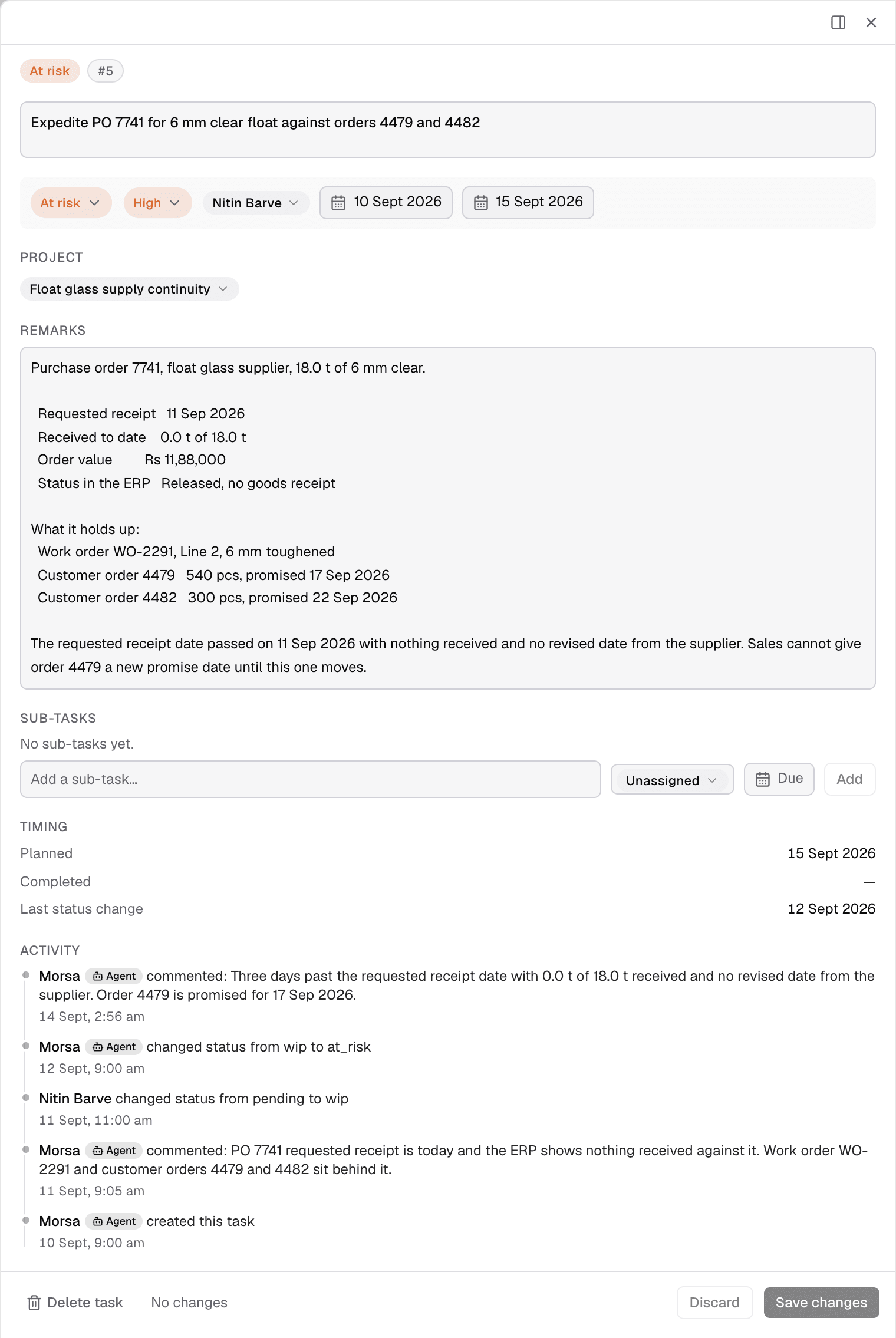
A purchasing commitment in Morsa, shown here for a demo plant.
What changes. At a 120-person glass plant, onboarded in two days, on-time completion of operational commitments rose from about 30% to about 75% in the first four weeks, across about 900 commitments in the first month. Plant Head Sunil K Verma: “I used to spend the first hour of every morning reconstructing yesterday. Now the chasing happens in the WhatsApp groups my supervisors already use, whether or not I remember.” The full account is in how a glass plant took on-time completion from 30% to 75% in four weeks. At JRG Automotive, an automotive and plastic body-parts manufacturer serving OEMs, Morsa identified 5 of 8 production-stopping material shortages early enough to act and saved the plant $2 million.
Deployment is cloud, private cloud, or fully on-premise, including the AI models and the databases, in four steps: Connect, Configure, Shadow, Live. Pilots start on one line or one workflow. The whole loop is on the AI copilot for manufacturing page.
Sources
National Institute of Standards and Technology, Lu, Morris, Frechette. Current Standards Landscape for Smart Manufacturing Systems, NIST IR 8107, February 2016.
Deloitte Insights, Sniderman, Hartigan, Burke, Laaper. The smart factory: Responsive, adaptive, connected manufacturing, August 31, 2017.
Deloitte and MAPI. 2019 Deloitte and MAPI Smart Factory Study, 2019, online survey of more than 600 executives (Deloitte’s own copy; the Manufacturers Alliance host blocks automated fetches).
Deloitte Insights, Cotteleer, Sniderman, Laaper, Dollar. Implementing the smart factory, March 30, 2020.
Deloitte, Gaus and Schlotterbeck. 2025 Smart Manufacturing and Operations Survey, May 1, 2025, 600 executives, fielded August to September 2024.
Deloitte, 2026 Manufacturing Industry Outlook, November 13, 2025.
Manufacturing Dive, Why most US manufacturers still aren’t using AI and automation, May 26, 2026 (reporting Deloitte’s 2025 survey).
Rockwell Automation. 90% of Manufacturers Say Digital Transformation Is Now Essential, According to New Global Study (2026 State of Smart Manufacturing Report, 1,560 respondents, 17 countries, Sapio Research; vendor research), May 19, 2026.
World Economic Forum with McKinsey & Company. Global Lighthouse Network: Rewiring Operations for Resilience and Impact at Scale, January 2026.
World Economic Forum with McKinsey & Company. Fourth Industrial Revolution: Beacons of Technology and Innovation in Manufacturing, January 2019.
SME, Smart Manufacturing: 7 Essential Building Blocks, 2018 (Jonathan Van Wyck, BCG, quotes).
The Manufacturing Institute and Deloitte. Manufacturers Need as Many as 3.8 Million New Employees by 2033, April 2024 (no sample size stated).
National Association of Manufacturers, Manufacturers’ Outlook Survey, Third Quarter 2026, September 14, 2026, 220 responses.
International Society of Automation. ISA95, Enterprise-Control System Integration.
IEC, IEC 62264-1:2013 Enterprise-control system integration, Part 1.
Wikipedia. Purdue Enterprise Reference Architecture (secondary source for the paid ISA-95 text).
Vorne Industries. World-Class OEE (vendor page; no sample or method stated).
acatech. Recommendations for implementing the strategic initiative INDUSTRIE 4.0: Final report of the Industrie 4.0 Working Group, April 8, 2013.
acatech. Industrie 4.0 feiert 10-jähriges Jubiläum (the 2011 Hannover Messe presentation), 2021.
CESMII, Conrad Leiva, A Brief History of Smart Manufacturing, June 6, 2021.
Manufacturing Dive, Cole Rosengren, MIT manufacturing event: Ford, Amgen, GE, ArcelorMittal on data and automation, May 22, 2026 (Yung Fung quotes).
Modern Machine Shop, Evan Doran, Benefitting From an Accurate Data Ecosystem, August 6, 2025 (Jeff Cypher, Alexandria Industries).
Manufacturing Dive, 5 manufacturing professionals talk AI, technology, September 9, 2026 (Kathie Mahoney, MassMEP).
Manufacturing Dive, Eric Geller, Manufacturing cybersecurity weaknesses, September 18, 2026 (Black Kite study; security vendor data).
NIST, About NIST MEP.
Changelog
20 September 2026: replaced the January 2023 Lighthouse count with the January 2026 figure (223 sites, 62% of top-five use cases on analytical AI) and added Deloitte’s 2025 survey cuts reported by Manufacturing Dive (29% using AI or machine learning, 24% generative AI, against 92% calling smart manufacturing the main driver of competitiveness).
20 September 2026: re-verified the 2019 Deloitte and MAPI figures from Deloitte’s own PDF and quoted them precisely (49% had “no ongoing smart factory initiatives”); corrected the Rockwell sample description to 1,560 respondents; dated Deloitte’s 2025 survey fieldwork to August to September 2024; removed the page’s own gloss on “operational risk.”
20 September 2026: added NAM’s third-quarter 2026 workforce figure, the Black Kite ransomware figures reported 18 September 2026, Rold’s audited OEE result, the BCG scrap and changeover ranges, and Vorne’s own account of where the 85% OEE benchmark came from, labeled as a vendor figure without a stated method.
20 September 2026: added named quotations from Yung Fung (Ford), Jeff Cypher (Alexandria Industries), Kathie Mahoney (MassMEP), Jonathan Van Wyck (BCG), Anil Kohli and Sunil K Verma (J4S).
20 September 2026: presented the four-level ladder as this guide’s own framing rather than attributing it to unfetched vendor pages; cited the IEC webstore for IEC 62264; labeled the Purdue article as a secondary source; fixed the redirected acatech anniversary URL.
20 September 2026: rephrased every section heading as a buyer’s question, added anchors to the table of contents, added the changelog and dateModified.

