Smart manufacturing is running a plant on live data instead of on yesterday’s reports. Sensors, machines, and business systems share what is happening as it happens, software works out what it means, and people or automated systems act on it. NIST puts the goal in two lines: optimize the use of labor, material, and energy, and respond quickly to changes in market demands and supply chains. In Rockwell Automation’s 2026 survey of 1,560 manufacturing respondents, 59% already use smart manufacturing technologies and 90% say digital transformation is essential to staying competitive.
In this guide
What is smart manufacturing in simple terms?
How is smart manufacturing different from a smart factory and Industry 4.0?
What technologies make manufacturing smart?
What is an example of smart manufacturing?
What are the benefits of smart manufacturing?
What are the barriers to smart manufacturing?
Is smart manufacturing only for large plants?
How do you start smart manufacturing at a mid-size plant?
What does smart manufacturing still leave open?
Where does Morsa fit in smart manufacturing?
FAQ, Sources, Changelog, Related pages
What is smart manufacturing in simple terms?
Smart manufacturing means the plant knows what is happening while it is happening, and can act on it. A machine reports its own state. A work order carries its own status. A late delivery shows up in the schedule before the line runs dry. The word “smart” does not mean the factory thinks for itself. It means information about the process reaches the person or system that needs it, when it is needed, in a form they can act on.
Three bodies own the term in the United States. Their definitions are worth reading side by side, because AI assistants and search engines quote them.
Who | Definition | What it stresses |
|---|---|---|
NIST (National Institute of Standards and Technology), NISTIR 8107, 2016 | Smart manufacturing systems “use information and communication technologies along with intelligent software applications to 1. Optimize the use of labor, material, and energy to produce customized, high-quality products for on-time delivery. 2. Quickly respond to changes in market demands and supply chains.” | Outcomes: on-time delivery and fast response to change |
CESMII, the US Department of Energy’s smart manufacturing institute, founded 2016; this is what CESMII now labels its original definition | “Smart Manufacturing is the information-driven, event-driven, efficient and collaborative orchestration of business, physical and digital processes within plants, factories and across the entire value chain.” | Orchestration across the whole value chain, not one machine or one building |
The MEP National Network (the Manufacturing Extension Partnership, NIST’s network of state manufacturing advisors), on SME.org, 2018 | “The practice of making information about manufacturing processes available when and where it is needed, in the form it is needed, so that smart decisions can be made about the course of critical business operations.” | Information reaching the decision, and people still making it |
CESMII adds seven first principles: open and interoperable, sustainable and energy efficient, secure, scalable, resilient and orchestrated, flat and real-time, proactive and semi-autonomous. “Semi-autonomous” is the honest word. The systems propose and sometimes act; people set the rules and handle the exceptions. How far plants have taken that is covered in autonomous manufacturing: the levels and the 2026 data. Jim Davis, CESMII’s Principal CIO Adviser and one of the people who coined the term, writes that “15 years ago the term Smart Manufacturing was coined as a shortened version of Smart (predictive, preventive and proactive), zero-incident, zero-emissions Manufacturing” (CESMII).
What smart manufacturing is not: a product you buy, a synonym for automation (a fully automated line with no data leaving it is not smart), or a dashboard. A dashboard shows you the plant. Smart manufacturing is what happens after you look.
How is smart manufacturing different from a smart factory and Industry 4.0?
Industry 4.0 is the era, smart manufacturing is the practice, and a smart factory is the place. The three terms get used interchangeably, and the People Also Ask box on Google shows readers want them separated. Smart manufacturing is the US name for the practice; the era it belongs to is explained in what is Industry 4.0.
Industry 4.0 is the era. The term “Industrie 4.0” was introduced at Hannover Messe (the Hannover trade fair) in Germany in 2011 as part of the federal government’s high-tech strategy (Wikipedia). The 2013 working group report that defined it, published by acatech (Germany’s National Academy of Science and Engineering), says: “Now, the introduction of the Internet of Things and Services into the manufacturing environment is ushering in a fourth industrial revolution.” It names the whole shift, across every industry.
Smart manufacturing is the practice. It is the American term for the same shift, and the older one: CESMII dates the phrase to a 2006 National Science Foundation workshop, and the Smart Manufacturing Leadership Coalition gathered “over 50 industry leaders” in 2010, before CESMII was formed in 2016. CESMII describes the two national tracks as parallel: “Industrie 4.0 has focused on cyber-physical systems while Smart Manufacturing has focused on highly connected information-driven manufacturing.”
A smart factory is the place. Deloitte’s 2017 definition: “a flexible system that can self-optimize performance across a broader network, self-adapt to and learn from new conditions in real or near-real time, and autonomously run entire production processes.” One site. Smart manufacturing can span ten of them and the suppliers in between.
THREE TERMS, ONE SHIFT
Industry 4.0 is the era. Smart manufacturing is the practice. A smart factory is the place.
INDUSTRY 4.0 · THE ERA
The fourth industrial revolution: the Internet of Things and cyber-physical systems reaching every industry. Named in Germany, Hannover Messe, 2011.
SMART MANUFACTURING · THE PRACTICE
Running manufacturing on data that moves across design, production, suppliers, and customers. The US term: Smart Manufacturing Leadership Coalition, NIST, CESMII.
SMART FACTORY · THE PLACE
One plant or site that runs that way. Deloitte, 2017: a flexible system that can self-optimize, self-adapt in near-real time, and run entire production processes.
ONE OF MANY SITES IN A PRACTICE
Sources: acatech 2013, NIST 2016, CESMII, Deloitte 2017
What it names
Industry 4.0: An era: the fourth industrial revolution
Smart manufacturing: A way of running manufacturing on live, shared data
Smart factory: One plant or site built and run that way
Origin
Industry 4.0: Germany, 2011, Hannover Messe; defined by acatech in 2013
Smart manufacturing: United States; coined 2006, Smart Manufacturing Leadership Coalition 2010, NIST standards review 2016, CESMII 2016
Smart factory: Popularized by consultancies; Deloitte’s definition dates from 2017
Scope
Industry 4.0: All industry, all technologies
Smart manufacturing: The product lifecycle, the production system, and the business, including suppliers and customers (NIST’s three dimensions)
Smart factory: One site: the four walls of one facility, and what feeds them
Who defines it
Industry 4.0: acatech, Plattform Industrie 4.0
Smart manufacturing: NIST, CESMII, SME
Smart factory: Deloitte, vendors
The question to ask
Industry 4.0: “Which era are we in?”
Smart manufacturing: “How do we run?”
Smart factory: “How does this site run?”
For the long version of each, read Industry 4.0 explained and what a smart factory is. This page stays on the practice.
What technologies make manufacturing smart?
No single technology makes manufacturing smart; the ten layers below produce, move, and use the data, and the value shows up only when the data changes a decision. NIST describes a smart manufacturing system as one that “maximizes the flow and re-use of data throughout the enterprise.” SME’s building-blocks report groups the technology into seven: smart devices, smart interfaces, edge computing devices, software platforms and apps, data management systems, big data analytics, and safety and security. Here is what each layer does in a plant.
Sensors and IIoT (Industrial Internet of Things)
What it is: Devices on machines, tools, and material that report state
What it does in the plant: Machine running or stopped, cycle counts, temperature, vibration, part location
Data it produces: Machine and process events, every few seconds
Connectivity and edge computing
What it is: Networks and small computers near the machines
What it does in the plant: Move machine data out of the cell; process it locally when the cloud is too slow
Data it produces: Cleaned, time-stamped event streams
PLCs and SCADA
What it is: Programmable logic controllers (PLCs) run equipment; supervisory control and data acquisition (SCADA) systems supervise and log it
What it does in the plant: Control the machine; expose its state
Data it produces: Machine states and alarms, as they happen
MES (manufacturing execution system)
What it is: Software that tracks work orders through the shop floor
What it does in the plant: Dispatch jobs, record what was made, by whom, on which machine, with what result
Data it produces: Work-in-progress status, actuals, traceability
ERP (enterprise resource planning) and MRP (material requirements planning)
What it is: The business system of record
What it does in the plant: Orders, bills of materials (BOMs), routings, inventory, purchasing, the plan
Data it produces: The plan, and the paperwork behind it
CMMS, QMS, WMS
What it is: Maintenance, quality, and warehouse systems
What it does in the plant: Work orders for repairs, inspection results, stock locations
Data it produces: Maintenance history, defects, inventory movements
Data platform and cloud
What it is: Where the streams land and get joined
What it does in the plant: Turn machine data and business data into one picture
Data it produces: The “digital shadow” of the plant
Analytics, machine learning, AI
What it is: Software that finds patterns and predicts
What it does in the plant: Predictive maintenance, quality prediction, schedule optimization, anomaly detection
Data it produces: Forecasts, alerts, recommendations
Digital twin
What it is: A live model of a line, a machine, or the whole plant
What it does in the plant: Simulate a change before you make it
Data it produces: Scenarios and expected outcomes
Connected worker tools
What it is: Tablets, wearables, augmented reality, messaging
What it does in the plant: Get instructions and alerts to people; capture what they did
Data it produces: Human confirmations, handovers, notes
One standard ties the layers together: ISA-95, whose purpose is to “define the interface between control functions and other enterprise functions.” When a vendor talks about “levels” (Level 2 control, Level 3 MES, Level 4 ERP), that is ISA-95 vocabulary. The practical point: your ERP and your machines were never designed to talk to each other, and a standard exists for the translation. Most plants have not made it: in Rockwell Automation’s July 2026 survey of 1,560 decision makers, 93% have an MES but only 23% report full integration with ERP, PLM, quality and OT systems (Rockwell Automation, July 2026; vendor research with a stated sample).
Three sibling guides go deeper on the systems that matter most for a discrete plant: what an MES system is, production planning software, and the full map of the twelve types in manufacturing software.
What is an example of smart manufacturing?
The best-documented examples are the World Economic Forum’s Global Lighthouse Network sites, audited with McKinsey since 2018, which have grown “from 16 factories to 223 sites across more than 30 countries and 40 industries” as of January 2026 (WEF, January 2026). Treat the numbers below as what the best-run sites in the world reported, not as an average.
Storage hardware (United States)
Plant: Hitachi Vantara, Norman, Oklahoma
What they did: Agentic AI on global demand forecasting and inventory, AI-generated proposal drafts, configure-to-order production
Reported result: Order-to-shipment lead time down 77%, inventory down 50%, forecast accuracy up about 19%, configure-to-order lead time down 84%, new-worker training time down 80% (company-reported)
Source: Hitachi, July 2026
Medical equipment
Plant: Agilent Technologies, Singapore
What they did: IIoT-powered digital twin, AI, and robotic automation for low-volume, high-complexity instruments
Reported result: Output up 80%, productivity up 60%, cycle time down 30%, quality cost down 20%
Source: WEF 2023
Automotive
Plant: Bosch, Bursa, Turkey
What they did: AI process control on hydro-erosion, anomaly detection on the shop floor, machining-tool life tracking
Reported result: Unit manufacturing cost down 9%, OEE (overall equipment effectiveness) up 9%
Source: WEF 2023
Electronics and appliances (United States)
Plant: LG Electronics, Clarksville, Tennessee
What they did: Deep learning, automation, and an intelligent injection molding system
Reported result: Injection molding OEE up 21%; sales up 68% and net profit up 703%
Source: WEF 2023
Consumer goods
Plant: Procter & Gamble, Rakona, Czech Republic
What they did: Live KPIs on the floor, in-process quality control, end-to-end supply chain synchronization, modeling and simulation
Reported result: In three years: productivity up 160%, inventory down 43%, changeover time down 36%
Source: WEF 2019
Electrical components, a 250-employee company
Plant: Rold, Cerro Maggiore, Italy
What they did: Machine alarm aggregation to operators’ smartwatches, OEE dashboards, sensor-based KPI reporting; three programmers hired, off-the-shelf technology
Reported result: OEE up 11%; revenue growth of 7 to 8% from 2016 to 2017
Source: WEF 2019
Commodity components, an SME
Plant: MantaMESH, Fröttstädt, Germany
What they did: Online ordering that generates “machine ready” data straight into production
Reported result: Quote-to-order time down 99%, changeover time down 99%, customer activity up 261%
Source: WEF 2023
Two things stand out. The results that matter to a mid-size plant are operational: OEE, lead time, changeover, on-time delivery. And the two smallest companies on the list did not buy the most technology. Rold’s president, Laura Rocchitelli, told the WEF the first reason was plain: “it was to become more efficient in our production performances. The opportunity to monitor in real time our manufacturing processes turned out to be essential to reach better results both in terms of machine utilization and performance of each machine” (WEF, 2019). Kiva Allgood, Managing Director at the World Economic Forum, said of the 2026 cohort: “The world’s leading manufacturers are no longer optimizing individual processes; they are reimagining entire operating systems” (Hitachi, July 2026).
What are the benefits of smart manufacturing?
The measured benefits are output, productivity and capacity gains in the 10% to 20% range at large US manufacturers, with wider ranges at the audited top end. The 2023 Lighthouse report (Figure 2, data dated 2022) plots the range of improvement reported across Lighthouse sites: factory output up 4% to 140%, productivity up 3% to 400%, OEE up 2% to 85%, lead time down 10% to 100%, changeover time down 10% to 100%, and on-time delivery up 1% to 33%. The ranges are that wide because the sites and use cases differ, and because these are the best-audited plants on the planet. By January 2026, analytical AI and machine learning were “embedded in nearly 62% of their top-5 use cases and generative AI (GenAI) embedded in 23%,” up from 9% in 2024 (WEF, January 2026).
For a plant deciding where to start, the narrower figures are more useful. In SME’s building-blocks report, Boston Consulting Group’s Jonathan Van Wyck described “raw material savings of 2 to 5 percent through reduction of scrap and rework” and “20 to 60 percent reductions in change over time by applying advanced technologies.” The measured version at scale is in Deloitte’s 2025 Smart Manufacturing and Operations Survey, 600 executives at large manufacturers with US headquarters or operations, fielded August to September 2024: “10% to 20% improvement in production output,” “7% to 20% improvement in employee productivity,” and “10% to 15% in unlocked capacity.”
Adoption is mainstream. Rockwell Automation’s 2026 State of Smart Manufacturing Report, 1,560 respondents in 17 countries fielded by Sapio Research, finds “6 in 10 manufacturers (59%) report actively using smart manufacturing technologies,” 90% “say digital transformation is essential to staying competitive,” and “one-third of operations (34%) are AI-augmented today,” with manufacturers expecting “more than half of operations to be AI-supported by 2030” (Rockwell is a vendor; read it as vendor research with a stated sample). Deloitte’s 2026 Manufacturing Industry Outlook reports that 80% of the 600 executives surveyed “plan to invest 20% or more of their improvement budgets in smart manufacturing initiatives.”
SOURCED FIGURES
Adoption is mainstream. Scaling is not.
59%
of manufacturers surveyed already use smart manufacturing
Rockwell Automation, State of Smart Manufacturing Report, 11th edition, 2026
80%
of 600 executives plan to put 20% or more of improvement budgets into it
Deloitte, 2026 Manufacturing Industry Outlook, Nov 2025
223
audited Lighthouse sites across more than 30 countries and 40 industries
World Economic Forum with McKinsey, Global Lighthouse Network, Jan 2026
62%
of Lighthouse top-five use cases now embed analytical AI and machine learning
World Economic Forum with McKinsey, Global Lighthouse Network, Jan 2026
All four figures are sourced in full in the guide.
The benefit that gets underreported is response time. acatech’s Industrie 4.0 Maturity Index puts it plainly: the capabilities “help manufacturing companies to dramatically reduce the time between an event occurring and the implementation of an appropriate response.” Every KPI above is downstream of that.
What are the barriers to smart manufacturing?
The barriers are mostly people and process, not technology: skills, knowing where to begin, pilots that never scale, and dirty records. They are better documented than the benefits.
Skills and knowing where to begin. In SME’s Manufacturing in the New Industry 4.0 Era survey (March 2018), which publishes no sample size, the top challenges to implementing smart manufacturing were finding skilled people (34%), figuring out where to begin (26%), changing existing processes (17%), developing a strategic roadmap (14%), and return on investment (13%). The top five barriers named were cost, lack of knowledge of the solutions needed, uncertainty of benefits, lack of the skill set to manage implementation, and “lack of corporate leadership to lead and plan a Smart Manufacturing strategy.” Deloitte’s 2026 outlook reports that the top concern for more than a third of the 600 executives surveyed was equipping workers with the skills and knowledge they need.
Pilot purgatory, shrinking. The 2019 WEF and McKinsey Lighthouse report, citing the pair’s earlier survey work, put “more than 70% of industrial companies still in ‘pilot purgatory’,” with only 29% deploying at scale; pilots ran long, with 56% taking one to two years and 28% more than two. By 2023 only 7% of production networks outside the Lighthouse group were considered advanced, against 20% within it, and non-Lighthouse companies “point to a lack of leadership commitment and investment” as the block (WEF, 2023). Rockwell’s 2026 figure of 18% still in pilot mode suggests the purgatory is emptying, though its sample skews large.
Legacy equipment and dirty records. acatech notes that “it is not unusual to see machines that are 50 or more years old still in use on the shop floor” and that they can be connected with new sensor technology. The cost is rarely the sensor. It is the months of cleaning up routings and part numbers so the data means something. Security is the newer cost: “nearly half of manufacturers (46%) experienced at least one cyber incident in the past year,” Rockwell reports (Rockwell Automation, May 2026).
The one nobody puts in a survey: the last mile. A plant can have live OEE, predictive alerts, and a digital twin, and still run its response on a group chat and a supervisor’s memory. The signal arrives in seconds. The purchase order, the schedule change, and the call to the supplier still take a day. More on this below.
Is smart manufacturing only for large plants?
No. The National Association of Manufacturers, citing Census Bureau data for 2022, counts 239,265 manufacturing firms in the United States, “with all but 4,177 firms considered to be small,” and 93.1% with fewer than 100 employees. A definition of smart manufacturing that only works for the 4,177 is not a definition of American manufacturing.
The 2019 Lighthouse report says the sites run “from established global blue-chips to small local businesses with fewer than 100 employees,” and singles out Rold, with 250 employees, as evidence that “Fourth Industrial Revolution innovation is possible even with limited investment by using off-the-shelf technology and collaborating with technology providers and universities.” Dustin Sanks, president and owner of Sanks Machining, a job shop in Staunton, Illinois, put the small-shop case to Modern Machine Shop in February 2026: “We’re not going to be here if we don’t start adopting technology and making that big capital expense” (Modern Machine Shop, February 2026). Satish Bukkapatnam, professor of industrial and systems engineering at Texas A&M, made the same point in 2022: “If small and medium companies don’t adapt, they will be at a great disadvantage. There will be a digital divide between businesses who have advanced capabilities and others who don’t” (Texas A&M, March 2022).
The support system exists too. The MEP National Network runs “nearly 1,400 trusted manufacturing advisors and experts at more than 450 MEP service locations,” state centers such as North Carolina’s NCMEP point manufacturers to federally funded adoption grants such as SMARTER NC, and CESMII’s stated mission is “to democratize Smart Manufacturing innovation.” Kathie Mahoney, President of MassMEP, describes what the advisors actually meet: “It’s a lot of they don’t know what they don’t know” (Manufacturing Dive, September 2026). What a 120-person plant lacks is not access to the technology. It is time, and someone who can hold the whole picture while the plant keeps shipping.
How do you start smart manufacturing at a mid-size plant?
Start with one business problem, get the record straight, connect what you own, and only then add analytics and a rule for who acts. A realistic roadmap borrows its stages from acatech’s Industrie 4.0 Maturity Index: computerization, connectivity, visibility, transparency, predictive capacity, and adaptability. acatech sums up the later four as questions: “What is happening?”, “Why is it happening?”, “What will happen?”, and “How can an autonomous response be achieved?” If you want a scored assessment, the Smart Industry Readiness Index rates a plant on 16 dimensions grouped under three building blocks, process, technology and organization, each dimension on a six-band scale from 0 to 5. Most plants only budget for the middle block. The quarter-by-quarter plan for a 150 to 500 person plant is in digital transformation in manufacturing.
A ROADMAP FOR A MID-SIZE PLANT
Six stages. Five are technology and mature. The sixth is organizational, and it is where plants stall.
01
DECIDE THIS FIRST
Business problem
Where do we want to be in three years? One KPI, one line, one owner.
02
MATURE AND WELL SUPPLIED
Computerization
Is the record right? Clean BOMs and routings; no paper travelers.
03
DO THEM IN THIS ORDER
Connectivity
Is the bottleneck connected? Machine monitoring; MES talks to ERP.
04
DO THEM IN THIS ORDER
Visibility
What is happening? Live plan vs actual, OEE by shift.
05
DO THEM IN THIS ORDER
Transparency and prediction
Why, and what next? Root cause, predictive maintenance, re-planning.
06
ORGANIZATIONAL
Adaptability
Who responds, how fast, and is it proven? Rules for response; closes on proof.
Stages 2 to 6 after acatech, Industrie 4.0 Maturity Index (2020). Stage 1 after MEP on sme.org (2018).
Start with the business problem, not the technology. The MEP advice on SME.org is to ask “Where do I want my business to be in three or five years?” before asking what to buy, then name the goal in numbers: on-time delivery, margin, throughput on the bottleneck. Deliverable: one KPI, one line, one owner.
Get the record straight (computerization). If the routing in the ERP says 40 minutes and the floor says 55, no sensor will fix that. Clean the BOMs and routings for that line. Move paper travelers and the whiteboard to something digital, even a spreadsheet, so there is one record of what was made.
Connect what you already own (connectivity). Machine monitoring on the bottleneck first; old machines take retrofit sensors. If you run an MES, connect it to the ERP so actuals flow back without retyping. If you do not, start with a monitoring layer, not a full MES rollout.
See the plant as it is (visibility). Live plan versus actual, OEE by shift, material status by work order. acatech calls this the “digital shadow,” which “can help to show what is happening in the company at any given moment so that management decisions can be based on real data.” Expect this stage to expose how much of the plan was fiction.
Understand and predict (transparency, predictive capacity). Root-cause the top three stoppages. Add predictive maintenance on the assets whose failure stops the line, and scheduling that re-plans from actual status. This is where analytics and AI earn their place, and only here. See predictive maintenance software.
Close the loop on response (adaptability). Decide, in writing, who acts on each kind of signal, how fast, and what counts as done. acatech’s example is “changing the sequence of planned orders because of expected machine failures or to avoid delivery delays.” Stages 1 through 5 are technology and mature. Stage 6 is organizational, which is why the WEF’s three must-haves for scaling are “a clear, value-driven strategy,” to “invest in people,” and to “set up the right governance.”
Timeline honesty: plan on the first pilot taking a year. In the 2019 WEF figures, “only 15% of respondents indicated pilots of less than one year.” Pick one line or one workflow, prove the KPI moves, then copy. For the wider program this sits inside, read digital transformation in manufacturing; for the systems that hold the record, fourteen compared with prices, see manufacturing management software.
What does smart manufacturing still leave open?
Smart manufacturing as practiced closes the first two of four delays between an event and its countermeasure, and leaves the last two running on people. acatech’s Maturity Index draws the four: insight latency, until someone knows; analysis latency, until someone understands; decision latency, until a countermeasure is approved; and action latency, until it takes effect. The value of the response falls with every hour.
FROM EVENT TO RESPONSE
Smart manufacturing closes the first two delays. The last two still run on people.
Event: machine down, supplier slips, order pulled forward. Someone knows: sensor, MES, or a message in the group. Someone understands: dashboard, analytics, root cause. Decision approved: the morning meeting, the phone call, the PO. Action takes effect: parts arrive, schedule changes, proof. Value of the response, falling.
SMART MANUFACTURING TECHNOLOGY CLOSES THESE
Insight latency: sensors, IIoT, MES. Analysis latency: dashboards, analytics, AI.
INSIGHT AND ANALYSIS
STILL RUNS ON CHAT AND MEMORY · MORSA WORKS HERE
Decision latency: who decides, by when. Action latency: who acts, and proof it happened.
DECISION AND ACTION
After acatech, Industrie 4.0 Maturity Index, update 2020, Figure 2 (Hackathorn 2002; Muehlen and Shapiro 2010).
Sensors and MES cut insight latency to seconds. Analytics cut analysis latency to minutes. Then the signal lands in a group chat, and the decision and the action run at the speed of whoever reads it next. The purchase request waits for the morning meeting. The schedule change waits for the planner to get back from the floor. The “done” message arrives, and nobody checks whether the parts did. Ford’s Yung Fung, Managing Director and General Manager of Advanced Industrial Technology and Platforms, described the missing layer at an MIT event in May 2026: “The secret sauce for any plant” is “the conversations that go to problem solve and understand and triangulate the context. That goes into the ether,” because “it’s not captured in a database, it’s not captured in a report” (Manufacturing Dive, May 2026).
The surveys describe the same gap from the other side. “Figuring out where to begin” (26%), “changing existing processes” (17%), and lack of leadership to plan a strategy are versions of one problem: the data exists, and the coordination still runs on memory.
Where does Morsa fit in smart manufacturing?
Morsa, the AI that operates the factory for you, works on the two latencies the rest of the stack leaves open, decision and action. Smart manufacturing produces the signals; Morsa turns them into coordinated action. Factories make a plan, reality changes, and Morsa handles the gap.
What it reads. The signals a smart plant already produces: the ERP (SAP Business One, Microsoft Dynamics 365 Business Central, Odoo, Zoho, QuickBooks), the MES, CMMS, QMS, and WMS, and the channels people already use, whatever they are: WhatsApp, Teams, email, Slack and SMS are examples, not the list. Any platform with an API, a database, a file export, a message stream, or an email trail can be connected, machines, PLCs, SCADA systems, and sensors included. Morsa does not replace the ERP or the MES; it works on top of them.
What it decides. For each change, Morsa works out the context (which part, work order, machine, customer, owner), the consequence (what it affects downstream), and the next action, within rules the plant approved. A 96-piece shortage against an 8,000-part night-shift target, visible because 4,131 were scheduled and 4,035 dispatched, was connected to its consequence in under a minute.
What it does. Routes the work to the person who can act on it (purchasing, planning, tooling) instead of leaving it in a group. Nudges idle work, then escalates up the reporting line before the date. Closes on proof, not on a “done” message. Runs the daily coordination too, not only the exceptions: capture, routing, follow-through, shift handovers, plan versus reality.
What the user sees. The job, with an owner and a date, in the group chat the supervisors already use. The escalation when a job goes quiet. The plan against what actually happened, without reconstructing yesterday from memory. Production Head Anil Kohli at J4S: “Our people don’t have to learn any new software. People just message the way they always have. Morsa coordinates all the messages in the background.”
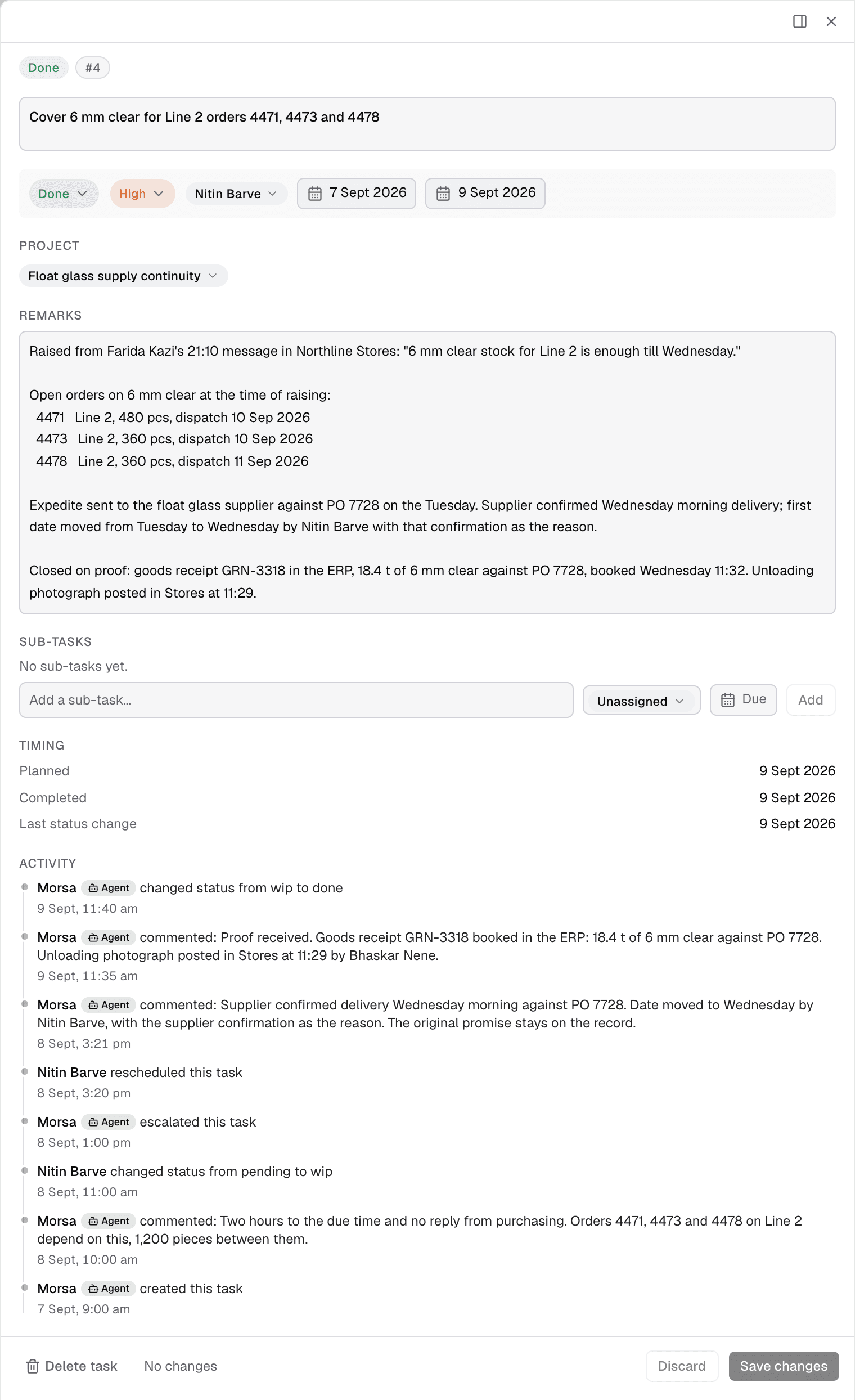
A commitment opened to its record in Morsa, shown here for a demo plant.
What changes. Morsa’s own measurements at two plants: at a 120-person glass plant, onboarded in two days, on-time completion of operational commitments rose from about 30% to about 75% in the first four weeks, across about 900 commitments in the first month. Plant Head Sunil K Verma: “I used to spend the first hour of every morning reconstructing yesterday. Now the chasing happens in the WhatsApp groups my supervisors already use, whether or not I remember.” The full account is in how a glass plant took on-time completion from 30% to 75% in four weeks. At JRG Automotive, running live, Morsa identified 5 of 8 production-stopping material shortages early enough to act, saving the plant $2 million.
Deployment is cloud, private cloud, or fully on-premise including the AI models and databases, in four steps: Connect, Configure, Shadow, Live. Pilots start on one line or one workflow, which is also where step 6 of the roadmap above starts. Read what an AI copilot for manufacturing does, or book a demo.
Sources
NIST, Lu, Morris, and Frechette, Current Standards Landscape for Smart Manufacturing Systems, NISTIR 8107, February 2016.
CESMII, What Is Smart Manufacturing? (the definition the page now labels its original one; Jim Davis quote; Conrad Leiva, author of the first principles).
CESMII, Conrad Leiva, A Brief History of Smart Manufacturing, June 6, 2021.
SME.org, sponsored by the MEP National Network, Shekhar Chandrashekhar (CMTC), Smart Manufacturing Is About More Than Just Technology, September 5, 2018.
SME, Smart Manufacturing: 7 Essential Building Blocks, Smart Manufacturing Industry Report Vol. 1 No. 2, 2018, citing the “Manufacturing in the New Industry 4.0 Era Survey,” SME, March 2018 (no sample size published).
Deloitte Insights, Sniderman, Hartigan, Burke, and Laaper, The smart factory: Responsive, adaptive, connected manufacturing, August 31, 2017.
Deloitte, Gaus and Schlotterbeck, 2025 Smart Manufacturing and Operations Survey, May 1, 2025, 600 executives, fielded August to September 2024.
Deloitte, 2026 Manufacturing Industry Outlook, November 13, 2025.
acatech and Forschungsunion, Recommendations for implementing the strategic initiative INDUSTRIE 4.0, final report of the Industrie 4.0 Working Group, April 2013 (DIN-hosted copy).
acatech, Industrie 4.0 Maturity Index. Managing the Digital Transformation of Companies, UPDATE 2020..
World Economic Forum with McKinsey & Company, Fourth Industrial Revolution: Beacons of Technology and Innovation in Manufacturing, January 2019 (Laura Rocchitelli quote).
World Economic Forum with McKinsey & Company, Global Lighthouse Network: Shaping the Next Chapter of the Fourth Industrial Revolution, January 2023.
World Economic Forum with McKinsey & Company, Global Lighthouse Network: Rewiring Operations for Resilience and Impact at Scale, January 2026.
Hitachi, A Hitachi Group site selected as Global Lighthouse Factory by the World Economic Forum, July 15, 2026 (company-reported figures; Kiva Allgood comment).
Rockwell Automation, 90% of Manufacturers Say Digital Transformation Is Now Essential, 2026 State of Smart Manufacturing Report, May 19, 2026, 1,560 respondents, 17 countries, Sapio Research (vendor research).
Rockwell Automation, 93% of Manufacturers Have MES, But Only 23% Have Fully Integrated It, July 14, 2026 (vendor research).
National Association of Manufacturers, Facts About Manufacturing, citing US Census Bureau Statistics of U.S. Businesses (2022 data, updated May 6, 2025).
NIST, About NIST MEP..
NCMEP, What is SMART Manufacturing? November 21, 2024.
Wikipedia, Fourth Industrial Revolution, for the 2011 Hannover Messe origin of the term Industrie 4.0 (secondary source).
Modern Machine Shop, Julia Hider, Multitasking Machines Scale Up Setup, February 16, 2026 (Dustin Sanks).
Texas A&M College of Engineering, Lauren Thompson, What is smart manufacturing, and how is it changing the industry?, March 14, 2022 (Satish Bukkapatnam).
Manufacturing Dive, 5 manufacturing professionals talk AI, technology, September 9, 2026 (Kathie Mahoney, MassMEP).
Manufacturing Dive, Cole Rosengren, MIT manufacturing event: Ford, Amgen, GE, ArcelorMittal on data and automation, May 22, 2026 (Yung Fung).
Changelog
20 September 2026: replaced the January 2023 Lighthouse count (132 sites) with the January 2026 figure (223 sites) and added the 2026 report’s AI figures (62% of top-five use cases on analytical AI, 23% on generative AI); added Hitachi’s Norman, Oklahoma plant, named a Lighthouse in July 2026, to the examples table.
20 September 2026: labeled the CESMII definition as the one CESMII now calls its original definition; quoted the acatech 2013 sentence whole; removed the unsupported “NIST’s 2014 program” claim; quoted the SME leadership barrier verbatim; noted that SME publishes no sample size; removed the unverified “January 2018 survey” date.
20 September 2026: corrected the SIRI description (16 dimensions under three building blocks, a six-band scale from 0 to 5) and removed the unverified claim that the WEF uses it; removed the page’s own parenthetical from the NAM sentence.
20 September 2026: added Rockwell’s 34% AI-augmented and 46% cyber-incident figures, Rockwell’s July 2026 integration figures (93% have MES, 23% fully integrated), and dated Deloitte’s 2025 survey fieldwork.
20 September 2026: added named quotations from Jim Davis (CESMII), Laura Rocchitelli (Rold), Kiva Allgood (WEF), Dustin Sanks (Sanks Machining), Satish Bukkapatnam (Texas A&M), Kathie Mahoney (MassMEP), Yung Fung (Ford), Anil Kohli and Sunil K Verma (J4S).
20 September 2026: rephrased every section heading as a buyer’s question, gave every section an answer-first opening, added anchors to the table of contents, added the changelog and dateModified.

