An ERP (enterprise resource planning) system runs the business side of a manufacturer: orders, purchasing, inventory, costing and the production plan. An MES (manufacturing execution system) runs the plant floor: it dispatches work, records what was made, and tracks material, labor, quality and downtime as they happen. In ISA-95 terms, ERP is Level 4 and MES is Level 3. Most plants with more than a line or two need both, connected. As of July 2026, 93% of manufacturers surveyed by Rockwell Automation have an MES, but only 23% have it fully integrated with their ERP. Neither system notices when reality moves off the plan. If you are choosing a vendor, see the best MES software for 2026.
In this guide
What is the difference between MES and ERP at a glance?
What is an ERP system?
What is a manufacturing execution system?
Are MES and ERP the same?
Where do MES and ERP sit in the ISA-95 levels?
What data flows between MES and ERP?
Which MES and ERP integration pattern should a plant use?
How many plants actually have MES and ERP integrated?
Do you need both MES and ERP?
Which should you implement first, MES or ERP?
What do MES and ERP projects cost, and what goes wrong?
What are the common mistakes when choosing between MES and ERP?
What happens when the plan changes?
How much does the gap between plan and floor cost?
Where does Morsa fit between the ERP and the MES?
What changed at plants running Morsa above their ERP and MES?
FAQ
Sources, Changelog, Related pages
What is the difference between MES and ERP at a glance?
The difference is scope and clock speed: an ERP holds the plan and the money for the whole company and works in days and weeks, while an MES holds the record of one plant floor and works in minutes. The table below puts thirteen dimensions side by side, from ISA-95 level to what breaks without each system.
Dimension | MES (manufacturing execution system) | ERP (enterprise resource planning) |
|---|---|---|
What it is for | Run the plant floor: dispatch work to lines, record what was actually made, track material, labor, quality and downtime as they happen | Run the business: sales orders, purchasing, inventory, costing, finance, and the master production plan |
ISA-95 level | Level 3, manufacturing operations management | Level 4, business planning and logistics |
Time horizon | Shifts, hours, minutes, seconds | Months, weeks, days, shifts |
Core record | Work orders in progress, operations and steps, machine and operator events, material lots, quality results, downtime reasons | Sales orders, purchase orders, bills of materials, routings, inventory balances, standard and actual cost, the general ledger |
Data latency | Seconds to minutes, straight from machines and operators | Posted transactions; MRP (material requirements planning) typically runs nightly or weekly |
Typical users | Operators, supervisors, quality, maintenance, production engineers | Planners, purchasing, finance, sales, materials, management |
What triggers action | A machine event, a completed operation, a failed inspection, a stopped line | A customer order, a demand forecast, an MRP run, a period close |
Scope of the record | One plant, one line, one work order, one lot | The whole company: every site, every order, every account |
Typical vendors | Siemens Opcenter Execution, AVEVA MES, Parsec TrakSYS, Tulip (composable MES), Critical Manufacturing, iBase-t Solumina, Aegis FactoryLogix, 42Q, MasterControl for regulated industries | SAP Business One and S/4HANA, Microsoft Dynamics 365 Business Central, Oracle NetSuite, Epicor Kinetic, Infor CloudSuite Industrial, Acumatica, Odoo, IFS Cloud, QAD, DELMIAWorks, Global Shop Solutions, JobBOSS2, MRPeasy |
Cost drivers | Priced per site, per line or per connected machine; the big line items are machine connectivity and the integration back to the ERP | Priced per user plus modules; implementation, data migration and process redesign usually cost more than the licenses |
Time to value | Weeks to months per line, and it can go live one line at a time | Quarters; a full-plant program that touches every department at once |
Who owns it | Operations, plant engineering, production IT | Finance and IT, with operations as a stakeholder |
What breaks without it | You learn what the floor did from paper travelers, spreadsheets and end-of-shift counts | There is no single record of orders, stock and cost, so planning lives in spreadsheets |
Vendor placements come from each vendor’s own product page, checked 12 September 2026 and re-checked 19 September 2026 where the vendor’s site allowed it (see Sources). The line is not always clean: Odoo sells MRP, MES, quality and maintenance on one platform, and SAP sells ERP and a separate manufacturing operations product, SAP Digital Manufacturing. The market itself is fragmented: IoT Analytics counted more than 300 MES vendors in December 2025, with the global leader holding under 10% share.
What is an ERP system?
An ERP system is the business record of the company: one database for customers, orders, suppliers, purchase orders, inventory, bills of materials (BOMs), routings, costs and the ledger. IBM defines it as “a business management software system that is designed to manage and streamline an organization’s functions, processes and workflows with automation and integration.” For a manufacturer the ERP also carries the planning engine, MRP, which turns demand into what to make and what to buy.
The ERP decides what should happen and when: which orders ship this month, which work orders are released this week, which purchase orders go out today. It works in business time. When the MRP run finishes overnight, the plan is a day old by first shift.
Two numbers describe the ERP market a plant is buying into. In Panorama Consulting’s 2026 ERP Report, based on 170 organizations with a median revenue of $200.5 million, the median project ran nine months, and more than a quarter of projects went over budget. The ERPs built for manufacturers, with honest pros and cons, are compared in manufacturing ERP software.
What is a manufacturing execution system (MES)?
An MES is the operating record of the plant floor: the system that tracks and documents the transformation of raw materials into finished goods, operation by operation. It tells an operator what to run next, records each operation as it completes, counts good and scrap, logs why the line stopped, and holds a lot when an inspection fails. MESA International, the trade body that gave the category its shape, defined eleven functions that set its scope, covering resource management, scheduling, dispatching, execution, data collection, performance analysis and lot tracking.
MESA itself no longer exists. It voted to cease operations on 30 June 2026 and its content moved to ISA. Its chairman, Khris Kammer, explained the choice in ISA’s announcement: “ISA is a global tax-exempt organization whose standards, including ISA-95 and ISA-88, form the technical foundation of much of MESA’s educational work.”
Most plants still run without one. IoT Analytics estimates that 54% of plants globally used pen, paper or spreadsheets to manage manufacturing operations in 2024, and that just 8% run a commercial MES. The plain-English explainer is what is an MES system; the vendors are compared in manufacturing execution system software.
Are MES and ERP the same?
No. They overlap on the words (both have “production orders” and “inventory”), not on the job. The ERP holds the order with its planned quantity, due date and cost. The MES holds what happened to that order on the floor, operation by operation. The ERP’s inventory is a balance in a bin; the MES’s inventory is a lot on a pallet at a work center, consumed against a specific run.
The confusion comes from two directions. ERP vendors add shop-floor modules (Business Central, Acumatica, Epicor and Odoo all have one) that cover dispatch and labor reporting for a plant with simple flows. MES vendors add scheduling and inventory features that reach up into ERP territory. The test is not the module name. It is whether the system connects to machines and records events in seconds (MES), or posts transactions against a plan (ERP).
Patrick Austin, President of Midwest Precision Molding, put the boundary plainly after his plant moved floor tracking out of its ERP, as reported by IndustryWeek: “[The ERP system] didn’t have the capabilities to hook up to real-time [data capture], like the current MES system does.”
Where do MES and ERP sit in the ISA-95 levels?
ERP sits at Level 4 and MES at Level 3 of ISA-95, the standard for integrating enterprise and control systems, published internationally as IEC 62264. IEC’s summary of Part 1 says it “describes the manufacturing operations management domain (Level 3) and its activities, and the interface content and associated transactions within Level 3 and between Level 3 and Level 4.” That interface is the MES-to-ERP boundary. ISA published a 2025 edition of Part 1, ANSI/ISA-95.00.01-2025.
WHERE MES AND ERP SIT
ISA-95 levels 0 to 4, with ERP at Level 4 and MES at Level 3
LEVEL 4
ERP
Business planning and logistics
ERP, plus supply chain, finance and often APS
MONTHS, WEEKS, DAYS, SHIFTS
THE MES TO ERP INTERFACE
PLAN DOWN. ACTUALS UP.
LEVEL 3
MES
Manufacturing operations management
MES / MOM, detailed scheduling, plant-level QMS, CMMS, WMS
SHIFTS, HOURS, MINUTES, SECONDS
LEVEL 2
SCADA
Monitoring and supervisory control
SCADA, HMI, DCS
REAL TIME
LEVEL 1
PLC
Sensing and manipulating
PLCs, sensors, actuators, instruments
REAL TIME
LEVEL 0
PLANT
The physical process
Machines, presses, cells, the material itself
Level names follow ISA-95 Part 1. Level 3 and Level 4 time frames follow the Purdue reference model that ISA-95 adopted. The standard defines what crosses the interface, not who acts when the two levels disagree.
4
ISA-95 name: Business planning and logistics
What runs there: ERP, plus supply chain, finance and often APS (advanced planning and scheduling)
Time frame: Months, weeks, days, shifts
3
ISA-95 name: Manufacturing operations management
What runs there: MES / MOM (manufacturing operations management), detailed scheduling, and often plant-level QMS (quality management), CMMS (maintenance management) and WMS (warehouse management)
Time frame: Shifts, hours, minutes, seconds
2
ISA-95 name: Monitoring and supervisory control
What runs there: SCADA (supervisory control and data acquisition), HMI (human-machine interface), DCS (distributed control system)
Time frame: Real time
1
ISA-95 name: Sensing and manipulating
What runs there: PLCs (programmable logic controllers), sensors, actuators, instruments
Time frame: Real time
0
ISA-95 name: The physical process
What runs there: Machines, presses, cells, the material itself
Time frame: n/a
Level names are ISA-95’s. The Level 3 and Level 4 time frames follow the Purdue reference model that ISA-95 adopted; Levels 1 and 2 are real-time control by definition. NIST’s standards review describes ISA-95 as “a commonly used reference model for developing automated interfaces between enterprise and control systems,” designed for batch, discrete and continuous processes alike. The level model makes two things obvious: MES and ERP are neighbors with a defined interface, not competitors, and their time frames never meet. The standard describes the data that crosses between them, not who acts when the two disagree. Where APS, QMS, CMMS and WMS sit relative to these two is mapped in the twelve types of manufacturing software.
What data flows between MES and ERP?
Integration is two flows across the Level 3 / Level 4 boundary: the ERP sends the plan down, and the MES sends the actuals up. What flows back up matters more than the transport. Orders down and nothing back leaves the ERP’s inventory, costs and order status drifting further from the floor every shift.
ERP sends down to MES | MES sends up to ERP |
|---|---|
Production orders: part, quantity, due date, priority | Completed quantities and scrap, by operation |
Bills of materials and the material master | Actual material consumption, by lot where traced |
Routings, operations, work centers | Labor and machine hours against each order |
Planned start and finish dates | Quality results, holds and dispositions |
Inventory available to issue | Downtime events and reason codes |
Engineering changes and revisions | Work-in-process status and order close |
THE GAP NEITHER SYSTEM OWNS
ERP released 500. MES recorded 462 good, 38 scrap. Both systems agree. Purchasing finds out at tomorrow's MRP run.
Plan down: Production orders. BOMs and the material master. Routings and work centers. Planned start and finish dates. Inventory to issue. Engineering changes. Actuals up: Completions and scrap by operation. Material consumed by lot. Labor and machine hours. Quality results and holds. Downtime reasons. Order close.
LEVEL 4
ERP
The business record. Sales orders, purchase orders, BOMs, routings, inventory balances, cost, the ledger. Plans in days and weeks; the MRP run is nightly or weekly.
PLAN DOWN
LEVEL 3
MES
The floor record. Work orders in progress, machine and operator events, material lots, quality results, downtime reasons. Executes in minutes and seconds.
ACTUALS UP
Transport: ISA-95 Part 2 object models, B2MML messages between ERP and MES, OPC UA from machines into the MES. The standard names the payload. It does not name who acts on the 38 scrap.
Three standards carry those payloads. ISA-95 Part 2 defines the object models (personnel, equipment, material, process segments, production schedule, production performance) so both systems name the same things the same way. B2MML, published by MESA, is “an XML implementation of the ANSI/ISA-95, Enterprise-Control System Integration, family of standards”; NIST calls it “a well-adopted implementation of the ISA 95 data models” that “facilitates the integration of ERP and supply chain management systems with manufacturing systems such as control systems and MES.” OPC UA, from the OPC Foundation, moves machine data from Levels 1 and 2 up into the MES, “from machine-to-machine, machine-to-enterprise and everything in-between,” with more than 150 industry companion specifications.
Which MES and ERP integration pattern should a plant use?
Plants of 50 to 1,000 people integrate in one of four ways, and the right one depends on how much the floor record has to carry. Each has a known failure.
The ERP’s own shop-floor module. One vendor, one database, nothing to build. Fails when the plant needs machine data, lot traceability or scheduling the module does not do.
Point-to-point APIs. The MES vendor’s connector to the ERP’s API. Fast to start. Fails when either side upgrades, or when QMS, CMMS and WMS each need their own connector.
Middleware or an integration platform. One hub, every system connects once. Fails when nobody owns the mappings and they drift from the process.
ISA-95 / B2MML message exchange. The most durable, and the one large plants and regulated industries use. Fails when the standard becomes the project and the payload list never gets agreed.
Check what the MES vendor names in public. Of eleven MES vendors whose integration pages we read on 19 September 2026, only four name a specific ERP: iBase-t (SAP, Deltek, IFS, Oracle), 42Q (SAP, Oracle, NetSuite), Tulip (Oracle NetSuite) and Critical Manufacturing (SAP). Plex, AVEVA, Aegis, MasterControl and Siemens Opcenter describe ERP connectivity generically. A vendor that will not name one is asking you to build pattern 2 yourself.
How many plants actually have MES and ERP integrated?
Fewer than a quarter. Rockwell Automation’s July 2026 report Scaling MES Across the Enterprise, based on 1,560 decision makers in 17 countries, found that “93% of manufacturers have MES in place, yet only 28% have deployed it enterprise-wide and just 23% report full integration across Enterprise Resource Planning (ERP), Product Lifecycle Management (PLM), quality and operational technology (OT) systems.”
The market already knows this is the problem. In the same survey, 44% of manufacturers ranked integration as their top MES buying requirement, 33% named MES as their biggest data integration problem, and 43% admitted they are not effectively using the data they collect. Lorenzo Veronesi, Associate Research Director at IDC, said in the release: “With integration ranking as both the top buying requirement and the leading modernization challenge, organizations risk leaving significant value on the table if disconnected systems and underutilized data go unaddressed.”
Anthony Murphy, Vice President of Product Management at Rockwell Automation, framed the gap the same way: “MES adoption is no longer the hurdle, but enterprise scale is.” Note the source: Rockwell sells an MES, so treat the survey as vendor research with a stated sample. The direction matches the independent evidence above that most plants still run the floor on paper.
Do you need both MES and ERP?
Most discrete manufacturers above a line or two end up with both, and the honest answer depends on what breaks today. Use the three lists below as the test.
ERP only is usually enough when
One or two lines, low product mix, few changeovers
End-of-shift counts are good enough; nobody needs to know at 10:40 what happened at 10:20
No customer, regulator or recall scenario requires lot-level traceability
Machine data is not part of any decision anyone makes
Add an MES (or a real shop-floor module) when
Multiple lines or shifts, and the schedule changes inside a shift
Traceability is a requirement: automotive, aerospace, medical, food, defense
Paper travelers or spreadsheets are the real record of what was made
Downtime, scrap and OEE (overall equipment effectiveness) have to be measured from the machine, not estimated
Quality holds have to stop material moving, not just record that it should have stopped
Neither one is the answer when
Both are in place and the pain is in the gap: the ERP says 500, the floor made 462, and the person who should do something about it finds out tomorrow
Size matters less than mix and traceability. NAM’s Facts About Manufacturing counts 239,265 US manufacturing firms, all but 4,177 of them under 500 employees, and most of those small firms run on an ERP or MRP alone.
If you already know you need both, the pairings that fit each kind of plant are set out in the best MES and ERP setups by plant type. The full enterprise stack, ERP to MES to planning, is compared in enterprise manufacturing software.
Which should you implement first, MES or ERP?
ERP first if you have neither, MES next if you have an ERP and the floor is the pain, and coordination rather than a third system if you have both and the plan still slips. If you are choosing the ERP side, start with the best ERP for manufacturing by plant type.
An MES executes orders, BOMs and routings that have to live somewhere, and the ERP is where they live. Running an MES against spreadsheets rebuilds the ERP badly. If the ERP is in place and the floor is the problem, add the MES one line at a time, starting with the line where a missed count or an untraced lot costs the most. Do not replace the ERP at the same time; the two projects compete for the same people.
Budget for the organization, not only the software. In Panorama’s 2026 ERP Report, the most common reason for a schedule overrun was “organizational issues,” and fewer than a quarter of organizations reported an intense focus on change management. If you have both systems and the plan still slips, the third thing is not another system of record. See what happens when the plan changes.
What do MES and ERP projects cost, and what goes wrong?
No vendor on either list publishes a full price, so the defensible numbers are about outcomes, not licenses. Panorama’s 2026 ERP Report (170 organizations, January 2025 to January 2026) found that “more than a quarter of organizations reported that their project was over budget” and “almost a quarter of organizations reported that their project was over schedule,” with the median project running nine months. The top cause of overspend was “the unexpected need for additional technology,” which is what a shop-floor gap discovered mid-project looks like on an invoice.
Gartner has predicted that by 2027 more than 70% of recently implemented ERP initiatives will fail to fully meet their original business case goals (Gartner’s ERP topic page; the host blocks automated re-checks, and the figure is corroborated by ERP Today). On the MES side, IoT Analytics sizes the global market at $5.5 billion in 2024, growing to $8.7 billion by 2031, about 6.5% of an $85 billion industrial software market.
The cost that surprises plants is customization. Patrick Austin of Midwest Precision Molding told IndustryWeek: “I’ve never heard anybody in any ERP system that says, ‘Yeah, customizations are great!‘”
What are the common mistakes when choosing between MES and ERP?
The most common mistake is buying a system of record to fix a coordination problem. The seven below account for most failed selections we see.
Buying an MES to fix a planning problem. If the schedule is wrong when it reaches the floor, executing it faster does not help. That is an ERP, APS or production planning software problem.
Expecting the ERP’s shop-floor module to be an MES. It records labor and completions. It rarely connects to machines, traces lots or reschedules inside a shift. Check those three before you decide the module is enough.
Buying a full MES for a plant that will not use it. A 60-person shop with two lines and no traceability requirement pays for machine connectivity it never wires up.
Replacing both at once. A rip-and-replace of ERP and MES together puts the business record and the floor record in flux in the same quarter.
Integrating one way. Orders go down, nothing comes back. ERP inventory and costs are wrong within a week, and planning quietly returns to spreadsheets.
Letting the standard become the project. ISA-95 and B2MML are the vocabulary. The deliverable is the agreed list of what crosses the boundary, which way, how often, and who fixes it when it fails.
Assuming “integrated” means “coordinated”. Two systems exchanging records is not a plant reacting to change. The systems now agree that 96 parts are missing. Someone still has to notice, decide, act and confirm.
What happens when the plan changes?
When the plan changes, both systems record the change correctly and nobody acts on it, because no system owns the consequence. The ERP released a work order for 500. The MES recorded 462 good and 38 scrap. The integration works: the ERP now shows 462 complete. But the customer order behind that work order needed 500 by Thursday. Purchasing does not know. Planning finds out at tomorrow’s MRP run. The supervisor mentions it in the shift-change group chat at 11pm.
That is the gap between Level 4 and Level 3, and it is not a data gap. It is a coordination gap: no system connects a floor event to a business consequence and gets a person to act before the date. It lives in group chats, phone calls and the first hour of every morning. Patrick Austin described the pre-MES version of that hour to IndustryWeek: “We’d have had to guess or go out [on the floor], count parts, figure out how many parts we have, how many do we have to make.”
How much does the gap between plan and floor cost?
The cost lands downstream, in lost sales rather than repair time. NIST’s survey of US discrete manufacturers found $119.1 billion a year in preventable maintenance losses, of which $100.2 billion was “lost sales from delays and defects” and only $18.1 billion was downtime itself (NIST AMS 100-34, 2016 data). Siemens’ 2024 downtime study of 181 large industrial firms found incidents fell from 42 to 25 a month per plant since 2019, but recovery per incident rose from 49 to 81 minutes: the fixing got faster, the reacting got slower.
The pressure on plans is not easing. In NAM’s Q3 2026 Outlook Survey (220 respondents, fielded 11 to 27 August 2026), 80.8% of manufacturers named rising raw material costs their top challenge, the second quarter running above 80%, and 54.9% named attracting and retaining a workforce. Yet optimism rose to 78.9%, its highest since 2022, and the ISM Manufacturing PMI registered 54.6% in August, an eighth month of expansion. More orders, higher input costs, fewer people: every one of those reaches the floor as a substitution, a resequence or an expedite that the ERP plans in days and the MES executes in minutes, with a person chasing in between.
A manager set an 8,000-part night-shift target. Seven hours later, dispatch posted photos in the group showing parts unavailable. Nobody connected the two. Morsa compared the schedule (4,131 units) with dispatch (4,035), found the 96-piece shortage, linked it to the target, told dispatch to arrange the parts, told production the target was blocked by supply, and opened a high-priority dependency. Under a minute.
Where does Morsa fit between the ERP and the MES?
Morsa, the AI that operates the factory for you, sits above the ERP and the MES, not between them and not instead of them. The ERP stays the business record. The MES stays the floor record. Morsa handles the gap when reality moves off the plan.
What it reads. The ERP, the MES, and the CMMS, QMS and WMS where they exist, plus the places people actually talk, whatever they are: WhatsApp, Microsoft Teams, email and SMS are examples, not the list. A shortage raised in a group chat is a signal the same way a scrap entry in the MES is. Machines, PLCs, SCADA systems and sensors can be read directly too.
What it decides. For each change, which part, work order, machine, customer order and owner it touches; what it affects downstream (this 96-piece shortage blocks tonight’s target); and, within the plant’s approved rules, what happens next: expedite, resequence, substitute, escalate, or ask for approval.
What it does. Acts across systems and people. Routes the job to purchasing, planning, tooling, maintenance or quality, in the channel that person already uses. Chases before the due date. Escalates when a job goes quiet.
What the user sees. A supervisor sees the ask and the deadline in the group they already read. A plant manager sees which jobs and customer orders are at risk, by when, and who owns the fix. Shift handovers start with the carry-overs already listed. Sunil K Verma, Plant Head at J4S: “I used to spend the first hour of every morning reconstructing yesterday. Now the chasing happens in the WhatsApp groups my supervisors already use, whether or not I remember.”
What changed at plants running Morsa above their ERP and MES?
J4S, a 120-person glass plant onboarded in two days, took on-time completion of operational commitments from about 30% to about 75% in the first four weeks, across about 900 commitments (how the glass plant did it with no new software). Work closes on proof, not on a “done” message: a photo, a document, a system entry, a confirmed receipt. Production Head Anil Kohli: “Our people don’t have to learn any new software. People just message the way they always have. Morsa coordinates all the messages in the background.” At JRG Automotive, Morsa identified 5 of 8 production-stopping material shortages early enough to act, and saved the plant $2 million.
PROOF FROM TWO PLANTS
Running Morsa above the ERP and the floor systems
~75%
on-time completion of operational commitments at J4S after four weeks, up from about 30%
J4S, glass manufacturing
~900
operational commitments captured and closed at J4S in the first month
J4S, glass manufacturing
5/8
production-stopping material shortages at JRG Automotive caught early enough to act
JRG Automotive, a live deployment
$2M
saved at JRG Automotive from the shortages caught in time
JRG Automotive, a live deployment
J4S is a glass manufacturing plant; JRG Automotive is a live deployment. Figures as reported by the plants; the ~ marks an approximate value. The ERP and MES stayed in place at both.
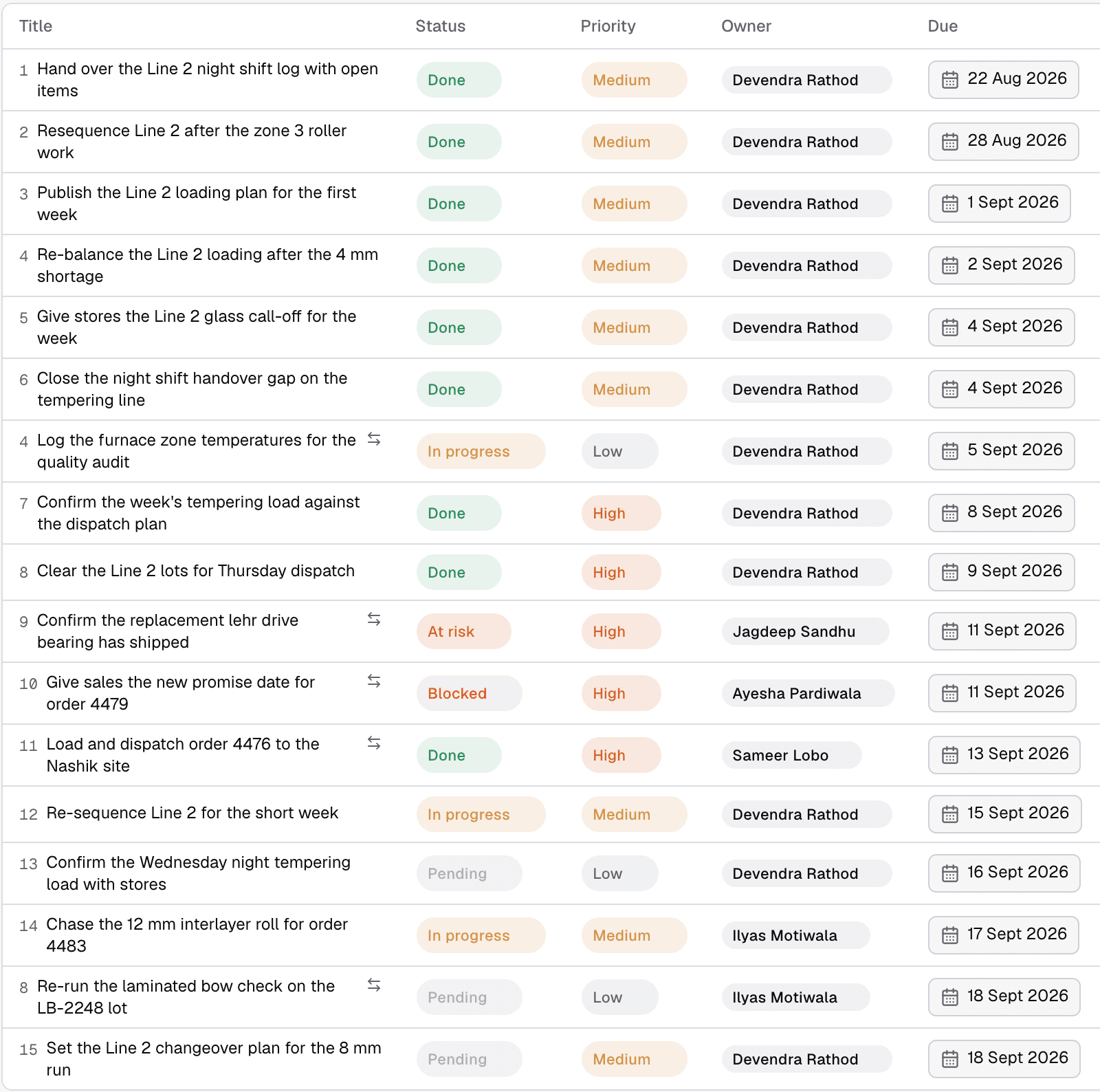
The tasks board in Morsa. Northline Glass, a demo plant.
Morsa connects to SAP Business One, Microsoft Dynamics 365 Business Central, Odoo, Zoho, QuickBooks, Excel and Google Sheets today, and to any MES or plant system with an API, a database, a file export, a message stream or an email trail. It runs in the cloud, a private cloud, or fully on-premise including the AI models. How the loop works, step by step: AI copilot for manufacturing. The wider map of the systems it reads is in manufacturing management software.
Sources
IEC, IEC 62264-1:2013 Enterprise-control system integration, Part 1: Models and terminology
ISA, ANSI/ISA-95.00.01-2025 (IEC 62264-1 Mod), product page
ISA, ISA95, Enterprise-Control System Integration (committee page)
NIST, Lu, Morris and Frechette, Current Standards Landscape for Smart Manufacturing Systems, NISTIR 8107, February 2016
Wikipedia, Purdue Enterprise Reference Architecture (Level 3 and Level 4 time frames; secondary source for the paid ANSI/ISA-95.00.01 text)
Wikipedia, Manufacturing execution system (MESA defined eleven functions)
ISA, ISA Announces Assumption of MESA Content, 30 June 2026 (Khris Kammer quote)
MESA International, B2MML-BatchML (GitHub)
OPC Foundation, Unified Architecture
IoT Analytics, MES vendors replace pen, paper, and spreadsheets, 15 December 2025 and the MES Market Report 2025-2031 product page, https://iot-analytics.com/product/mes-market-report-2025-2031/
Rockwell Automation, 93% of Manufacturers Have MES, But Only 23% Have Fully Integrated It, press release for Scaling MES Across the Enterprise, 14 July 2026, 1,560 respondents in 17 countries
Panorama Consulting Group, The 2026 ERP Report, 170 respondents, January 2025 to January 2026
Gartner, Enterprise Resource Planning (ERP) insights (70% by 2027 prediction; host blocks automated fetches, corroborated by ERP Today) and https://erp.today/closing-the-erp-intelligence-to-action-gap/
IndustryWeek, Dennis Scimeca, Switching from ERP to MES Drives Improvement for Plastics Manufacturer, 15 December 2023 (Patrick Austin quotes)
NIST, Thomas and Weiss, Economics of Manufacturing Machinery Maintenance, AMS 100-34, June 2020
Siemens, The True Cost of Downtime 2024, 181 interviews, April 2019 to March 2023 (vendor research)
National Association of Manufacturers, 2026 Third Quarter Manufacturers’ Outlook Survey, 14 September 2026, 220 responses
National Association of Manufacturers, Facts About Manufacturing
Institute for Supply Management, Manufacturing PMI at 54.6%, August 2026, via PR Newswire, 1 September 2026
SAP, SAP Digital Manufacturing (product existence; page verified 12 September 2026, host returned 403 to automated re-check on 19 September 2026)
Vendor placements in the comparison table were checked on each vendor’s own product page on 12 September 2026 and re-checked on 19 September 2026: Siemens (siemens.com/en-us/products/opcenter/execution/), AVEVA (aveva.com/en/products/manufacturing-execution-system), Parsec (parsec-corp.com/traksys), Tulip (tulip.co/solutions/composable-mes), Critical Manufacturing (criticalmanufacturing.com), iBase-t (ibaset.com), Aegis (aiscorp.com), 42Q (42-q.com), MasterControl (mastercontrol.com/manufacturing-execution-system), Microsoft (microsoft.com/en-us/dynamics-365/products/business-central), Infor (infor.com/products/cloudsuite-industrial), Acumatica (acumatica.com/cloud-erp-software/manufacturing-management), Odoo (odoo.com/app/manufacturing), IFS (ifs.com/solutions/enterprise-resource-planning), Dassault Systèmes (3ds.com/products/delmia/delmiaworks), Global Shop Solutions (globalshopsolutions.com), ECI JobBOSS2 (ecisolutions.com/products/jobboss2), MRPeasy (mrpeasy.com). Epicor, Oracle NetSuite, SAP Business One and QAD pages blocked automated re-checks on 19 September 2026; their placements stand on the 12 September check. MES integration pages read 19 September 2026: ibaset.com/solutions/integration, 42-q.com/mes-products, library.tulip.co/connectors/netsuite-integration, criticalmanufacturing.com enterprise integration data sheet, parsec-corp.com/integrations, plex.rockwellautomation.com, aveva.com, aiscorp.com/solutions/integration, mastercontrol.com MES integration page, siemens.com Opcenter pages.
Changelog
20 September 2026: added Rockwell Automation’s July 2026 MES integration survey (93% have MES, 23% fully integrated) as a new section, because it measures the gap this page is about.
20 September 2026: replaced the NAM Q2 2026 cost figure with Q3 2026 (published 14 September 2026) and added ISM’s August PMI, so the pressure paragraph reads current.
20 September 2026: added Panorama’s 2026 ERP Report figures on budget, schedule and duration, and IoT Analytics’ MES market and adoption figures, so cost and adoption are sourced rather than described.
20 September 2026: added named quotations from Khris Kammer (MESA), Lorenzo Veronesi (IDC), Anthony Murphy (Rockwell), Patrick Austin (Midwest Precision Molding), Anil Kohli and Sunil K Verma (J4S).
20 September 2026: rephrased every section heading as a buyer’s question and split integration into data flows and patterns, so each section answers one question in its first sentence.
20 September 2026: fixed dead vendor URLs (Siemens Opcenter, Plex), added the 2025 edition of ISA-95 Part 1, and marked the SAP Digital Manufacturing citation as bot-blocked on re-check.

